

























Planets Aligning Tonight March 1, 2026: Six-Planet Parade Peaks Now — How to See It

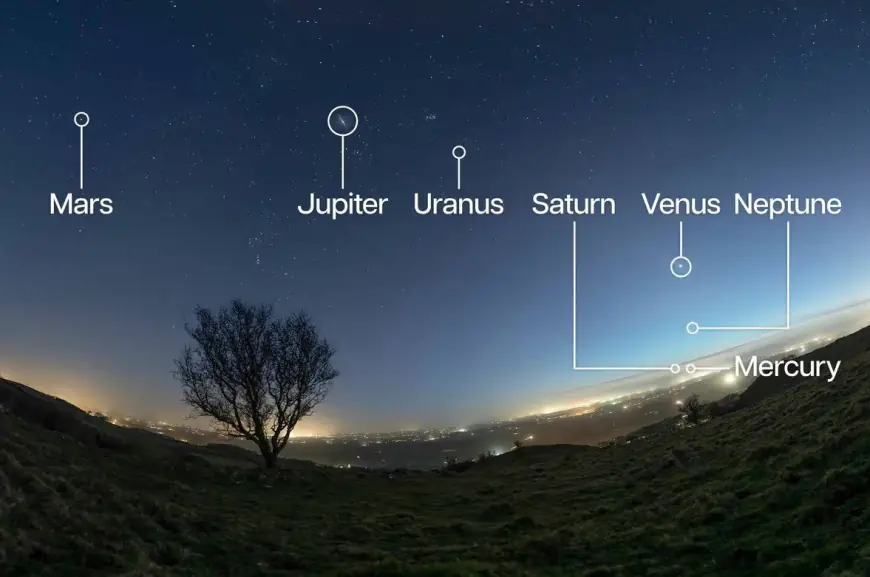
The planetary alignment is not just a February story — it is happening right now. Tonight, March 1, 2026, is confirmed as part of the peak viewing window for the six-planet parade, with Mercury, Venus, Jupiter, Saturn, Uranus, and Neptune appearing in a sweeping arc across the evening sky shortly after sunset. NASA, National Geographic, EarthSky, and Scientific American all confirm this is one of the best nights to look up.
What Is the Planet Parade and Why Are the Planets Aligning in 2026
A planetary parade occurs when multiple planets are visible in the sky at the same time. The reason they appear lined up comes down to geometry — the planets orbit the sun roughly on the same plane, known as the ecliptic. Viewed from Earth, that shared plane compresses into a line across our field of vision.
The phenomenon is not physically rare in the scientific sense, but it offers something genuinely compelling: a chance to see nearly half the solar system at once. What makes the 2026 planet parade especially notable is its evening visibility — far more convenient than the early-morning alignments that defined 2025 events.
What Time Will the Planets Align Tonight and Where to Look
In most locations, the best viewing window begins about 30 minutes after local sunset. The Mercury and Venus part of the lineup is brief, so try to observe within the first hour after sunset. For the US East Coast, that translates to roughly 6:10–7:10 p.m. ET tonight.
Mercury, Venus, Saturn and Jupiter will all be visible to the naked eye for between a half hour and an hour around twilight, appearing in that order and stretching upward from the horizon shortly after sunset. Timing is everything — move fast for the western horizon before Mercury and Venus vanish.
What Planets Are Visible Tonight — Your Full Guide
Here is exactly what to expect tonight for the planetary alignment:
| Planet | Naked Eye? | Where to Look | Color/Clue |
|---|---|---|---|
| Venus | Yes — brightest | Low west horizon | Brilliant steady white glow |
| Jupiter | Yes — easiest | High in the east | Bright, steady, near the Moon |
| Saturn | Yes — briefly | Low west, near Venus | Golden yellow hue |
| Mercury | Very difficult | Far western horizon | Faint, sets fast |
| Uranus | Binoculars needed | Near Aries/Taurus | Faint greenish dot |
| Neptune | Telescope required | Near Saturn in Aquarius | Tiny bluish disk |
Venus will be the first one that pops up — the brightest object in the sky after the sun and moon, with a steady, brilliant white glow on the western horizon after sunset. Saturn appears fainter but naked-eye visible low in the west, near Venus during twilight. Mercury, the most challenging naked-eye planet, hugs the horizon and requires a clear western view and quick timing, as it sets soon after the sun.
How to See the Planetary Alignment Tonight — Step by Step
Astronomers advise going somewhere high-altitude and cloud-free because all the visible planets will be relatively low in the western sky. Bundle up, bring something warm, and step outside promptly after sunset.
Use apps like Stellarium, SkySafari, or Sky Tonight to pinpoint positions based on your exact location and time. Allow your eyes to adjust to darkness and avoid phone screens for at least five minutes before scanning the sky.
Use Venus as your anchor point first — it is unmistakable. Then clench your fist and hold it at arm's length. About that distance above Venus, look for golden Saturn in Pisces. From there, scan upward and eastward toward Jupiter, which will be glowing high near the waxing gibbous Moon.
What Comes Next After the 2026 Planetary Parade
As March unfolds, Venus and Saturn will draw closer for a conjunction on March 7–8, while Jupiter remains prominent in the evening sky well into spring. The planetary parade also immediately precedes a total lunar eclipse on March 3 ET, when Earth's shadow will darken the full Snow Moon into a blood red color — the last total lunar eclipse until New Year's Eve 2028. The next major planetary alignment after this one arrives on August 12, 2026, when Jupiter, Mercury, Mars, Uranus, Saturn, and Neptune line up in the morning sky.