

























Planetary Alignment Feb 28 2026: How to See Tonight's Six-Planet Parade

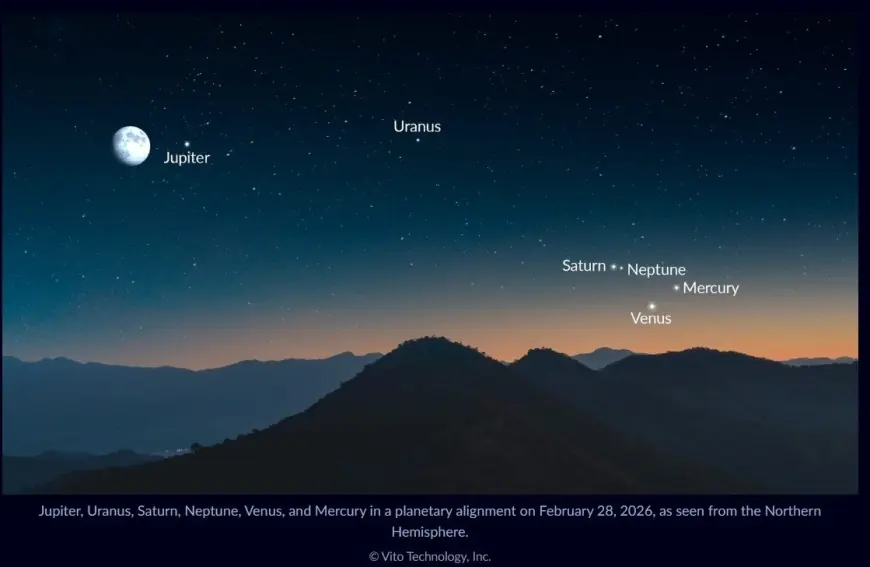
The planetary parade is here. On February 28, 2026 ET, six planets align across the evening sky in one of the most talked-about astronomical events of the year. Mercury, Venus, Saturn, Jupiter, Uranus, and Neptune are all above the horizon after sunset — but knowing exactly what to expect is the key to not missing it.
What Is the Planet Parade and Why Is It Happening Tonight
A planetary alignment, often called a planet parade, is when several planets appear grouped along the ecliptic as seen from Earth. NASA highlights February 28 as a Planetary Parade in its list of notable 2026 sky events.
Because the planets orbit the Sun along the same flat plane, they naturally gather along a single curved path in our sky. Tonight, that alignment becomes unusually clear, with multiple worlds stretched across one broad span above the western horizon.
This is a six-planet alignment, because Mars is not visible this month. Last year's February 2025 event featured seven planets. Tonight's parade is the follow-up act, and it is still a genuinely rare sight.
What Time Will the Planets Align on the 28th
The best window starts about 30 minutes after local sunset. In most locations, the best window begins about 30 minutes after local sunset.
From the United States, the best viewing window will be roughly 30 to 60 minutes after your local sunset on February 28, 2026. That translates to approximately 6:10–6:40 p.m. ET for the East Coast, 5:50–6:20 p.m. CT for the Midwest, and 6:20–6:50 p.m. PT for the West Coast.
Act fast. Mercury and Venus will follow the sun out of sight roughly an hour after sunset, briefly becoming more visible as the sky darkens and they grow closer to the horizon.
Which Planets Are Visible Tonight and Where to Look
Here is your planet-by-planet guide for the planetary alignment tonight:
| Planet | Visibility | Where to Look |
|---|---|---|
| Jupiter | Naked eye — easiest | High in the eastern sky |
| Venus | Naked eye — briefly | Low on the western horizon |
| Saturn | Naked eye — narrow window | Low west, near Venus |
| Uranus | Binoculars recommended | Beneath the Pleiades in Taurus |
| Mercury | Very difficult | Far western horizon in twilight |
| Neptune | Telescope required | Near Saturn, very faint |
Jupiter is past its peak but is still the best planet to see in the night sky at the moment and by far the easiest to see in the planet parade. By sunset on 28 February it's high in the eastern sky, higher than the Moon and close to bright stars Castor and Pollux in Gemini. If you only see one planet during the February 2026 alignment, it's probably going to be Jupiter.
Saturn, Venus, and Mercury will appear low on the western horizon immediately after sunset. In fact, Saturn is only just above Venus and Mercury in the evening twilight, so you'll still need a relatively clear horizon to see it.
What You Realistically Need to See the Planetary Parade
Under good conditions, Mercury, Venus, Saturn, and Jupiter can be seen without optics. Uranus and Neptune are much dimmer and usually require binoculars or a telescope.
Mercury is too dim to be seen, even with an optical assist. Evening light is brighter than the planet. Venus can be found 30 minutes after sunset for about 20 minutes — it sets 62 minutes after sunset.
For Uranus, binoculars make it much easier to identify. When you find it, Uranus looks like a small, steady point of light with a faint bluish tint, noticeably calmer than the twinkling stars around it.
How to See the Planetary Alignment Tonight — Step by Step
Find a location with an unobstructed western and eastern horizon. Head outside 30 minutes after your local sunset. Face west first to catch Venus, Saturn, and Mercury in the fading twilight before they disappear. Then turn east and look high for Jupiter, which will be glowing brightly near the waxing gibbous Moon.
Use the skywatching app Star Walk 2 to get exact guidance in real time. Stellarium is another free option that overlays planet positions on your live sky view using your phone's camera.
As March begins, Mercury and Venus will move closer to the Sun's glare and gradually slip from view, and the tight grouping of planets will begin to loosen. Jupiter and Uranus will remain visible into the spring. Tonight is the peak window — step outside and look up.