

























Witness Six-Planet Alignment: Ultimate Guide to the Celestial Parade

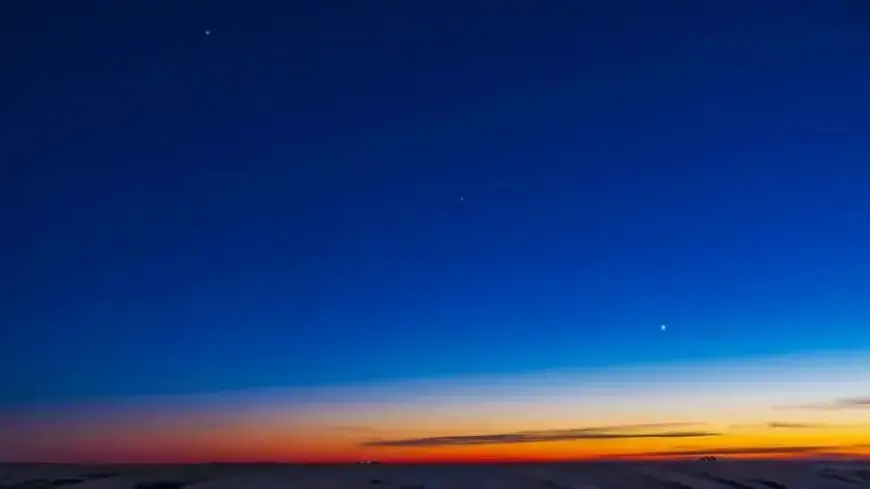
Stargazers have a remarkable opportunity to witness a rare six-planet alignment this Saturday, weather permitting. This celestial event, also known as a planetary parade, showcases the fascinating dance of planets in their orbits around the sun.
Planets Visible During the Alignment
According to NASA, four of the six planets—Mercury, Venus, Saturn, and Jupiter—will be visible to the naked eye. The remaining two, Uranus and Neptune, will require binoculars or a telescope for viewing.
- Mercury: Hard to spot without aids, best seen 30-60 minutes after sunset.
- Venus: The brightest planet, visible after sunset in the western horizon, glowing white.
- Saturn: Displays a yellowish hue in the sky.
- Jupiter: Located high above, easily identifiable.
- Mars: Appears as a red dot.
- Uranus and Neptune: Require binoculars or telescopes.
Optimal Viewing Conditions
The best time to view the planetary parade varies by location. Observers should look for the planets when they are at least 10 degrees above the horizon. Viewing is optimal at twilight, with early risers encouraged to try before sunrise and night owls after sunset.
NASA planetary scientist Heidi Haviland advises that the event does not require protective eyewear, unlike solar eclipses. For ideal visibility, viewers should escape city lights and seek clear skies.
Significance of the Planetary Alignment
This celestial event serves as a reminder of the complex dynamics within our solar system. Haviland highlights the importance of planetary positions when planning space missions, such as the InSight mission to Mars in 2018, which required careful timing for the Earth and Mars to align.
Upcoming Celestial Events
Another significant event is a total lunar eclipse happening Tuesday, visible from regions including Asia and the Americas. This eclipse will transform the moon into a red hue, earning it the nickname “blood moon.” Additionally, this eclipse will be the last of its kind visible from North America until December 2028.
On May 31, viewers can anticipate a blue moon, the second full moon within a single month, occurring approximately every two and a half to three years.
Conclusion
The six-planet alignment offers a unique opportunity for sky-gazers to observe the splendid arrangement of celestial bodies. Mark your calendars and prepare for this astronomical phenomenon, best viewed in clear conditions without the interference of city lights.