

























Samsung S26 Ultra debuts with privacy display and S Pen as Galaxy lineup heads to preorders

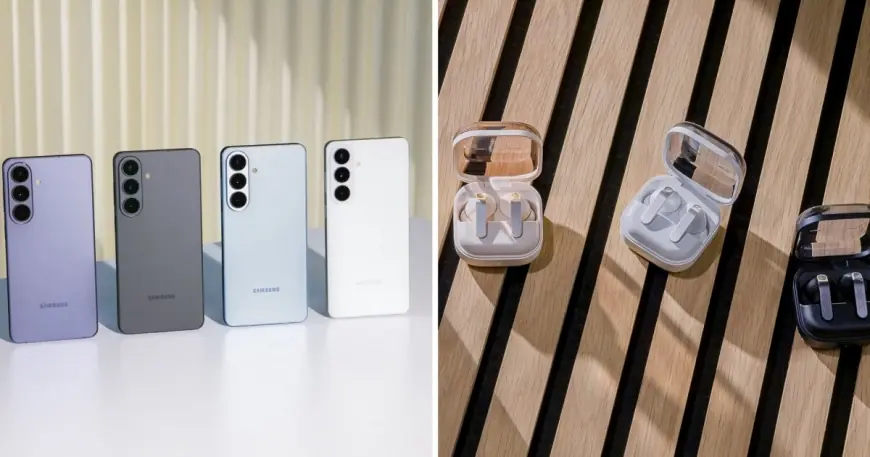
The new Galaxy phones and earbuds are available for preorder now, with preorders having opened Feb. 25 and devices scheduled to ship starting March 11; the centerpiece is the Samsung S26 Ultra, which brings a customizable privacy display and S Pen support. The timing matters because the company has raised base storage and prices across the family amid memory-market pressure and retained a high-end chip to power new AI features.
Samsung S26 Ultra hardware and privacy display
The Samsung S26 Ultra is positioned as the flagship: it keeps S Pen support with a slot in the phone’s base, offers improved cameras and faster wired and wireless charging, and is priced at $1, 299 (sometimes rounded to $1, 300 in coverage). The Ultra’s display runs at 3, 120 x 1, 440 resolution with a stated 500 pixels-per-inch, and it is the only phone in the lineup with a special Privacy Display that blacks out parts of the screen to prevent onlookers from reading texts unless they view the device directly in front.
Galaxy S26, S26 Plus specs, storage and pricing
Samsung launched a three‑model S26 family: the Samsung Galaxy S26, Samsung Galaxy S26 Plus and Samsung Galaxy S26 Ultra. All three now start at 256GB of storage, up from 128GB on last year’s S25 and S25 Plus, and ship with a new internal chip intended to accelerate general performance and new AI software features. The base Galaxy S26 now carries a slightly larger battery at 4, 300 mAh (up from 4, 000 mAh), while the S26 Plus gains slightly faster wireless charging. Retail prices for the non‑Ultra models were listed at $899 and $1, 099 (often rounded to $900 and $1, 100), reflecting a $100 increase over last year’s baseline prices.
Galaxy Buds 4 and Galaxy Buds 4 Pro earbuds
Alongside the phones, Samsung introduced the Galaxy Buds 4 and Galaxy Buds 4 Pro. Both adopt a new design with smoother, rounded eartips, a clear departure from the Buds 3’s sharp, triangular stem shape. The Buds 4 are the more budget‑friendly option, using a semi‑open design without rubber eartips—similar in concept to another maker’s recent earbuds—and deliver up to six hours of playtime plus an additional 30 hours from the charging case. The Galaxy Buds 4 Pro are the premium pair, equipped with rubber eartips and offering up to seven hours of battery life with 30 more hours available the case.
Chip choice, display and physical design decisions
All three Galaxy phones are powered by a Snapdragon 8 Elite Gen 5 for Galaxy chip, a mobile flagship processor chosen instead of an in‑house Exynos variant. The company retained the higher memory spec rather than downgrading RAM; coverage links the decision to an ongoing RAM shortage and the need to preserve AI processing capabilities. Physically, recent Galaxy models have moved to aluminum frames rather than titanium; the change is intended to keep devices lighter and reduce overheating risk but is noted to make them less durable. The regular Galaxy S26 weighs 167 grams compared with 177 grams for the iPhone 17, and display comparisons highlight different resolutions and pixel densities across rival models.
Color options, Apple comparison and market context
The new Galaxy colors include a classic cobalt violet, sky blue, black and white, with silver and pink gold available through online ordering. In direct device comparisons, the non‑Ultra Galaxy S26 has a 2, 340 x 1, 080 display (about 411 PPI) versus the iPhone 17’s 2, 622 x 1, 206 display (about 460 PPI); both support refresh rates up to 120Hz. On pricing, the Galaxy S26 family’s higher base storage contributes to a roughly $100 uplift versus last year, while competing flagship pricing from Apple places certain iPhone 17 models at lower entry points for equivalent storage capacities.
Galaxy Ring litigation, Edge uncertainty and product cadence
Samsung’s product roadmap and accessory lineup show mixed clarity. The Galaxy S25 Edge, introduced last year as a super‑thin, super‑light model, was not mentioned at the event, making the existence of a Galaxy S26 Edge unclear in the provided context. The Galaxy Ring, launched in summer 2024, has become entangled in litigation: Oura filed a patent infringement lawsuit against Samsung, and Samsung has filed a counter suit. Samsung has a history of filing similar patent suits against makers such as Ultrahuman, RingConn and Zepp Health. The fate of the Galaxy Ring—and the timing of any Galaxy Ring 2—remains uncertain. Separately, Samsung typically stages a second Galaxy Unpacked event in the summer for Galaxy Watches, Z‑Flip and Z‑Fold updates, so further product announcements are expected later in the year.
What makes this notable is the combination of upgraded base storage, retained high‑end processing and a privacy display at the top tier, a mix that directly affects pricing, battery and AI performance decisions as Samsung rolls the S26 family into the market.