























Amd Stock: Meta signs multiyear, multigeneration deal for MI450 GPUs

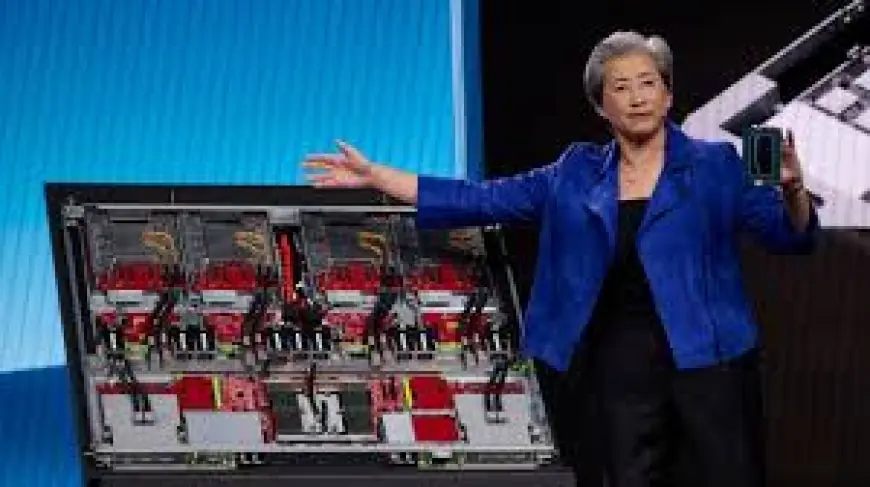
Advanced Micro Devices announced on Tuesday that it landed a multiyear, multigeneration deal with Meta Platforms that could be worth as much as $100 billion, and the structure of that agreement has immediate implications for amd stock and shareholder dilution risk. The pact pairs six gigawatts of custom AMD Instinct MI450 GPUs and Helios rack-scale servers with performance-based warrants for Meta.
Details of the Meta–AMD agreement: six gigawatts, MI450 and Helios
The deal commits Meta Platforms (NASDAQ: META) to deploy six gigawatts of custom AMD Instinct MI450 GPUs as part of a major data center build-out. The arrangement expands on an existing partnership and, in the companies' words, "aligns roadmaps across silicon, systems, and software to deliver AI platforms purpose-built for Meta's workloads. " The MI450 chips and Helios rack-scale servers are scheduled to begin shipping later this year.
Amd Stock dilution mechanics: warrants, 160 million shares and 2031 expiry
As part of the deal, AMD issued Meta a performance-based warrant that would allow Meta to buy up to 160 million shares of AMD common stock; if exercised, Meta could own up to 10% of AMD's outstanding stock. Those warrants are good until 2031, so they will not dilute existing shareholders until exercised. If Meta and OpenAI both exercise their warrants, that combined action would dilute existing shareholders by 20%.
How the Meta pact echoes the OpenAI arrangement and raises investor scrutiny
AMD struck a similar six-gigawatt deal with OpenAI late last year that gave the start-up the option to purchase up to 160 million shares at $0. 01 per share, giving OpenAI a 10% stake in AMD. The two transactions together represent one of the circular deals that has been attracting scrutiny from AI investors, because the chip-for-equity structures concentrate ownership and link sales to share issuance.
Deal sits alongside Meta's Nvidia partnership and hyperscale build-out
The Meta–AMD agreement is not exclusive. It follows an announcement revealed just last week in which Meta detailed a multiyear, multigenerational partnership with Nvidia for a large-scale deployment of Nvidia CPUs and "millions of Nvidia Blackwell and Rubin graphics processing units (GPUs), as well as the integration of Nvidia Spectrum-X Ethernet switches. " That Nvidia arrangement is part of Meta's rapid hyperscale data center build-out, optimized for both AI training and inference, underscoring that Meta's deal with AMD is a vote of confidence but by no means the only supplier commitment.
CEO remarks and strategic trade-offs for AMD shareholders
AMD CEO Lisa Su characterized the deal's structure as a "win-win" for shareholders and cautioned that the company is "early in the cycle of seeing what the ultimate payoff can be... We have to invest ahead of the curve and really point in the direction that is going to have the largest benefit. " The company has taken a novel approach to attracting buyers for its high-end AI chips as the artificial intelligence revolution enters its fourth year and demand for AI-capable chips remains intense. Nvidia continues to control the biggest share of the data center GPU market, and AMD has signaled it has no plans to cede the opportunity.
Investor questions remain: dilution versus market access
The structure raises a basic strategic question for AMD: is the company exchanging equity to secure large-scale deployments now, or handing away too much to win customers? That balance depends on whether AMD is done doing deals for shares, and, as the company itself acknowledged, only time will tell.