


















Exploring American Greatness and Barbarism

Artemis II lifted off Wednesday at 6:35 p.m. Eastern Time. It is humanity’s first crewed trip toward the moon in over fifty years.
Launch and early mission milestones
The Space Launch System super heavy-lift vehicle powered the ascent. The SLS has been in development since 2011.
Two minutes after liftoff, the twin solid rocket boosters separated. Six minutes later the rocket core completed its burn and separated.
The vehicle reached speeds up to 25,000 miles per hour during boost. At about 9 p.m., the crew completed an apogee burn.
Crew and public remarks
Reid Wiseman commanded the mission. He gave the final go-for-launch call from the capsule.
Victor Glover serves as pilot and is from California. Christina Koch is a mission specialist from Michigan.
Jeremy Hansen is the first Canadian astronaut on a lunar mission. All four spoke about family, teammates, and humanity.
Tomahawk strikes and the opening days of war
On Feb. 28, U.S. ships launched Tomahawk cruise missiles at a facility in Minab, southern Iran.
The complex was used by the Islamic Revolutionary Guards Corps’ navy. Not all structures there were in military use.
One building had been converted to a school up to a decade earlier and was walled off. Accounts say the school was struck.
Casualties and evidence
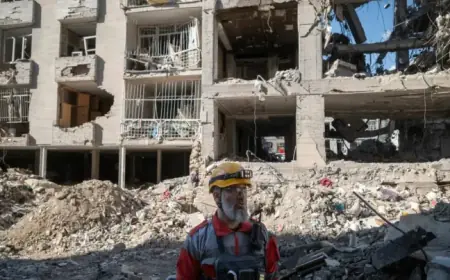
Firsthand accounts and video evidence point to strikes that killed more than 170 people. The majority were schoolgirls.
Video shows at least one strike that appears to have been a Tomahawk. That missile type was used only by U.S. forces in this conflict.
How Tomahawk strikes are planned and executed
Strike lists are assembled by analysts at a Combined Air Operations Center. Those lists become target data packages.
A Cruise Missile Support Activity creates encrypted target files. Ships upload packages after receiving an Indigo message.
Tomahawk flight begins with a solid-fuel booster. At about 1,500 feet it separates and the turbofan engine ignites.
The missile then descends to roughly 500 feet to avoid radar and cruises at up to 570 miles per hour.
Command centers and recent attacks
The CAOC that compiled early strike lists likely operated from Al Udeid Airbase in Qatar. They used imagery and multiagency intelligence.
That base has since been targeted by Iranian long-range drones and ballistic missiles. Personnel there have likely dispersed.
Weapons lineage and historical context
Iran’s ballistic missile program grew during the Iran‑Iraq war in 1984. It relied on reverse-engineered Scud‑B missiles from Libya.
Scud designs came from the Soviet Union and trace back to the Nazi V‑2 rockets. Those early systems also influenced U.S. rocket work.
The technology that built the Saturn rockets and the SLS has roots in Cold War and wartime research.
Politics, budgets, and past conflicts
At roughly the same time as the apogee burn, the U.S. president spoke about the war in Iran. He used combative language.
The administration proposed a $1.5 trillion defense budget for next year. The debate over force and funding continues.
When Apollo 11 landed on July 20, 1969, American forces were heavily engaged in Vietnam. That year saw more than 549,000 U.S. troops deployed.
| Artemis II liftoff | Wednesday, 6:35 p.m. ET |
| Apogee burn completed | About 9 p.m. ET |
| Tomahawk cruise speed | Up to 570 mph |
| Reported civilian deaths in Minab strikes | More than 170 |
| SLS development began | 2011 |
| Apollo 11 landing | July 20, 1969 |
The parallel of a lunar mission and wartime strikes prompts hard questions. It invites a sober act of exploring American Greatness and Barbarism.
That contrast frames contemporary choices about science, force, and national character. Filmogaz.com will continue to follow developments on both fronts.