






















Mexico Cartel leader 'El Mencho' killed as Puerto Vallarta descends into fires and chaos

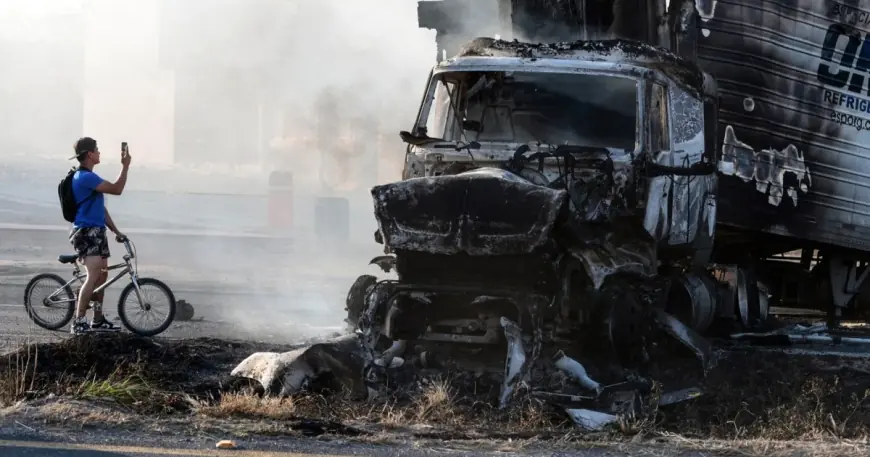
The Mexican military’s killing of Nemesio Rubén Oseguera Cervantes, known as "El Mencho, " set off a wave of violence that left smoke and scorched streets in Puerto Vallarta and prompted remain-in-place orders for tourists and residents. The fallout matters now because the operation—carried out 180 miles east of the resort town—triggered coordinated arson, travel disruption and school cancellations.
Nemesio Rubén Oseguera Cervantes
The military killed Nemesio Rubén Oseguera Cervantes in a shoot-out 180 miles east of Puerto Vallarta. He was the head of the New Generation drug cartel, known more fully as the Jalisco New Generation Cartel, and Mexico had placed a $15 million reward on his capture.
Mexico Cartel response in Puerto Vallarta
Smoke filled the sky over the swanky beach town as shops and cars were set ablaze, allegedly by cartel members. Burned-out shells of vehicles and heavily scorched storefronts were visible in videos. Streets were largely deserted the next day as locals and tourists heeded remain-in-place orders; schools in several states canceled classes in the wake of the unrest.
Zona Romántica attacks and two-wave tactics
Eyewitnesses described the violence unfolding in two waves that began early Sunday morning. The first wave involved several cars set on fire on the main road and on bridges in and out of the Zona Romántica, with much of that activity occurring in an area behind the foothills. When those fires were dying down, some people ventured out, only to be met by a second, more violent wave targeted inside the Zona Romántica. Buses and taxis had been positioned at intersections overnight and then coordinated to be set alight so the barricades would burn through the day; the action was intended to terrify residents and visitors.
Eyewitness accounts from Puerto Vallarta
American tourist Jim Beck, sheltering in his hotel, said he saw taxicabs blown up and blocking streets while people ran for cover. Marcus Brady, a Chicago resident who was in Puerto Vallarta and shared video of the chaos, said he believed the cartel intended to send a message to the Mexican government and to American and Canadian tourists that it could seize control of public space. "If we want to, we will take complete control of everything and everyone here, no one can stop us, " he said.
Another visitor, Yoni Pizer, said he, his husband and friends had to run for their lives from what he identified as members of the Jalisco New Generation Cartel. "The gunmen were following us and they were shooting, " Pizer said. He described attackers pulling drivers from vehicles; his own SUV was torched before a passerby helped them escape.
Steven Polito, a drag performer who divides his time between New York City and Puerto Vallarta, described a stark change in the town’s atmosphere over a short interval: he found the streets "unusually quiet" at about 8: 30 a. m. Sunday but, when he left around 10: 00 a. m., the scene had shifted dramatically. He added a further comment that was cut off in the provided context: "Everyday life was ju"—unclear in the provided context.
Airports, Costco parking lot fires and travel disruption
Video showed several cars ablaze in the parking lot of a Costco. Social media footage from Sunday captured sirens blaring and passengers and workers running through Puerto Vallarta's airport; images showed long lines of people hiding behind ticket counters. It was unclear in the provided context why the sirens went off or why people were running.
U. S. and Mexican embassy and consulate officials warned that road closures affected some travelers' ability to reach airports. The combination of arson, barricades and roadblocks produced measurable disruption to movement in and out of the resort area.
What makes this notable is the speed with which a targeted operation against a single high-profile figure precipitated coordinated, visible reprisals in a major tourist center—displacing visitors, prompting school cancellations and disrupting airport access within roughly a day.