






















Jack Hughes’ Overtime Strike Sends U.S. to First Olympic Men's Hockey Gold Since 1980

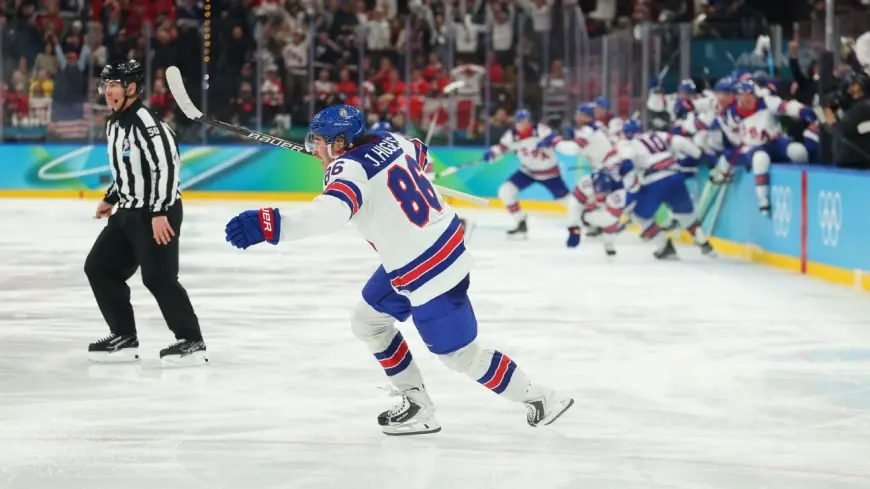
Jack Hughes scored the golden goal in 3-on-3 overtime as the United States beat Canada 2-1 to win its first Olympic men’s hockey gold since the 1980 Miracle on Ice. The result, sealed less than two minutes into the extra period in Milan, capped a tournament where Connor Hellebuyck’s 41 saves kept the Americans alive and USA Hockey completed a clean sweep over Canada.
Connor Hellebuyck’s 41 saves
Connor Hellebuyck was the backbone of the U. S. run, turning away 41 of the 42 shots he faced and producing several game-changing stops. In the third period he used his paddle to deny Devon Toews on a rebound that looked destined for the net, and earlier he denied Connor McDavid on a breakaway. Those interventions preserved a 1-1 score through regulation and created the chance for overtime heroics.
Jack Hughes’ overtime winner
Hughes finished the job in 3-on-3 overtime, scoring the decisive goal after a cross-ice feed from Zach Werenski. Werenski had wrestled the puck away from Nathan MacKinnon before sending the pass to an open Hughes, who ripped the puck past Jordan Binnington less than two minutes into the extra period to make it 2-1 and trigger jubilant celebrations on the ice.
Matt Boldy’s early strike and game sequence
Matt Boldy opened scoring six minutes into the first period with a deft move that saw him flip the puck over the sticks of Cale Makar and Devon Toews, then beat Binnington with a backhand. Canada answered late in the second when Cale Makar levelled the match, setting the stage for the goalie duel and Hughes’ decisive finish. Earlier in the tournament the Americans had required an overtime winner from Quinn Hughes to survive Sweden in the quarterfinals; Canada’s path included late comebacks against Czechia in the quarterfinals and Finland in the semifinals, underlining how tightly contested the bracket was.
Milano Cortina atmosphere and fans
The gold-medal game was staged in Milan on the 46th anniversary of the 1980 Miracle on Ice, and the city’s metro and venues were awash in jerseys and chants. Fans had gathered from hockey cities across the U. S., with bars opening before sunrise in New York, Minneapolis and Milwaukee and many watching the original Miracle film the night before. In Milan supporters chanted names from Eruzione to Gretzky to McDavid and Tkachuk; a lone fan in a USA cap attempted a cheeky "51st state" chant and was promptly shouted down.
Broader Olympic context: women’s sweep, curling and freeskiing
The men’s victory completed a weekend sweep for USA Hockey after the U. S. women’s team also beat Canada 2-1 in overtime earlier in the Games. Elsewhere on the final day of the Milano Cortina Winter Olympics, Anna Hasselborg’s curling rink—featuring three teammates who became mothers during this Olympic cycle—defeated Switzerland 6-5 to win the women’s title, making Hasselborg only the second woman to win two Olympic golds as a skip. In the freeski half-pipe, Eileen Gu defended her title with a score of 94. 75, bringing her career Olympic medal total to six; she revealed that she learned of her grandmother’s passing shortly after winning gold.
Reactions, redemption and legacy
Players and observers highlighted both individual performances and the wider significance of the win. P. K. Subban praised Team USA following the victory. Teammates celebrated wildly—gloves flew and players described a blackout of euphoria—and Charlie McAvoy said he could barely recall who he hugged in the immediate aftermath. Quinn Hughes called Jack a "freaking gamer, " noting his mental toughness after the forward lost at least one front tooth when he was high-sticked by Sam Bennett in the third period. That penalty produced a four-minute U. S. power play that preceded the late surge.
For Hellebuyck, the result was a personal redemption of sorts: the reigning Vezina and Hart Trophy winner had endured a difficult 2025 Stanley Cup playoffs, having been pulled three times in the first round for the Winnipeg Jets against the St. Louis Blues. Matthew Tkachuk placed Hellebuyck’s effort among the best goaltending performances of all time, referencing 1980 standouts, while Dylan Larkin quipped that Hellebuyck should never buy a drink in Michigan again.
What makes this notable is that the win arrived on a symbolic anniversary, ending a 46-year drought and shifting the narrative of the U. S. –Canada rivalry on the Olympic stage. The combination of Hellebuyck’s saves and Hughes’ finishing touch produced a straightforward causal chain: sustained goaltending under relentless pressure preserved the tie, and the turnover-and-assist by Werenski directly created the opening Hughes converted for gold.
The city of Milan witnessed both an operatic Olympic finale and a sporting moment likely to be replayed for years: a chipped-tooth smile exchanged for the shimmer of a gold medal, and a U. S. team that seized a long-awaited place atop the Olympic podium.