

















Mexico: 'El Mencho' killed in special forces operation, triggering cartel reprisals

The leader of the Jalisco New Generation Cartel, Nemesio Rubén Oseguera Cervantes — known as El Mencho — was wounded in a military operation in Tapalpa, Jalisco, and died while being flown to Mexico City, the defence department said. The strike, conducted by Mexican special forces with U. S. intelligence support, has set off a wave of retaliatory violence across mexico and prompted domestic and international security alerts.
Tapalpa, Jalisco operation
Mexican special forces carried out an operation in Tapalpa, Jalisco, on Sunday that left Oseguera Cervantes wounded; he later died in transit to Mexico City, the defence department confirmed. Troops came under fire during the operation: they killed four people and wounded three others, including Oseguera Cervantes, who did not survive. Two additional suspects were arrested during the operation. Armoured vehicles, rocket launchers and other firearms were seized from the scene.
Casualties, arrests and seizures
The defence department said three members of the armed forces were wounded in the clash. In total, troops killed four people on site, and three wounded individuals — one of them Oseguera Cervantes — later died. Authorities detained two people and recovered armoured vehicles, rocket launchers and other firearms. The United States provided complementary intelligence support for the operation, and the Mexican government carried out the strike within a framework of bilateral cooperation.
CJNG tactics and past attacks
The Jalisco New Generation Cartel, based in Jalisco, has a reputation for ultraviolence and a military-style arsenal. It has mounted aggressive attacks on Mexico's security forces, including shooting down an army helicopter with a rocket launcher in 2015. In 2020 the cartel launched a brazen assassination attempt in Mexico City using grenades and high-powered rifles against the then head of the capital's police force, who is now the federal security secretary. The group has pioneered the use of explosives from drones and the deployment of mines.
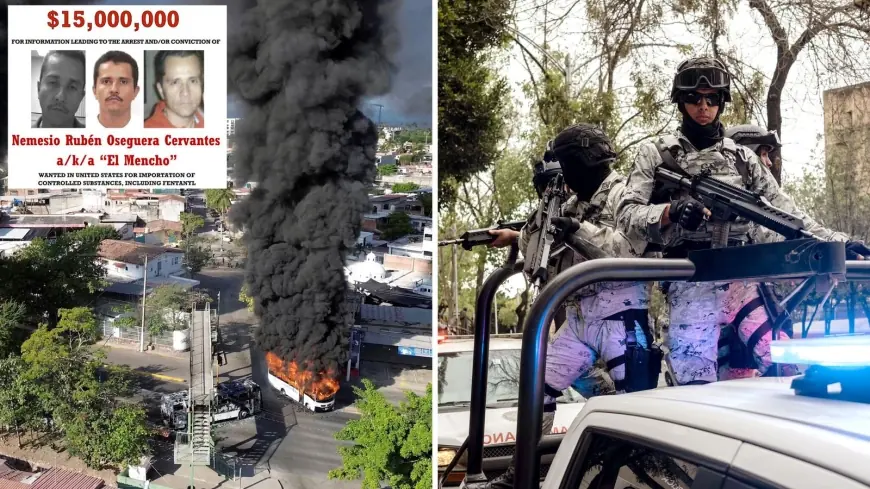
What makes this notable is the cartel’s capacity to mount large-scale, coordinated retaliation: within hours of news of Oseguera Cervantes' death, cartel operatives set cars alight, built roadblocks and attacked security forces in eight states, blockading highways with burning vehicles and torching businesses — tactics commonly used by criminal groups to hinder military operations.
El Mencho's background from Aguililla to CJNG
El Mencho, a 59-year-old former police officer originally from Aguililla in Michoacán, had been involved in drug trafficking since the 1990s. As a younger man he migrated to the United States and was convicted in the US district court for the Northern District of California in 1994 of conspiracy to distribute heroin, serving nearly three years in prison. After his release he returned to Mexico and worked with Ignacio Coronel Villareal, alias "Nacho Coronel. " Following Coronel's death, Oseguera Cervantes and Erik Valencia Salazar, alias "El 85, " founded the Jalisco New Generation Cartel around 2007. The group initially worked for the Sinaloa cartel before splitting and engaging in years of territorial battles across Mexico. One underworld yarn holds that the split began when a Guadalajara narco spilled hibiscus tea over a rival; the story is part of the cartel lore surrounding the break.
El Mencho has preferred to avoid publicity and few photographs of him exist. Since 2017, El Mencho — unclear in the provided context.
Domestic and international reactions
President Claudia Sheinbaum Pardo urged the public to remain calm as violence spread. The Foreign Office warned British nationals in Mexico to stay indoors and avoid unnecessary travel, describing the situation as involving "serious security incidents" following a federal law-enforcement operation against organised crime. A spokesman urged: "You should exercise extreme caution, follow local authorities' advice, including orders to stay indoors and avoid non-essential travel in affected areas. "
U. S. officials publicly endorsed the operation: the U. S. embassy in Mexico stated that Mexican special forces acted within a bilateral cooperation framework with U. S. authorities providing complementary intelligence. The White House press secretary confirmed U. S. government involvement in providing intelligence support and described Oseguera Cervantes as "one of the top traffickers of fentanyl. " The U. S. deputy secretary of state, Christopher Landau, called the killing a "great development" for the United States, Mexico and the rest of Latin America.
The cartel has been characterised by law-enforcement agencies as a major trafficking organisation. The U. S. Drug Enforcement Administration assesses the Jalisco New Generation Cartel as comparable in power to the Sinaloa cartel, with a presence in all 50 U. S. states and as one of the main suppliers of cocaine to the U. S. market, also earning billions from the production of fentanyl and methamphetamines. Earlier this month the cartel was designated a foreign terrorist organisation by Donald Trump's administration. Sinaloa has been weakened by infighting following the loss of leaders Ismael "El Mayo" Zambada and Joaquín "El Chapo" Guzmán, who are both in U. S. custody.
The death of Oseguera Cervantes followed a targeted capture operation that combined Mexican special forces capability with U. S. intelligence support; the operation's immediate effect was his death and a swift, violent pushback by the cartel across multiple states, prompting domestic advisories and international travel warnings as security forces consolidate control.