

























Weather: Blizzard warnings expanded, snow totals increased for NYC and Tri-State weather emergency

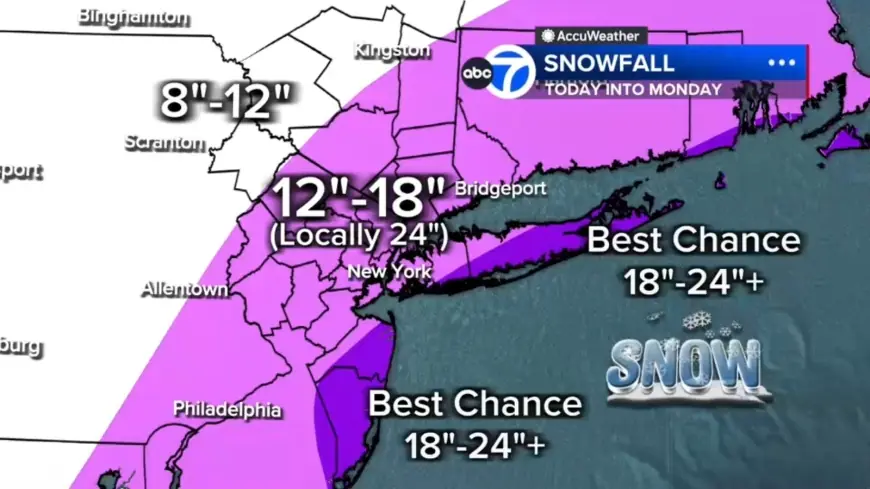
A rapidly intensifying coastal storm has put the entire Tri-State area under a Blizzard Warning through 6 p. m. Monday, and the unfolding weather will deliver heavy snow, high winds and coastal flooding across New York City and the region. Winds are already near blizzard criteria and temperatures have dropped below freezing faster than expected, allowing snow to accumulate quickly as conditions worsen.
Weather warnings cover all 29 counties and echo past historic storms
The Blizzard Warning now covers all 29 counties in the viewing area, an exceptionally rare setup not seen since the Blizzard of 1996, with an upper‑air pattern resembling the Blizzard of 1978. To qualify as a blizzard, conditions must include gusts over 35 mph, heavy snow and visibility under a quarter‑mile for at least three hours; many places — even inland communities such as Sussex, Poughkeepsie and Newburgh — are likely to meet or exceed that threshold tonight into Monday.
More than 40 million Americans are under blizzard warnings, and states of emergency declared in New York and New Jersey have been expanded to include Connecticut, Delaware, Massachusetts and Rhode Island. The storm has been described as potentially historic for the Northeast.
Snow, falling temperatures and deteriorating roads
Snow is falling across New York City and the metropolitan area, with accumulations piling up fast, visibilities reduced and roads that were wet and slushy becoming snow‑covered. Temperatures dropped below freezing faster than expected, and that cold air is expected to lock in overnight, allowing snow to accumulate quickly as the storm ramps up.
Travel is deteriorating rapidly tonight as the system evolves into a full‑blown blizzard; officials note that travel may become treacherous and potentially life‑threatening in whiteout conditions.
Wind gusts, coastal flooding and power outage risk
Expect wind gusts of 45 to 60 mph, especially along the coast, with 70 mph gusts possible on the East End, while the National Weather Service warned the storm could bring gusts up to 55 mph. Forecasters say the strong winds, combined with the weight of heavy, wet snow, will likely result in scattered to numerous power outages as trees and wires are stressed.
Coastal flooding is a major threat, particularly along the South Shore of Long Island and the Jersey Shore, where 2 to 3 feet of inundation is possible in vulnerable back‑bay areas during high tide. Some coastal communities could endure 12 to 16 consecutive hours of blizzard conditions.
Bands, rates and timing: when the heaviest snow will fall
The storm is expected to organize and intensify dramatically tonight, with forecast models showing widespread heavy snow by early evening and the most intense snowfall likely from midnight through daybreak Monday. Embedded snow bands could produce 2 to 3 inches per hour, and any location stuck under one of these bands for several hours could quickly rack up totals near two feet or more.
Two potential heavy‑snow bands appear most likely: one stretching from New Jersey into the Hudson Valley, and another from Long Island down to the Jersey Shore. Snow is expected to continue through Monday morning, remaining heavy at times especially from the city eastward, with conditions easing around midday and tapering to lighter bursts late afternoon and evening. Winds are forecast to remain strong well into Monday.
Projected totals and local differences across the region
Forecast amounts vary across the region: widespread totals of 12–18 inches are expected across much of the area, with localized 18–24+ inches in eastern Long Island, the South Shore of Nassau County and parts of the Jersey Shore. Areas farther north and west, for example Pike and Sullivan counties, are expected to see under 12 inches where the storm's moisture will be less concentrated.
The nor'easter is forecast to bring 1 to more than 2 feet of snow to parts of the Northeast, and potential totals Sunday night into Monday could top 18–24 inches in New York City, Philadelphia and Boston.
Transport disruptions, cancellations and a mounting toll
Travel disruptions are widespread: more than 14, 000 U. S. flights had been disrupted as of 5: 30 p. m. ET on Sunday, with about 8, 858 cancellations and another 5, 196 delays. JetBlue, American Airlines, Delta, Southwest and United announced they will waive change and cancellation fees ahead of the storm's expected impact on many Northeast hubs.
Public transit is affected in New York City: C train subway service is no longer running Sunday night, and the A train has been running local because both lines share the Eighth Avenue route. Maintenance crews cleared snow from a taxiway at LaGuardia Airport on Jan. 26, 2026, and travelers were shown waiting for flights at John F. Kennedy International Airport on Nov. 18, 2025, underscoring year‑round airport strain during major storms.
The human toll is already being felt: one Tennessee man died after suffering a heart attack while shoveling snow, adding to the storm's casualties.