

























Lindsay Clancy appears in court, asks judge to split murder trial into two parts

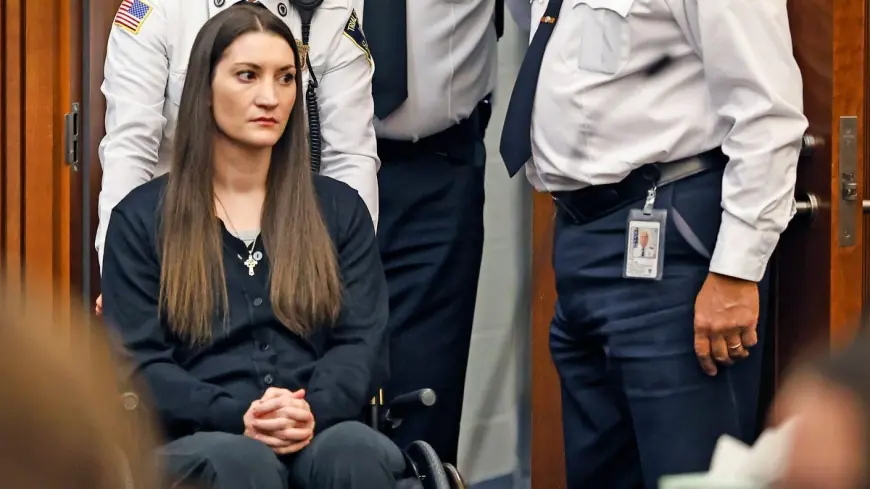
lindsay clancy appeared in person at Plymouth Superior Court on Friday for a 2 p. m. ET hearing, her first full in-court appearance in the case. Her defense filed a motion seeking a two-stage trial that would separate the question of guilt from questions about her mental state, a procedural move that will shape pretrial argument schedules ahead of the July trial.
Lindsay Clancy appears in court
Clancy, 35, was transported from a state psychiatric hospital to the courthouse by a sheriff’s office wheelchair van and was wheeled into the courtroom wearing all black and a silver cross. Nurses and EMTs were seated in the gallery on standby. She spoke briefly to greet the judge and answered her attorney when asked whether she preferred to appear in person at the next hearing on March 2.
Her parents attended the hearing and expressed support as it concluded. Clancy has attended earlier proceedings by video while held at the psychiatric hospital.
Defense seeks two-stage trial
On Feb. 19 the defense filed three motions that the court will fully hear in March: a request to bifurcate the trial, a request to videotape an interview by the commonwealth’s psychiatric expert, and a motion for early access to a pool of potential jurors. The bifurcation request would separate the proceedings into two phases — the first to determine whether the government has proven guilt beyond a reasonable doubt, and the second to decide whether Clancy was suffering from a mental disease or defect that left her unable to appreciate the criminality of her conduct or conform her conduct to the law.
Defense counsel said the motion is tied to an insanity defense strategy. The parties briefly discussed videotaping of a psychiatric evaluation; both sides signaled agreement to some videotaping while prosecutors raised concerns about recording proprietary testing material.
Transport, custody and upcoming dates
The subject of how to move Clancy between the psychiatric hospital and the courthouse has recurred in earlier hearings. The hospital is roughly 64 miles from the courthouse, a trip that can take more than an hour. The judge indicated there would be no change in the custody arrangement for the time being.
Court scheduling set a sequence of upcoming steps: oral arguments on outstanding pretrial issues are scheduled for March 2; a mental evaluation by an expert selected by prosecutors is set for April 10; a further motions hearing is scheduled for June 18. The trial is set to begin in July.
Case facts and immediate implications
Clancy is charged in the deaths of three children: a 5-year-old, a 3-year-old and an 8-month-old who prosecutors say were strangled with exercise bands in the family home. The children’s deaths occurred in January 2023. Clancy survived an apparent suicide attempt at the scene that left her paralyzed and confined to a wheelchair.
Court records and filings noted that Clancy had been treated with medications including antidepressants, benzodiazepines and an antipsychotic in the months before the deaths. Defense counsel has described her as emotionally unstable at the time and said he will pursue an insanity-related defense.
What happens next is procedural but consequential: if the judge grants bifurcation, jurors in the first phase will hear only evidence bearing on guilt. Only if the jury reaches a verdict on liability would the trial move to the second phase examining mental state. All three defense motions will be argued further at March hearings, and the April mental evaluation is expected to inform those arguments.