

























Lindsay Clancy appears in person in court for first time as defense seeks two-stage trial

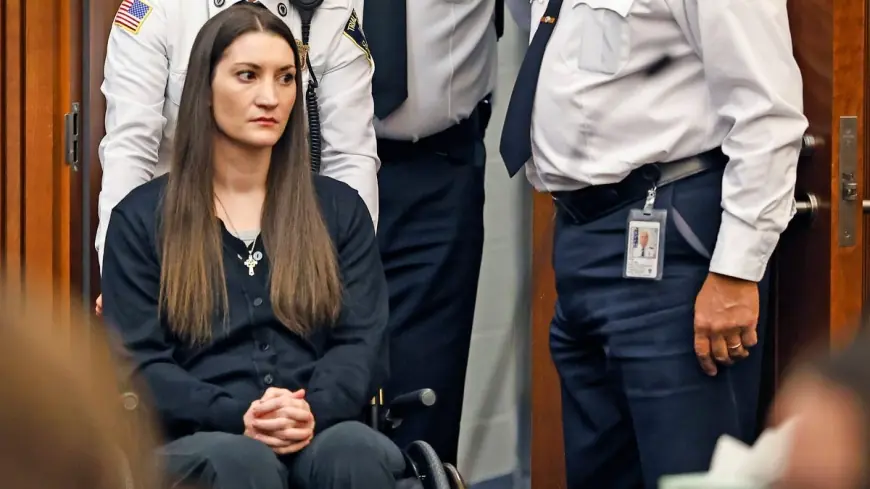
Lindsay Clancy appeared in Plymouth Superior Court in person for the first time on Friday, as her defense filed motions seeking a bifurcated trial and other pretrial relief ahead of a July 2026 trial. The brief hearing highlighted logistical questions about transporting a paraplegic defendant from Tewksbury Hospital and set a calendar for upcoming filings and evaluations.
Lindsay Clancy in court: what happened and who was present
Clancy, 35, who faces charges in the strangling deaths of her three children — 5-year-old Cora, 3-year-old Dawson and 8-month-old Callan — was brought to the Obery Street courthouse by a wheelchair van from the sheriff’s office for a 2 p. m. hearing. She has pleaded not guilty.
Family members were in the courtroom; her parents attended and expressed support after the roughly 20-minute hearing. Medical personnel, including nurses and EMTs, sat in the gallery on standby while Clancy, dressed in all black and wearing a silver cross, was wheeled into the courtroom. She spoke only briefly, greeting the judge and answering her attorney’s question about whether she preferred to appear in person for the next hearing.
Clancy became paraplegic after harming herself and leaping from a second-floor window on the day the children died. She has attended earlier proceedings by videoconference from Tewksbury Hospital, where she has been held in a treatment setting since 2023. The 64-mile distance between that facility and the courthouse has been central to discussions about transport and custody logistics.
Defense motions, scheduling and evidentiary disputes
On Thursday, the defense filed three motions: a request to split the trial into two phases (bifurcation), a request to videotape a psychiatric interview by the commonwealth’s expert, and a request for early access to a pool of potential jurors. The court briefly addressed the videotaping issue during Friday’s hearing and set dates to flesh out the remaining disputes.
- March 2: oral arguments on outstanding issues, including the bifurcation request.
- April 10: a mental evaluation to be conducted by an expert chosen by the prosecution.
- June 18: a further motions hearing, with the parties also discussing an additional pretrial session in mid-June.
The videotaping matter drew particular attention. Both sides signaled tentative agreement to videotape the psychiatric interview itself, while prosecutors objected to filming the defendant completing proprietary testing materials, citing concerns about protecting proprietary testing information. All three defense motions are scheduled to be fully heard in March.
The defense outlined the purpose of bifurcation: the first phase would ask a jury to determine beyond a reasonable doubt whether Clancy is guilty and to what degree; the second would examine whether Clancy was suffering from a mental disease or defect that rendered her unable to appreciate the criminality of her conduct or conform her actions to the law.
Competing narratives and what comes next
The defense has signaled an insanity-based strategy, with the attorney confirming plans to pursue that line and indicating that Clancy had been emotionally unstable in the period before the deaths. Court filings state that she was taking medications that included antidepressants, benzodiazepines and an antipsychotic in the months leading up to the incident.
Prosecutors have advanced a different account, alleging that Clancy deliberately sent her husband out that night so she would have time to harm the children and contesting that she suffered from postpartum depression. Those are competing factual theories that the court will need to sort through during pretrial proceedings and, potentially, at trial.
With the trial set for July 2026, the coming weeks will focus on the March arguments, the April mental evaluation and the June motion calendar. Details may evolve as the court rules on the defense motions and the parties complete the scheduled evaluations and disclosures.