























Decade-Long Puzzle Rewound: What New Modeling Reveals About the Greenland Ice Sheet's Pasta-Like Internal Churning

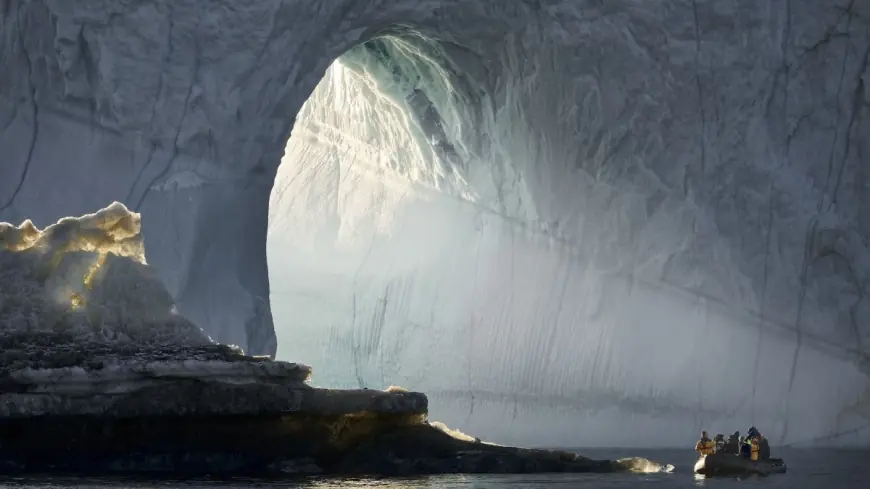
Why this matters now: Deep radar scans of the greenland ice sheet exposed odd plume-like distortions more than a decade ago; recent computer modeling now ties those features to thermal convection — a mantle-style, slow churning driven by heat from below. That shift reframes how scientists think about internal ice mechanics and forces an update to models that aim to predict future changes in the ice body's behavior.
Greenland Ice Sheet: the context that pushed researchers to rethink internal physics
Researchers have long used ice-penetrating radar to read internal layers formed by centuries of snowfall and compression. When radar revealed large, upward-buckling plumes deep inside northern ice, the shapes didn't match bedrock patterns and resisted simple explanations. Previous hypotheses included meltwater refreezing at the base or migrating slippery patches under the ice, but those ideas didn't fully recreate the observed layering distortions. More than a decade after the initial discovery, teams returned to the puzzle with a different toolset: mantle-style convection models adapted for ice.
Here’s the part that matters: reframing the anomaly as a consequence of heat-driven movement forces modelers to ask whether basal ice is softer and warmer than commonly assumed — and that question changes which measurements and tests are most valuable going forward. What's easy to miss is how a tiny, persistent geothermal flux, trapped under kilometers of insulating ice, can produce long-term mechanical effects.
- Modeling implication — If thermal convection occurs, internal transport of heat and mass inside the ice matters for layer folding and structure.
- Practical reach — Glaciologists and ice-sheet modelers will need to account for possible convection zones when interpreting radar layering and projecting mass-balance behavior.
- Signal to watch for — Repeated radar signatures that match plume geometry would strengthen the convection interpretation; evidence of softer basal ice would be confirmatory.
- Limits of the finding — Softer deep ice does not automatically mean faster surface melting; the relationship to sea-level contribution remains unsettled without further isolation of processes.
How modeling tied mantle-style convection to the radar plumes
To test the convection idea, researchers built a simplified digital slice of the ice sheet and repurposed a geodynamics package normally used for mantle simulations. The modeled slab was set to the approximate thickness observed beneath the plumes and key parameters were varied: snowfall rate, ice thickness, the softness (viscosity) of the ice near the base, and surface flow speed. Under certain combinations, the model produced slow, plume-like upwellings that folded overlying layers into geometries strikingly similar to radar images.
Two technical points stand out. First, plumes formed only when the basal ice was warmer and significantly softer than typical assumptions — suggesting the real basal ice under those radar-detected regions may be unusually soft. Second, the heat budget needed to sustain the modeled convection aligned with the tiny but continuous geothermal heat that comes from radioactive decay and residual planetary heat. Over long timescales and beneath a vast insulating ice cover, that small flux can accumulate effects large enough to produce the observed structures.
Earlier ideas such as basal refreezing of meltwater or migrating low-friction zones remain possible contributors in other contexts, but the new modeling shows that internal thermal convection is a physically plausible mechanism for the specific plume geometries in question.
Timeline rewind: radar anomalies were first described in a mid-2010s paper; the current modeling effort revisits that puzzle and produces a candidate mechanism. The real test will be gathering independent measures of basal temperature and softness to confirm whether the modeled conditions exist beneath the plumes.
The real question now is whether routine observations and targeted field measurements can pin down where and how often this convection happens. If repeated radar signatures and basal softness measurements converge on the convection scenario, ice-sheet models will need to incorporate a previously overlooked mode of internal motion.
It’s easy to overlook, but this finding is not a simple alarm about melting — it’s a refinement of internal physics that changes which uncertainties scientists prioritize next.