
























Carlos Alcaraz's momentum redraws Doha: finals frequency, unbeaten stretch and a public blast at ATP rules

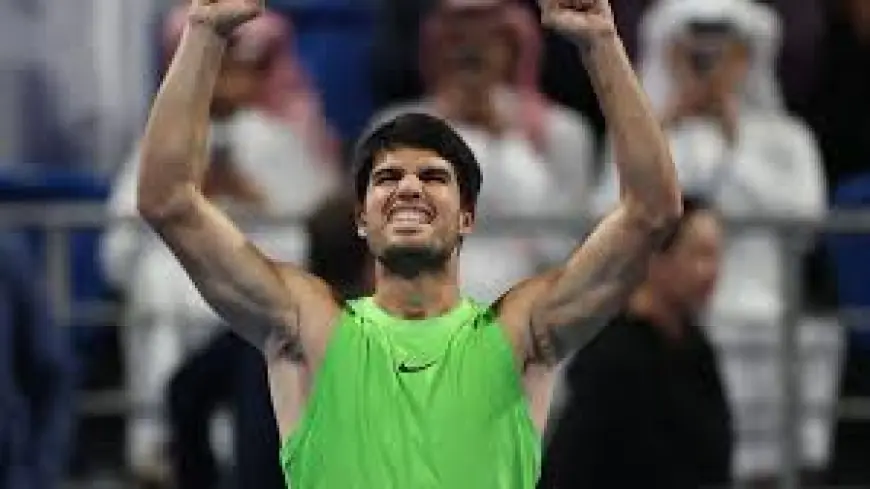
What matters now is how sustained dominance changes the tournament landscape: carlos alcaraz is not just winning matches in Doha, he is reshaping expectations for opponents and for the event itself. His run combines relentless results with a visible edge off the court—an outspoken frustration with the ATP rules—so the simple result line no longer captures the larger effect on rivals and the draw.
Carlos Alcaraz and the performance shift: streaks, finals and tournament control
The pattern is stark: this stretch adds to a run in which Alcaraz has reached the final in 12 of his last 13 tournaments, pushed his career tally of finals to 34, and finished this Doha sequence with an unblemished set of wins at the venue. That consistency turns him from a single-event favorite into a season-defining force, forcing rivals to plan for a player who converts deep into events with alarming regularity.
- Here’s the part that matters: Alcaraz will face Arthur Fils next, after Fils defeated Jakub Mensik 6-4, 7-6; the match is listed for Saturday at 19. 00.
- Alcaraz’s run in recent tournaments includes reaching 12 finals across 13 events and totals 34 career finals.
- In the Doha draw he completed an 11-match, 11-win sequence at the site during this run.
- He also registered a straight-sets win over a top opponent to reach the final, underscoring a blend of peak form and match management.
What's easy to miss is that those headline numbers carry tactical consequences: opponents can no longer treat him as a periodic threat—he is the match-to-match benchmark this week.
Match snapshot and the moment that followed
The immediate event that sealed the title match was a straight-sets victory over Andrey Rublev, 7-6, 6-4, in a contest that lasted 2 hours and 2 minutes. Rublev, listed in the match notes as world number 14 and 28 years old, fought long rallies (exchanges reached up to 26 shots) and created pressure moments, but Alcaraz’s control in decisive phases proved decisive.
Against that backdrop, there was also a public burst of frustration from Alcaraz earlier in the week while moving toward the semifinals: he criticized the governing body's rules with the phrase "Las reglas ATP son una mierda. " That remark adds a political edge to his campaign—an athlete not only consolidating on-court superiority but also venting about the framework around the tour.
The win over Rublev was described by observers as one where Alcaraz combined offensive creativity with a tighter, more reliable mentality. Even when conceding unforced errors or a slip in execution, he had the elasticity to reclaim control; that blend explains why opponents who can summon quality still struggle to convert it into wins.
The real question now is how this streak will influence the next opponent’s game plan: will Fils alter tactics to blunt Alcaraz’s offensive initiation, or will the match follow the pattern of previous rounds where Alcaraz closes out key moments? The answers will tell whether the dominance is match-by-match situational control or a deeper seasonal advantage.
Micro timeline:
- 12 finals in the last 13 tournaments — a near-constant presence at the end of events.
- 34 career finals reached, matching a notable benchmark mentioned in coverage.
- Victory over Rublev in Doha (7-6, 6-4) after a 2h 02m match; next opponent is Arthur Fils, who won his semifinal 6-4, 7-6.
From a competitive standpoint, tournament organizers and rivals now face a player whose statistical profile forces strategic adjustments: seeding and draws are still what they are, but the lived reality on court has shifted toward preparing for Alcaraz as a consistent final-round actor rather than an occasional headline-grabber.
The bigger signal here is that results and temperament are converging: a high conversion rate of deep runs together with a public critique of tour rules suggests a player both dominant and increasingly vocal—an intersection that could affect negotiations, scheduling pressure, and opponent psychology if the pattern continues.
Brief aside: it's easy to overlook, but a run that combines on-court dominance with visible frustration at governance can ripple beyond a single event—expect competitors to factor both form and temperament into their plans.