























Quinn Hughes Sends Team USA Past Sweden in Overtime as Olympic Men’s Hockey Bracket Turns to Semifinal Day

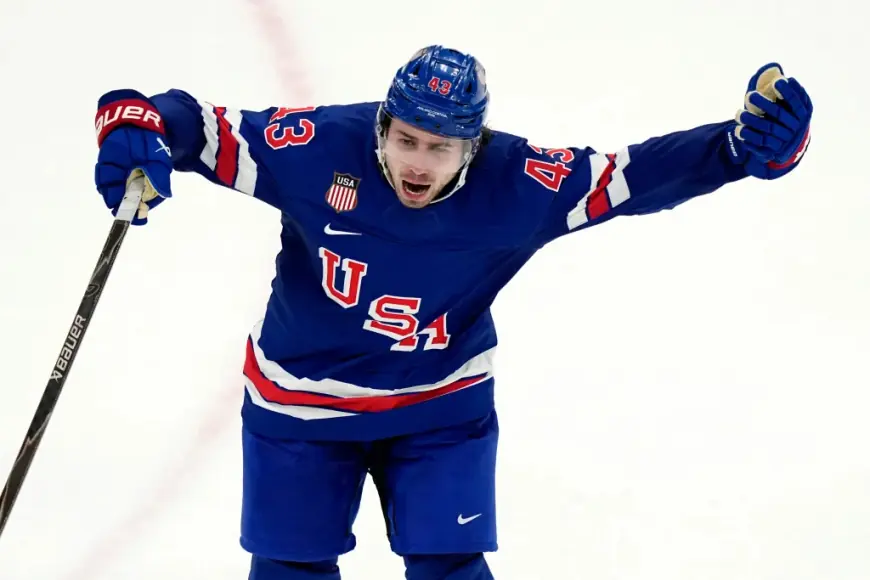
Team USA men’s hockey is moving on at the Olympics after a tense, low-scoring USA vs Sweden quarterfinal ended with Quinn Hughes scoring in overtime for a 2–1 win. The result keeps the United States on track for a medal push and sets up a semifinal meeting with Slovakia on Friday, February 20 at 3:10 PM ET.
The game had the feel of a classic knockout: long stretches of structured defending, goaltending that kept small mistakes from becoming disasters, and one sudden burst that decided everything.
USA vs Sweden hockey: the score, the scorers, and the moment that broke it open
The United States led 1–0 after Dylan Larkin opened the scoring in the second period, finishing a net-front chance created by pressure from the Hughes brothers. Sweden’s equalizer arrived late in the third, when Mika Zibanejad tied it with 1:31 remaining to force overtime.
Then came the defining sequence. In three-on-three overtime, Quinn Hughes attacked with speed, created separation, and ended it 3:27 into the extra frame. Matt Boldy and Auston Matthews drew the defense’s attention and were credited with the assists, but the play was driven by Hughes’ willingness to take the risk that overtime hockey demands.
Connor Hellebuyck steadied the U.S. net through the final push, while Sweden’s goalie faced a heavy workload all night and kept the game within a shot.
Behind the headline: why this win matters for USA hockey at the men’s Olympics
This was not just a “survive and advance” night. It was a blueprint win, and it highlights how the U.S. is trying to win this tournament.
Context: the modern Olympic men’s bracket is unforgiving. One late penalty, one missed coverage, one bounce, and a medal contender goes home. In that environment, Team USA’s roster construction makes more sense: mobile defense, fast retrievals, and puck-moving skills that can turn a defensive stand into an instant counterattack. Quinn Hughes is the central piece of that identity.
Incentives: in a close game, both teams had reasons to play conservatively until they didn’t. Sweden needed patience to earn one clean look late. The U.S. wanted to avoid giving Sweden transition chances where Zibanejad thrives. Once overtime arrived, the incentive flipped: possession became the only “safe” choice, and elite skaters with decision-making—like Hughes—gain outsized value.
Stakeholders: for Team USA, this is also a credibility game. Winning in a tight quarterfinal validates the goaltending plan around Hellebuyck and reinforces the leadership spine of the lineup—centers like Larkin and top-end finishers who can win small moments. For Sweden, a late rally that still ends in elimination will sharpen questions about what they needed earlier: more direct offense at five-on-five, better overtime management, and full health on the blue line after a key defenseman missed the game following a warmup injury.
What we still don’t know heading into the semifinal
Even with an overtime win, the quarterfinal raised a few unanswered questions:
-
Can the U.S. generate more controlled offense without opening the door to odd-man rushes the other way?
-
How will Team USA manage the emotional swing of allowing a late tying goal, then immediately resetting for a bigger game two days later?
-
Will Sweden’s late push serve as a cautionary tale about protecting leads, or was it a one-off sequence driven by special late-game chaos?
Those details matter because the semifinal opponent is built to punish lapses.
USA men’s hockey today: Slovakia next, and the bracket picture with Canada
Friday’s men’s Olympic hockey schedule puts Team USA vs Slovakia in the late semifinal at 3:10 PM ET. Earlier, Canada meets Finland at 10:40 AM ET after Canada survived an overtime scare in its own quarterfinal.
The U.S. matchup is intriguing because Slovakia tends to lean into tight checking and opportunistic scoring. That style can force a favorite into long, grinding minutes where one defensive read decides the night—exactly the territory the U.S. just escaped against Sweden.
What happens next: 4 realistic scenarios and the triggers to watch
-
Team USA wins if it scores first and keeps the game at its preferred pace, with Hughes driving exits and Hellebuyck controlling rebounds. Trigger: early lead and clean breakouts.
-
Slovakia pulls the game into a low-event coin flip if it clogs the middle and turns the semifinal into a special-teams and net-front battle. Trigger: limited rush chances and heavy traffic.
-
A goaltending swing decides it if either side gets a multi-save sequence that flips momentum and bench energy. Trigger: a key stop in a tied third period.
-
Overtime again, where possession and elite skating take over. Trigger: disciplined defense and a one-goal game late.
For Team USA, the headline is Quinn Hughes and a dramatic USA hockey scoreline. The deeper story is that the tournament is now down to single moments—and the U.S. has a defenseman capable of creating one when it matters most.