

![Florida Panthers Face Off Against [Team Name] on April 4, 2026](https://www.filmogaz.com/uploads/images/202604/image_430x256_69d2395a47e1f.webp)














gianluca prestianni faces UEFA probe after Vinicius Jr allegation halts Champions League tie

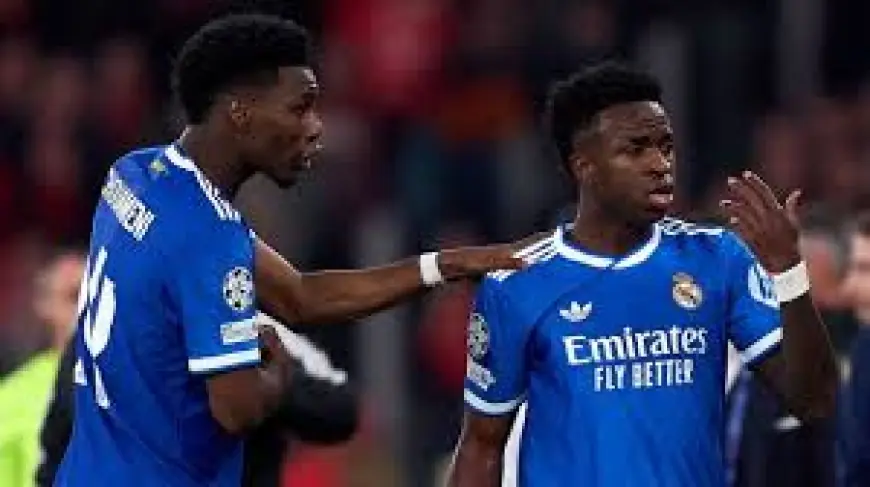
UEFA has opened an ethics and disciplinary investigation after Real Madrid forward Vinicius Jr said he was the target of racist abuse by gianluca prestianni during Tuesday's Champions League play-off first leg at the Estadio da Luz. The match was stopped for roughly 8–10 minutes when match officials invoked FIFA’s anti-racism protocol; the accused player denies the allegation and is likely to be available for the second leg at the Bernabéu next Wednesday (ET).
What unfolded on the pitch
The incident came moments after Vinicius scored a spectacular goal that otherwise would have dominated headlines. The forward celebrated in front of the home fans and then appeared to confront a nearby player. The referee implemented the first step of FIFA's three-step anti-racism procedure, making the 'No Racism' gesture, and paused play so the situation could be assessed. Play was halted for roughly 8–10 minutes while discussions took place on the field.
Vinicius pointed toward the player he accused; that player denies using racist language. A teammate of the Madrid forward said he heard a racial slur repeated multiple times. The accused player has publicly rejected the claim, saying the alleged insult was a misunderstanding.
While the match resumed and finished as a narrow victory for Madrid, the stoppage—and the allegation itself—drew immediate scrutiny and strong emotion from players, staff and observers. A noted football analyst who was in attendance described the scene as emblematic of a broader struggle against discrimination that the Brazil international has faced repeatedly.
UEFA steps in; what the process could mean
European competition authorities have assigned an ethics and disciplinary inspector to gather evidence and interview those involved. Given the profile and sensitivity of the allegation, officials expect the inquiry to take days to weeks rather than concluding before the return leg, meaning the accused player will likely remain available for selection next Wednesday (ET).
Past disciplinary outcomes in similar cases show that sanctions are not always immediate. There is a defined minimum suspension for racist conduct in UEFA competitions, and guidelines recommend that any disciplinary measure be coupled with education and awareness programs run by the club. A precedent exists of lengthy probes and subsequent multi-match bans, underscoring that determinations in these matters can follow a lengthy fact-finding phase.
Wider fallout and Vinicius's history of abuse
The allegation adds to a long pattern of abuse the forward says he has endured. Over eight years at his club, he has now identified this as the 20th time he has faced racist insults while playing. That history has shaped how he reacts on the field: moments of visible protest or confrontation are often framed by critics as poor behavior, while supporters view them as a response to ongoing hostility.
The accused player's club has issued a statement backing its player and emphasising a commitment to equality and inclusion. The home side's coach suggested the incident was provoked by the celebration that followed the goal, referencing the club's historical identity in an attempt to refute claims of institutional bias. Anti-racism campaigners described that reaction as unhelpful and said it risks minimising the seriousness of the allegation and the experience of victims.
As the investigation proceeds, attention will remain fixed on both governing-body processes and the second-leg clash next Wednesday (ET). Whatever the final disciplinary outcome, the encounter has again highlighted the challenge football faces in eradicating racist abuse and ensuring clear, timely mechanisms for justice and prevention.