

























Elana Meyers Taylor’s ethnicity and heritage come into focus after Olympic gold

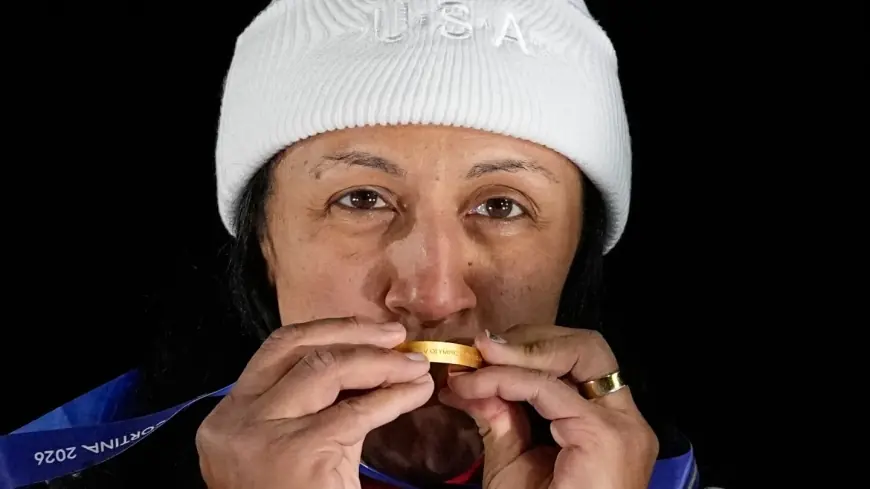
Elana Meyers Taylor’s long-awaited Olympic breakthrough on Monday, Feb. 16, 2026 (ET) did more than add another medal to a historic résumé. It also pushed renewed attention toward how she describes her ethnicity and heritage—in her own words—at a moment when visibility in winter sports remains a recurring theme.
The 41-year-old U.S. bobsledder won gold in women’s monobob in Cortina d’Ampezzo, finishing four heats in 3:57.93 to edge Germany’s Laura Nolte, with American teammate Kaillie Humphries taking bronze. The result gave Meyers Taylor her first Olympic title and sixth career Olympic medal, further extending her standing among the most decorated U.S. women in Winter Games history.
How Meyers Taylor describes her ethnicity
In a recent social media post written during the Olympic period, Meyers Taylor described herself as:
-
A first-generation American
-
“A proud Jamaican Panamanian Italian American”
-
The daughter of an immigrant
Those phrases speak to ethnicity and family heritage—the cultural and national roots she traces through her family—rather than an event-specific label assigned by an organization. It’s also a framing she has used to connect identity with opportunity and representation, especially in sports where athletes from diverse backgrounds have historically been underrepresented.
Why this discussion is resurfacing now
Meyers Taylor has been a major face of U.S. sliding sports across five Olympic cycles, but the spotlight after a gold medal tends to broaden from results into biography. The timing matters: this win comes after years of competing at the top level while navigating concussion setbacks and motherhood, and it arrives in an Olympics where fans are tracking milestones across age, gender, and representation.
Her heritage statement has circulated widely because it’s unusually direct and specific—three distinct roots named plainly—at a time when many athletes are asked broad identity questions immediately after high-profile performances.
Ethnicity, race, and winter-sports representation
Ethnicity and race aren’t the same thing, and Meyers Taylor’s public story often touches both.
Her ethnicity/heritage, as she describes it, is Jamaican, Panamanian, and Italian, and she identifies as a first-generation American. Separately, she has also been recognized in Olympic discussions as a Black American athlete, with her medal haul frequently cited in the context of Black representation at the Winter Games.
Those two layers can be true at the same time: ethnicity speaks to cultural and ancestral background; race often reflects how someone is socially categorized and experiences the world, including in sport.
A career shaped by barriers and persistence
Meyers Taylor’s on-ice results have made her hard to ignore, but she has also spoken publicly over the years about the structural challenges faced by athletes in her sport—ranging from access and cost to issues of fairness and inclusion. That broader context helps explain why her heritage statement resonates beyond a simple biographical detail.
Her gold in monobob also arrived in the narrowest of margins: she rallied in the final heat to flip the podium order. The finish reinforced a theme that has defined her Olympic career—being consistently close to the top step—before finally breaking through.
What the moment signals going forward
Meyers Taylor’s post and her victory land together as a kind of statement: a first-generation American athlete, openly naming her Jamaican, Panamanian, and Italian roots, standing on top of an Olympic podium in a sport that still battles perception as exclusive and inaccessible.
The practical next question is how this visibility translates. In the near term, it can mean more attention to pathways into sliding sports, more public conversation about who gets access to high-cost Olympic disciplines, and more young athletes seeing an elite competitor who speaks about heritage plainly while delivering results at the highest level.
For Meyers Taylor, the medal is the headline. The way she describes who she is—and where her family comes from—is part of why the headline is traveling farther than a time on a results sheet.