
























Jordan Stolz enters Milano Cortina as the man to beat in men’s speed skating

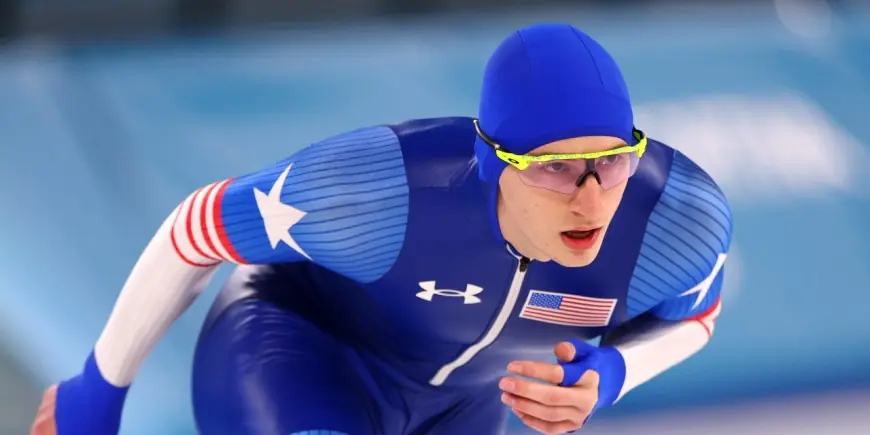
Jordan Stolz’s Olympic campaign is shifting into its most defining phase this week, with the 21-year-old American lining up for the men’s 1,000 meters in what many in the sport view as his best chance to open the Games with gold. The stakes are straightforward: Stolz arrives with a rare mix of range and dominance across sprint and middle distances, and he’s chasing a multi-event medal haul that would put him in the same conversation as the most decorated Winter Olympians from the U.S.
Stolz made his Olympic debut as a teenager in 2022. Four years later, he enters the Milano Cortina Games with a world-record résumé and the expectation that he can contend in multiple events rather than peaking at just one.
Why the 1,000 meters is the headline
The men’s 1,000 is widely viewed as Stolz’s strongest distance, combining the raw speed of the 500 with the pacing discipline needed for the 1,500. In recent seasons, he’s been the standard-setter in the event, and the Olympic start list reflects that: he’s the target everyone has been building toward, especially the deep Dutch contingent that historically sets the benchmark in long-track speed skating.
The 1,000 also functions as a tone-setter. If Stolz wins early, it increases the pressure on rivals in the remaining distances and sharpens the storyline around whether he can pull off a rare three-distance sweep.
The rivals most likely to shape the race
A key dynamic this week is the clash of styles: Stolz’s crisp technical approach and controlled aggression versus veterans and emerging challengers who are peaking for a single, perfectly timed Olympic performance.
Among the names generating the most attention is Dutch veteran Kjeld Nuis, a three-time Olympic gold medalist who has framed these Games as a final run at the top. The Netherlands also brings younger contenders with proven speed on the World Cup circuit, creating the kind of depth that can turn a “favorite’s race” into a tight, tactical finish decided by small timing margins.
In speed skating, that margin is often the last straightaway: one clean line, one better exit off the final corner, one slightly faster closing split.
What makes Stolz different: range and repeatability
Most Olympic speed skaters build a medal plan around one distance, maybe two. Stolz is trying to do something far rarer: contend seriously in the 500, 1,000, and 1,500, with the mass start also on the table.
That combination matters because it changes how opponents prepare. He isn’t just a one-race threat; he forces the field to consider that the same athlete could show up with medal-level speed on multiple days, under different race demands, and still look fresh enough to close.
It also means his Olympics isn’t defined by a single moment. A small misstep in one event doesn’t end his medal prospects; it just shifts where he can make it back.
The old-school partnership behind the surge
One of the most closely watched elements of Stolz’s rise is his training partnership with veteran coach Bob Corby, a longtime physical therapist and former elite skater who has leaned into a demanding, high-volume approach. The pairing has drawn attention because it runs counter to some modern training trends, emphasizing toughness, repetition, and a near-constant focus on mechanics.
For Stolz, the appeal is clear: consistent work that translates into consistent racing. In a sport where a tiny technical leak can cost a podium, the promise of repeatability can be as valuable as top-end speed.
Where his Olympic schedule points next
Stolz’s plan centers on four medal opportunities. Exact session start times vary by day and venue operations, so the best guide is the event order and date windows.
| Event | Expected Olympic window (ET) | What it tests |
|---|---|---|
| Men’s 1,000 meters | Feb. 11 | Power + pacing under pressure |
| Men’s 500 meters | Mid-Games window | Pure acceleration and clean corners |
| Men’s 1,500 meters | Mid-to-late Games | Efficiency, rhythm, late speed |
| Men’s mass start | Late Games | Positioning, tactics, finishing kick |
If Stolz opens strongly in the 1,000, the conversation quickly turns from “medal contender” to “multi-gold threat,” and every subsequent race becomes part of a larger sweep watch.
What to watch for in the next 48 hours
Two indicators usually separate Olympic champions from favorites who fall short: execution under noise, and recovery between efforts. Stolz’s races are often decided not by whether he’s fast enough—he is—but by whether he stays error-free when the stakes spike and the field tightens.
Look for:
-
how cleanly he exits the final corner in the 1,000,
-
whether his closing split holds when others surge late,
-
and how he looks physically and mentally the day after a marquee race.
If he wins early, the pressure doesn’t go away—it multiplies. But that’s also the point of his Olympics: he’s here to race often, race wide, and try to define the Games.
Sources consulted: Reuters, The Guardian, The Wall Street Journal, International Skating Union