

























AI Unravels Ancient Roman Board Game Rules Beyond Expectations

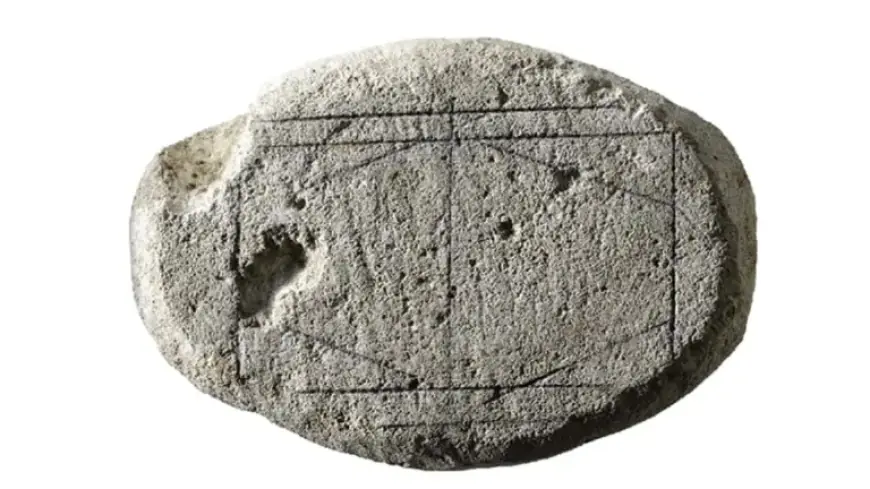
Recent archaeological findings have provided surprising insights into ancient Roman leisure activities. Walter Crist, an archaeologist specializing in board games, discovered a peculiar piece of Jurassic limestone at the Het Romeins Museum in Heerlen, Netherlands, during a visit in 2020. This artifact, cataloged as a potential board game, featured an unusual oblong octagon within a rectangle, leading to questions about its purpose and design.
Uncovering the Artifact’s Mystery
The stone slab, labeled object 04433, was initially found in the late 19th or early 20th century but lacked detailed contextual data due to its non-scientific excavation. Experts debated whether it was merely a mason’s practice piece or doodle. However, closer examination revealed incised lines and evidence suggesting it was a game board.
Microscopic Analysis
Detailed studies of the stone’s surface uncovered localized abrasion, consistent with the movement of game pieces over time. Crist and his team noted wear patterns specifically concentrated along certain lines, indicating that the object was indeed a game board.
AI-Powered Game Reconstruction
To determine the rules of the game played on this board, researchers utilized advanced AI methods developed by the Digital Ludeme Project. The AI was programmed to simulate different board game variations, including alignment and blocking games.
- They tested various configurations, such as different numbers of pieces for each player.
- The AI played over 1,000 rounds for each ruleset to mirror potential historical gameplay.
Ultimately, the analysis pointed to a specific game, now called Ludus Coriovalli, resembling a blocking game where one player aims to trap the other. The mechanics showed one player controlling four “dogs” while the other managed two “hares.”
Historic Significance of Ludus Coriovalli
Previously, historians believed that blocking games emerged in Europe during the Middle Ages. This recent study extends the timeline, indicating that such games were present in Roman culture, thus filling a gap in historical understanding.
Gameplay Mechanics
- Dogs start on the leftmost four positions, and hares begin on the inner two rightmost points.
- Players take turns moving their pieces along the lines on the board.
- The goal is for the dogs to block the hares, while the hares attempt to avoid being trapped.
This finding suggests that Romans participated in a form of folk tradition involving “hunt” games alongside more documented pastimes like Latrunculi and Duodecim Scripta.
Implications of the Findings
These discoveries also validate the use of AI not just for data analysis but as a tool to reconstruct human behavior and interactions related to ancient artifacts. Crist emphasized the importance of understanding how such games were played to gain insights into the everyday lives and leisure of ancient Romans.
As we explore these ancient games, we can envision how people engaged in friendly competition, skillfully moving their pieces across the limestone board. Ludus Coriovalli highlights the timeless nature of play, indicating that the desire to enjoy games transcends generations and cultures.
For those interested in a modern experience, the reconstructed game can be played online, inviting players to experience this historical pastime firsthand. Visit Filmogaz.com for more details on this fascinating study and the history of ancient board games.