





















Charlie McAvoy injury: Bruins defenseman exits after high hit, status uncertain

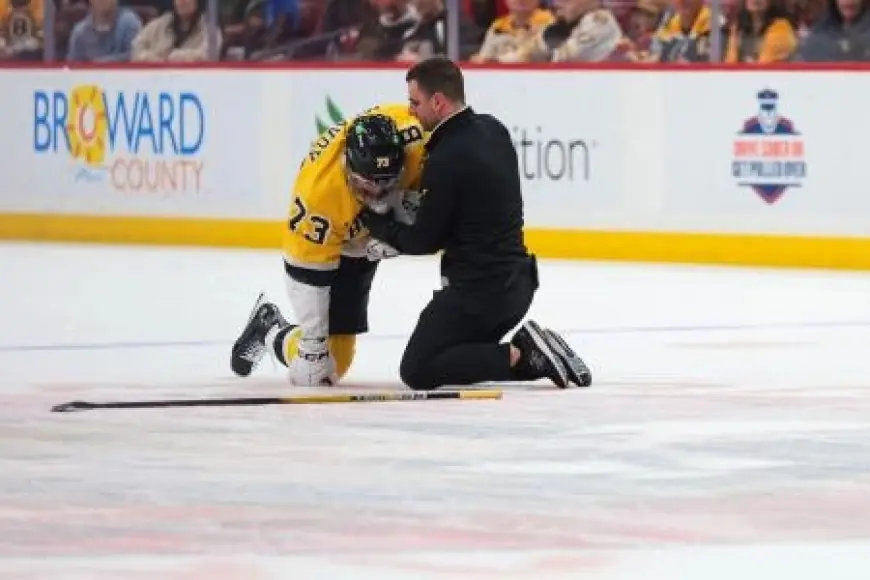
Boston Bruins defenseman Charlie McAvoy left Wednesday night’s game against Florida after taking a high, head-area hit in the first period and did not return, putting his availability for the Olympic break period and the Bruins’ next stretch of games into immediate question.
The Bruins announced during the game that McAvoy would not return with an upper-body injury. No additional diagnosis was provided during the game window, and a clearer update is expected after further evaluation.
What happened in the game
Midway through the opening period Wednesday (ET), McAvoy carried the puck through the neutral zone and absorbed an open-ice collision that appeared to make primary contact up high. He went down on the ice and needed assistance getting to the bench area before heading to the locker room for evaluation.
Officials assessed a minor penalty for an illegal check to the head on the play. McAvoy remained out for the rest of the game, and the team’s in-game update listed an upper-body injury.
Immediate questions: concussion protocol and next steps
When a player exits after a head-area hit and does not return, the next-step assumption around the league is evaluation under concussion protocols. That is not a diagnosis, and teams often keep details limited until after postgame testing and follow-up assessments the next day.
The key questions for the Bruins over the next 24–48 hours are straightforward:
-
Whether McAvoy entered concussion protocol evaluation
-
Whether symptoms were present immediately or developed after initial testing
-
Whether imaging or additional examinations are needed
-
Whether the injury is considered day-to-day or longer-term
Without a confirmed diagnosis, the best indicator is the timeline of updates: teams typically clarify quickly if it’s strictly precautionary, while more serious situations often come with “out indefinitely” language or a longer evaluation window.
Why this matters: Boston’s blue line and timing
McAvoy is Boston’s top all-situations defenseman and one of the team’s primary minute-eaters at even strength and on special teams. Any absence forces a ripple effect: pairings get reshuffled, power-play looks change, and matchups become harder against top lines.
The timing is especially sensitive because the Bruins are approaching a short schedule pause tied to the Olympics calendar. In some cases, a break can help a player recover without missing many games; in others, it can delay clarity if teams use the extra days to evaluate symptoms and recovery progression.
Injury context: a season that’s already been interrupted
McAvoy’s latest exit comes after a recent stretch in which he dealt with significant health interruptions. Earlier this season, he missed time after suffering a serious face injury that required surgery following a puck-to-face incident. During his return window, he described the injury publicly as involving a fracture and dental damage, and the club emphasized there was no firm timetable until healing progressed.
That history doesn’t necessarily connect to Wednesday’s incident medically, but it adds context to why the Bruins are likely to be cautious. Head/neck evaluations and facial trauma recovery are handled conservatively across the league, particularly for players with heavy minutes and frequent contact.
What fans should watch for in the next update
Teams usually provide a more meaningful status read in one of three ways:
-
A morning practice availability report (skate/no skate is often telling)
-
A coach’s post-practice update (day-to-day vs. longer absence language)
-
A roster move (injured reserve placement signals a longer absence)
If McAvoy is listed as day-to-day and returns to practice quickly, the exit may be treated as precautionary. If he misses multiple skates or is formally ruled out for upcoming games, it suggests the evaluation is ongoing and the team is prioritizing symptom-free recovery steps.
Outlook: Boston’s priority is health and stability
In the short term, Boston’s biggest need is simple: keep the defensive group stable heading into the next run of games and avoid compounding injuries. For McAvoy, the priority will be a clean evaluation and a return path that is symptom-driven, not schedule-driven—especially given the scrutiny and risk around head-area impacts.
Until a formal medical update arrives, the most accurate framing is also the most limited: McAvoy left after a high hit, was ruled out with an upper-body injury, and his timetable remains unclear.
Sources consulted: National Hockey League game coverage, team in-game injury announcement, major-league beat reporting, regional sports desk coverage