
























Knicks standings surge: New York climbs to 2nd in East after 2OT win vs. Nuggets, eighth straight victory

The New York Knicks climbed into second place in the Eastern Conference on Wednesday night, February 4, 2026 (ET), after outlasting the Denver Nuggets 134–127 in double overtime at Madison Square Garden. The win pushed New York’s streak to eight straight and delivered another late-game statement in a season that’s increasingly shifting from “nice run” to “real contender pace.”
Jalen Brunson’s 42-point masterpiece powered the finish, but the bigger message was structural: New York is winning close, exhausting games against elite opponents—and stacking enough results to move up the standings even with a packed, high-performing top tier in the East.
How the Knicks moved up in the East
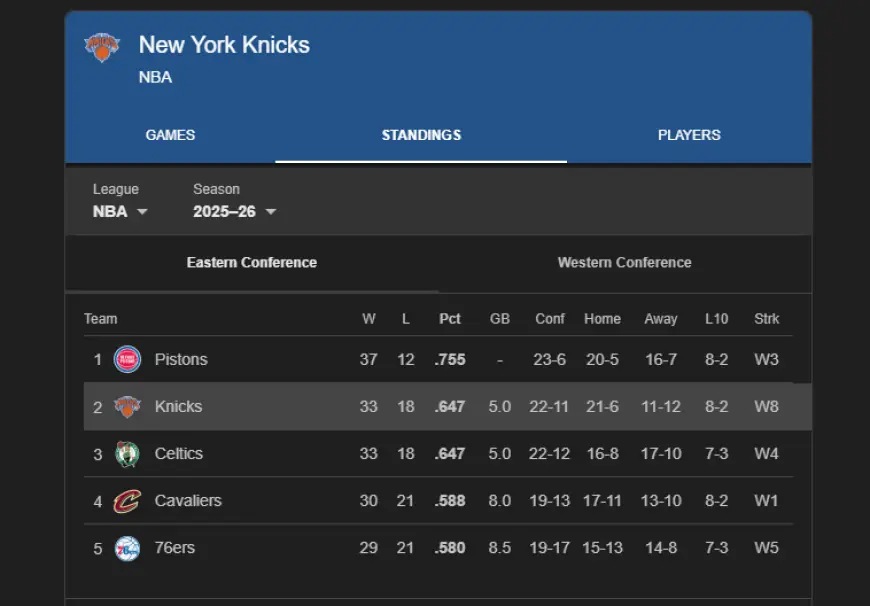
With the double-overtime win, New York improved to 33–18, matching Boston’s record but holding the conference’s No. 2 spot on tiebreak positioning at the end of the night.
Here’s the East’s top tier after Wednesday’s results:
| Eastern Conference (top 3) | Record |
|---|---|
| Detroit | 37–12 |
| New York | 33–18 |
| Boston | 33–18 |
It’s a notable checkpoint because it comes without a soft landing: this wasn’t a routine February win. It was a high-leverage, two-overtime grind against a West contender, the kind of game that tends to reveal whether a team can execute under playoff-style pressure.
Brunson–Murray duel turns into a classic
The headline duel delivered. Brunson controlled pace and spacing, getting to his spots late when defenses tighten. Jamal Murray answered with shot-making that kept Denver alive through regulation and into overtime.
Brunson finished with 42 points, 9 assists, and 8 rebounds, and his defining stretch came in the second overtime, when he scored six straight points to break the game open and then created one more clean look as Denver scrambled to load up on him.
Murray posted 39 points, repeatedly hitting tough pull-ups and off-screen threes that turned several “Knicks have it” moments into “not yet” moments. Denver just couldn’t find one last stop when fatigue and spacing narrowed in the final minutes.
Jokić’s triple-double, and why it didn’t win
Nikola Jokić did Nikola Jokić things: he orchestrated, rebounded, and kept Denver’s offense functional even when possessions got messy. He recorded a 30-point, 14-assist, 10-rebound triple-double, and still walked off in a loss.
The reason wasn’t effort. It was efficiency at the margins. Jokić struggled from deep (1-for-13 on three-pointers), and Denver’s late possessions drifted toward difficult jumpers as New York stayed attached to Murray and lived with contested looks elsewhere.
Over two overtimes, those small misses compound quickly—especially in a building where the home team’s momentum spikes on every stop and every scramble rebound.
The moments that decided two overtimes
This game had multiple endings that didn’t end the game. New York had chances in regulation and again in the first overtime, but Denver kept extending the night with composure and timely shot-making.
What ultimately swung it for the Knicks:
-
Late-game shot quality: Brunson consistently generated something usable—either his own pull-up or a kick-out that forced Denver into rotations.
-
One more make from the wings: New York hit a key corner three in the second overtime when the defense collapsed toward Brunson.
-
Defensive discipline after fatigue: The Knicks tightened their switches and stayed connected to Murray’s creation lanes, forcing Denver into later-clock decisions.
Double overtime often becomes less about schemes and more about who can still execute the simple things—screen angles, rebound positioning, and making the next pass on time. New York did that slightly more consistently when both teams were running on fumes.
What the eight-game streak says about New York now
Eight straight wins is impressive in any month. Doing it while also beating a team led by the reigning standard of offensive control (Jokić) makes it louder.
This streak has been defined by two traits that tend to translate to postseason basketball:
-
A closer who can dictate possessions. Brunson’s late-game comfort is now a nightly expectation, not a surprise.
-
Enough supporting shot-making to punish help. When teams crowd Brunson, New York has options that can swing a game without needing a perfect set.
The standings bump to No. 2 is the reward, but the real value is what it signals: New York is building habits—closeouts, overtime composure, half-court creation—that separate “good regular-season team” from “hard playoff matchup.”
Sources consulted: NBA, Associated Press, ESPN, Reuters