

























Japanese Automakers Bolster Canadian Presence Amid U.S. Ontario Retraction

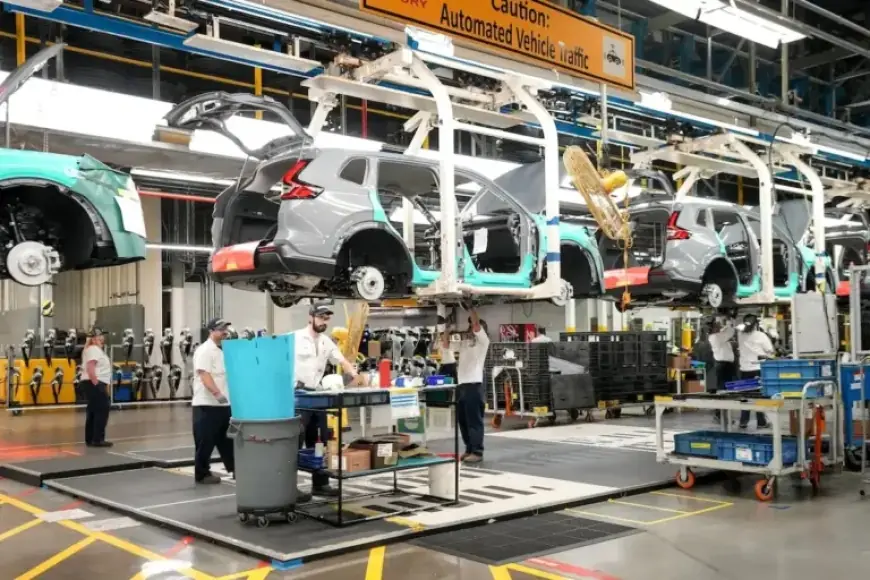
The Canadian automotive industry is experiencing significant shifts as Japanese automakers strengthen their presence amid the retraction of U.S. manufacturers in Ontario. A recent report from the Trillium Network for Advanced Manufacturing underscores the resilience of Japanese brands like Honda and Toyota, even as production from the Detroit Three has declined sharply.
Decline of the Detroit Three
Production in Ontario’s automotive sector dropped from 2.3 million vehicles in 2016 to 1.2 million by 2025. This decrease is largely attributed to reduced output from Ford, General Motors, and Stellantis.
- In 2016, four manufacturers produced over 400,000 vehicles each in Ontario.
- By 2025, only Honda and Toyota are expected to maintain such production levels, together accounting for 77% of the region’s total output.
Assembly plant employment has also taken a hit, falling from 32,700 jobs in 2015 to just 23,700 in 2024. Notably, this statistic excludes job losses linked to tariffs in 2025.
Stability of Japanese Automakers
In contrast to their American counterparts, Honda and Toyota have maintained stable production levels. Their resilience persists despite U.S. President Trump’s 25% tariffs on non-U.S. content of Canadian-made cars, which had a temporary impact during the COVID-19 pandemic.
Brendan Sweeney, managing director of the Trillium Network, notes that Honda and Toyota’s long-term outlook contrasts sharply with the U.S. manufacturers’ focus on short-term profits. Japanese companies maintain a broader perspective on how their plants fit within their global operations.
Honda and Toyota Operations in Ontario
Honda produces the Civic and CR-V at its Alliston facility, while Toyota manufactures the RAV-4 hybrid and Lexus RX at its plants in Cambridge and Woodstock. The stability of these operations stands in stark contrast to the significant cutbacks seen among U.S. automakers.
- Ford’s Oakville factory has been idled for retooling since 2024.
- Stellantis has suspended work at its Brampton plant.
- GM closed its BrightDrop facility in Ingersoll, eliminating 1,150 jobs.
- Recently, GM cut 700 jobs at its Oshawa Silverado factory.
Future Challenges and Opportunities
Amid uncertainty, the Canadian auto sector’s future depends on key upcoming events. These include the release of the federal government’s new auto strategy in February and a review of the U.S.-Mexico-Canada trade agreement slated for July.
Sweeney remains hopeful that the U.S. administration will reassess its tariff approach, especially given the rising costs American automakers currently face.
Potential Strategies for the Canadian Auto Sector
The report from the Trillium Network recommends various strategies to bolster the Canadian auto industry, including:
- Incentives for automakers producing cars or components in Canada.
- Tariff breaks or remissions for compliant manufacturers.
- Consumer rebates for Canadian-made vehicles.
- Encouraging better utilization of Canadian technology and talent.
Implementing these strategies could revitalize Canada’s automotive sector, attracting investment and enhancing the long-term sustainability of local manufacturing.