






















Wordle Hints Answer: Puzzle #1688 “SPINY” lands as a change looms

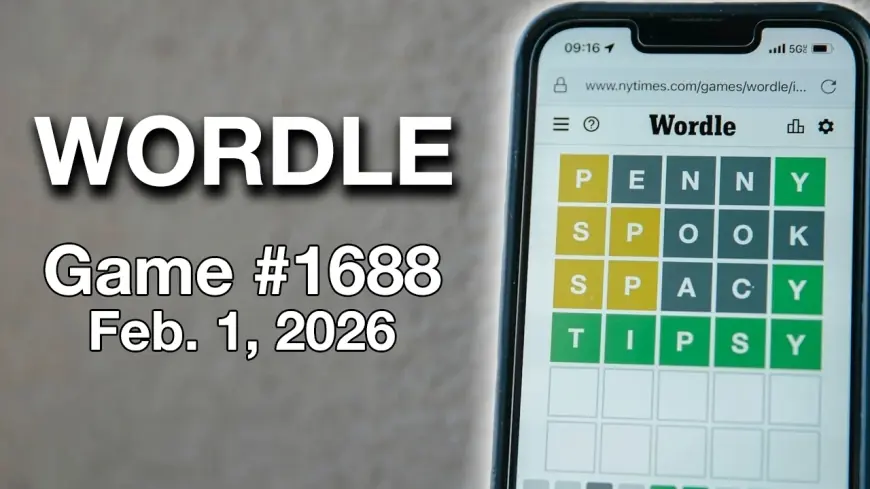
Sunday’s Wordle Hints Answer focused on a deceptively simple five-letter adjective—“SPINY”—as players compared solve paths and debated an upcoming rules shift that could alter long-standing strategies. The February 1, 2026 puzzle (#1688) leaned on a tight letter set (one standard vowel plus a “Y”) that punished vowel-heavy openers and rewarded balanced starts.
Across recent coverage and community chatter, two threads stood out: the day’s word itself—prickly in both meaning and letter distribution—and the timing, with a announced update set to begin Monday, February 2, 2026, that will start mixing previously used solutions back into the pool.
Wordle Hints Answer for Feb. 1
“SPINY” is straightforward once it clicks, but the grid often narrows slowly because the word’s consonant cluster can produce many near-misses early. Players who began with common, vowel-rich openers frequently learned little beyond the initial “S” (if they used it) and had to pivot quickly to hunt consonants.
The word’s structure also explains why so many guesses tend to circle around similar patterns. With “Y” operating as a vowel-like ending, solvers who delay testing “Y” can burn attempts on plausible but unhelpful alternatives. Meanwhile, the “P” and “N” are common enough to appear in many candidates, but not always in the right alignment, creating that familiar Wordle feeling of being close but not converging.
Snapshot: Puzzle #1688 details (ET)
| Item | Detail |
|---|---|
| Date (ET) | February 1, 2026 |
| Puzzle number | 1688 |
| Solution | SPINY |
| Letter notes | No repeats; one standard vowel (“I”) plus “Y” |
| Definition cue | Prickly; covered in spines |
Why “SPINY” played trickier than it looks
The difficulty wasn’t obscurity—it was constraint. “SPINY” has five unique letters and only one standard vowel, which reduces the usual early-game signal that comes from testing multiple vowels at once. That makes the best mid-game move less about chasing more vowels and more about anchoring consonants in place.
It also nudges players toward a specific tactical fork:
-
If early guesses confirm “S” and “Y” (or hint at an “-Y” ending), it becomes efficient to test consonant-heavy words that still include “I.”
-
If “I” is unconfirmed, testing “I” quickly prevents wasting turns on “-Y” endings that don’t fit the vowel requirement.
The practical takeaway from today’s grid is that “Y” is no longer optional in many solve paths—especially when the puzzle seems stingy with vowels.
A major shift starts Monday, Feb. 2
Beginning Monday, February 2, 2026 (ET), Wordle is set to begin reintroducing previously used solutions into the daily rotation. That change directly touches one of the game’s most-cited “rules”: that solutions never repeat.
The impact is bigger than trivia. A sizeable number of dedicated solvers have treated the historical answer list as a strategic guardrail—either by avoiding past solutions in their guesses or by using the “no repeats” assumption to eliminate possibilities late in the game. Once repeats return, that entire elimination layer weakens, and the best play becomes more classical Wordle: work the grid, not the archive.
What repeating solutions changes for strategy
If repeats become part of the pool, players can expect three immediate effects:
-
Archive-based elimination fades. You can’t safely strike a word just because it was an answer years ago.
-
Starter-word orthodoxy may loosen. Some players will feel freer to use historically “burned” words as openers, since the stigma of “it can’t be the answer” disappears.
-
Endgame ambiguity increases. In late turns, when multiple candidates remain, the historical list used to act like a tiebreaker. That tiebreaker won’t reliably exist.
None of this makes the game harder by default—but it does make it less predictable, especially for veterans who built habits around the old constraint.
What to watch in the next week
The first week after February 2 will be a real-world test of how frequently repeats appear and how far back the pool reaches. If repeats are rare, the psychological shift may outweigh the practical one. If repeats show up quickly, expect visible changes in how people approach early guesses and how they discuss “fairness” between casual and highly optimized play styles.
For now, February 1’s “SPINY” is a fitting hinge point: a compact word that rewards flexible thinking—right as the game itself prepares to make flexibility more important.
Sources consulted: The New York Times; Forbes; TechRadar; Tom’s Guide