

























Europa League play off draw sets Forest–Fenerbahce, Celtic–Stuttgart ties

The Europa League play off draw on Friday, Jan. 30, 2026, produced a February slate that mixes brand names with tricky travel and contrasting styles, headlined by Nottingham Forest facing Fenerbahce and Celtic meeting VfB Stuttgart. The two-legged knockout round play-offs decide the final eight places in the round of 16, where the league-phase top eight are waiting.
The draw was held in Nyon at 7:00 a.m. ET, with first legs scheduled for Thursday, Feb. 19, and second legs on Thursday, Feb. 26. The seeded teams (those finishing 9th–16th in the league phase) play the second leg at home.
Europa League play off draw: eight ties set for February
The full set of knockout round play-off matchups is: Genk vs Dinamo Zagreb; Bologna vs Brann; Stuttgart vs Celtic; Ferencváros vs Ludogorets; Nottingham Forest vs Fenerbahce; Viktoria Plzen vs Panathinaikos; Red Star Belgrade vs Lille; Celta Vigo vs PAOK. With no country protection at this stage, the bracket is built purely from seeding bands, and the “return leg at home” advantage goes to the higher-ranked side from the league phase.
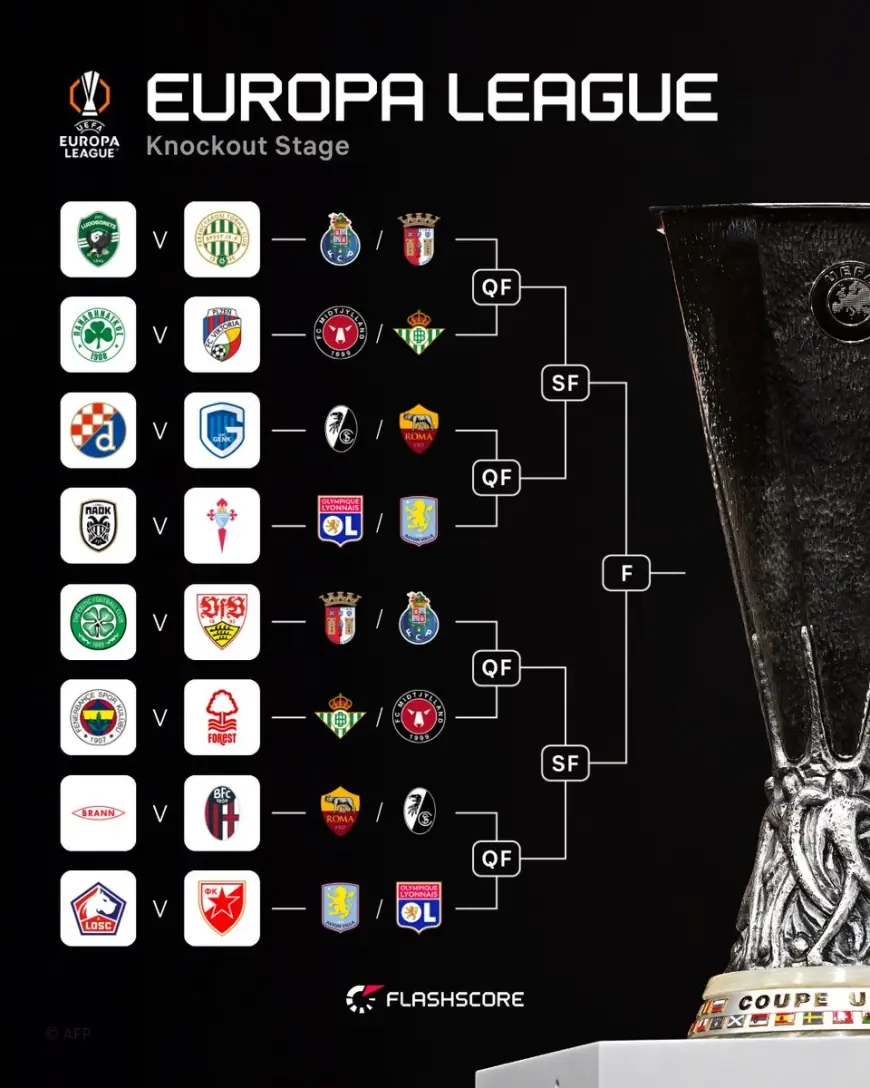
One immediate consequence is that several clubs that entered the competition with round-of-16 expectations now have a high-variance, two-game sprint where a single poor half can swing the entire European season.
The headline ties and why they matter
Nottingham Forest vs Fenerbahce stands out as a heavy-hitters clash that feels more like a later-round pairing. Forest’s path is complicated by the atmosphere typically generated in Istanbul for European nights, while Fenerbahce must navigate a decisive second leg away from home.
Celtic vs Stuttgart pairs a high-tempo Scottish home environment with a Bundesliga opponent that tends to punish defensive lapses in transition. With Stuttgart hosting the second leg, Celtic’s first match becomes even more pivotal for setting the tone and the aggregate margin.
Elsewhere, Lille’s draw with Red Star Belgrade brings a classic contrast: a French side often comfortable in structured away plans versus a Belgrade home crowd that can tilt momentum quickly. Celta Vigo vs PAOK has similar “fine margins” energy, with both sides capable of turning matches on set pieces and pressure spells.
Seeding edge and the second-leg factor
The format subtly rewards league-phase performance: seeded clubs not only avoid each other in this round, they also get the second leg at home. That matters for game-state management—especially if the first leg ends tight—because the return match often becomes a tactical tug-of-war between protecting a lead and chasing one.
It also affects travel and preparation. Clubs playing away first can approach the opening leg with a more conservative plan, knowing they’ll have home backing to finish the job. The flip side is pressure: seeded teams are expected to advance, and an early stumble in the first leg can turn the second into a tense night.
What to watch in the February legs
Expect matchup-specific chess:
-
In Forest–Fenerbahce, the midfield battle and discipline against quick counters could determine whether the tie becomes stretched or stays cagey.
-
In Celtic–Stuttgart, the early phases of each leg—first 15 minutes, especially—may be decisive as both sides look to impose tempo and force mistakes.
-
In Genk–Dinamo Zagreb and Ferencváros–Ludogorets, small advantages like set-piece delivery, card management, and late substitutions often decide ties that are otherwise even.
Key takeaways
-
Two-legged play-offs run Feb. 19 and Feb. 26, with seeded teams hosting the second leg.
-
Forest–Fenerbahce and Celtic–Stuttgart are the marquee pairings.
-
The next major date is the round-of-16 draw on Friday, Feb. 27, 2026.
The road ahead to the round of 16
The eight winners advance to the round of 16, where the league-phase top eight are already through and will be paired with play-off survivors in the next draw. For clubs still alive, the next month becomes a tight squeeze of domestic priorities, squad rotation decisions, and travel planning—especially for teams balancing top-four pushes or title races at home.
From here, the Europa League usually turns on depth as much as star power: the sides that can keep intensity across both legs—while limiting injuries and suspensions—tend to be the ones still standing when March arrives.
Sources consulted: UEFA, Reuters, Sky Sports, Flashscore, The Guardian