
























Bruce Springsteen’s “Streets of Minneapolis” Ignites a New Flashpoint in the Minnesota Immigration Crackdown Debate

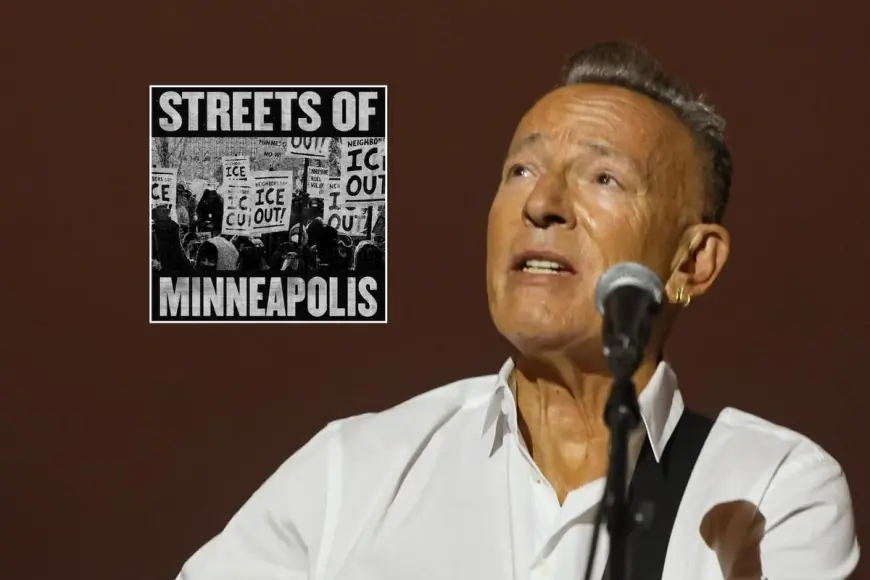
Bruce Springsteen has dropped a surprise protest track titled “Streets of Minneapolis,” a rapid-response song that lands right in the middle of a volatile political moment: federal immigration enforcement surging in Minnesota, public protests expanding, and grief hardening into demands for accountability. The release has quickly spilled beyond music talk, becoming a cultural accelerant for a fight already defined by competing narratives, raw footage, and pressure on officials to either defend tactics or change them.
The timing is the message. Springsteen didn’t wait for investigations to conclude or for Washington to settle on talking points. He released a track while emotions are still live, before the story calcifies into a single “official” version. That choice turns the song into something closer to a civic intervention than a normal single.
What Happened: A Song as Immediate Commentary, Not a Retrospective
“Streets of Minneapolis” frames Minneapolis as a city caught between winter hardship and institutional force, with the daily texture of fear and disruption placed front and center. The song’s emotional core tracks the human cost of enforcement-driven confrontation: families and neighborhoods shaken, protests escalating, and a sense that the rules of public space have changed.
The title itself does extra work. It positions Minneapolis as a national symbol, not just a local headline—suggesting a city standing in for broader questions about power, rights, and what “security” means when it arrives with visible coercion.
Context: Why Minneapolis Became the Stage for a National Argument
Minneapolis didn’t become a flashpoint by accident. It sits at the intersection of three forces:
-
A federal enforcement push meant to demonstrate toughness and capacity
-
Local political resistance that turns routine operations into public conflict
-
A protest environment where encounters are documented, amplified, and rapidly politicized
When those forces collide, small operational choices—where agents stage, how arrests are conducted, how officials speak about residents—become high-stakes signals. In that environment, a protest song isn’t “just art.” It’s another actor entering the arena.
What’s Behind the Headline: Incentives and Pressure Points
Springsteen’s incentive is narrative timing. Protest art is most effective when the story is still forming—when people are still deciding what to believe, which facts matter most, and what kind of response feels morally acceptable.
Government incentives run in the opposite direction: control the frame, narrow the debate, emphasize order. For officials, the risk is that a widely shared song can lock in a public perception that is hard to reverse—even if later findings complicate the early picture.
Protest organizers and community advocates have a clear incentive too: sustain attention. Movements often struggle to keep national focus once the daily news cycle shifts. A high-profile cultural moment can extend the runway for pressure campaigns, fundraising, and turnout.
Stakeholders: Who Gains, Who Loses, Who Has Leverage
-
Immigrant communities and their allies gain a megaphone that reaches beyond policy circles.
-
Federal agencies and political leadership face heightened reputational exposure: tactics become identity, not just procedure.
-
Local officials are pulled between public safety optics, community trust, and federal pressure.
-
Frontline agents become lightning rods—sometimes unfairly—because individual encounters are treated as proof of systemic intent.
-
The broader public becomes a stakeholder through polarization: people interpret the same images and stories through radically different moral lenses.
What We Still Don’t Know: The Missing Pieces That Decide What This Becomes
Even with intense public attention, the most important elements of the story remain unsettled:
-
The full factual record around recent violent incidents tied to protests and enforcement activity
-
Whether any misconduct findings, disciplinary outcomes, or policy revisions are coming—and on what timeline
-
Whether leadership changes represent real operational reform or simply a shift in optics and messaging
-
How local cooperation (or refusal) will change the scale and style of future enforcement actions
These missing pieces matter because a protest song can define the emotional truth of a moment, but it can’t answer the procedural questions that ultimately determine policy outcomes.
Second-Order Effects: How a Song Can Change Real-World Behavior
Cultural interventions can reshape incentives fast:
-
More scrutiny on enforcement tactics as video, testimony, and documentation efforts expand
-
Harder partisan sorting where the song becomes a litmus test rather than an invitation to reflect
-
Pressure for “safer optics” instead of safer practices, pushing officials to change what looks bad without addressing underlying harms
-
Copycat cultural responses from other artists, escalating the story’s visibility and raising the political cost of inaction
The risk for everyone is escalation by interpretation: a song inspires protests, protests create more encounters, more encounters produce more incidents, and the cycle deepens.
What Happens Next: Realistic Scenarios and Triggers
-
The song becomes a rally staple if protests remain sustained and organizers adopt it as a shared soundtrack. Trigger: continued demonstrations and visible confrontation.
-
Official backlash intensifies if political leaders treat the song as misinformation or provocation. Trigger: sharper rhetoric and defensive messaging.
-
Operational tweaks without policy change if leadership tries to lower visible conflict while keeping the same enforcement goals. Trigger: legal scrutiny, public pressure, and reputational risk.
-
A pivot to accountability debates if investigations produce findings that materially challenge early claims from any side. Trigger: formal reports, court actions, or disciplinary decisions.
-
Attention fades if a new national crisis displaces the story—unless another major incident pulls it back. Trigger: news-cycle displacement or renewed flashpoints.
Springsteen’s “Streets of Minneapolis” is landing as more than a song because it targets a moment when institutions are trying to define reality in real time. The practical question now is whether the cultural shock translates into policy change—or simply hardens the camps while the underlying machinery keeps moving.