























Nicki Minaj steps into Washington spotlight with Trump as “Trump Accounts” rollout sparks praise and backlash

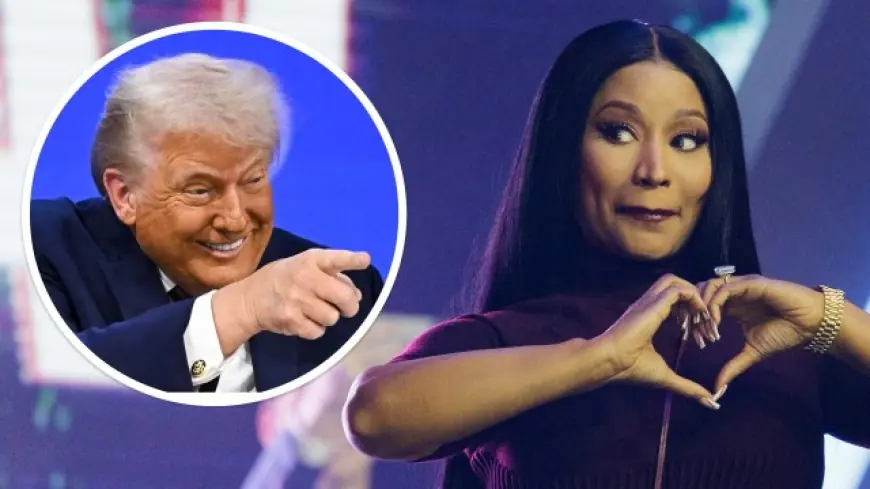
Nicki Minaj moved from chart talk to policy talk in Washington on Wednesday, January 28, 2026, ET, appearing alongside President Donald Trump at an event promoting a new government-backed child investment initiative. The appearance quickly turned into a broader political moment, with Nicki Minaj framing herself as a loyal supporter of the president and pledging a sizable personal contribution meant to fund accounts for children of her fans.
The event placed Nicki Minaj and Trump on the same stage to spotlight what the administration is calling “Trump Accounts,” and it amplified a question that has followed the artist in recent months: whether her public alignment with the White House is a one-off cameo or a sustained shift into political advocacy. Further specifics were not immediately available.
A pop-culture collision with a policy launch
At the Washington rollout, Minaj presented her involvement as a philanthropic step tied to children’s financial futures, not simply a celebrity photo opportunity. She said she intends to contribute between $150,000 and $300,000 to help seed accounts connected to her fan community, a gesture designed to draw attention to the program while signaling that private supporters are expected to play a role.
Her appearance also arrived amid a louder national debate over celebrity politics, where entertainers face immediate backlash for aligning with either party. Minaj leaned into that friction, casting criticism of Trump and criticism of her as a form of bullying and arguing that it only hardens her support rather than softens it.
What Trump Accounts are and how they work
Trump Accounts are structured as custodial investment accounts for minors, designed to start with a government seed deposit for eligible newborns and then allow additional contributions over time. Under the program’s framework, American children born between January 1, 2025, and December 31, 2028, can qualify for a one-time $1,000 federal contribution if an account is opened for them.
The accounts are intended to invest in low-cost, broad U.S. equity index funds, aiming to let compounding do the heavy lifting over 18 years. Families and other contributors can add money annually, with common limits discussed at up to $5,000 per year in total contributions, and separate contribution categories for parents and employers. Access is generally designed to occur when the child reaches adulthood, with rules steering withdrawals toward purposes such as education, starting a business, or purchasing a home.
Mechanically, this works like many long-horizon investment vehicles: the earlier the money is invested, the more time it has to grow, and small contributions can become meaningful if markets cooperate and the account remains intact. It is also why these programs tend to draw both praise and criticism at the same time, because the benefits depend on participation, steady contributions, and a long wait before funds can be used.
Some specifics have not been publicly clarified.
Why Minaj’s pledge is landing as more than a donation
Minaj’s participation is unusual because it ties a pop superstar’s brand directly to a White House initiative with a political name, raising the stakes for both sides. For the administration, the presence of a globally recognized musician signals confidence that the policy can be marketed beyond traditional partisan channels and framed as pro-family, pro-savings, and pro-opportunity. For Minaj, the bet is that philanthropy and visibility can coexist with the reputational risk of being seen as endorsing an entire political agenda rather than a single program.
The reaction has split along predictable fault lines. Supporters argue that a high-profile donation that benefits children is hard to criticize on the merits, regardless of politics. Critics argue that attaching a celebrity spotlight to a branded government program can blur the line between policy and promotion, and that it can distract from concerns about who benefits most when a program relies on optional private contributions.
Who is affected and what to watch next
The most directly affected groups are parents and guardians deciding whether to open accounts and contribute over time, and lower-income families who may benefit from the seed deposit but struggle to add money consistently. A second set of stakeholders includes employers and philanthropic donors, who may use contributions as a benefits tool or a public-facing pledge. Financial firms that manage the investments also stand to gain long-term account relationships, while critics and watchdog groups will scrutinize fees, access rules, and whether the program widens gaps between families who can contribute and those who cannot.
In the weeks ahead, the program’s practical test will be participation and clarity. Enrollment is expected to open in July 2026, with contributions slated to begin on July 4, 2026, and the next verifiable milestone will be the release of formal administrative guidance and the first public enrollment data once signups begin.