























Doomsday Clock 2026 moves to 85 seconds to midnight as global risks stack up

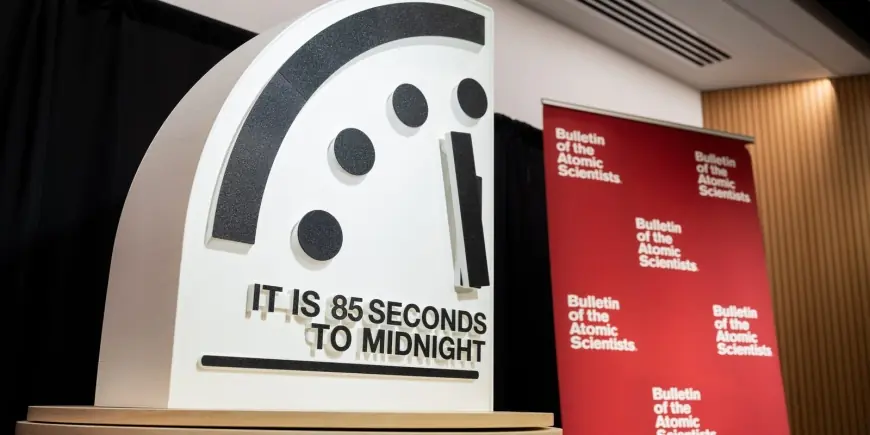
The doomsday clock was set closer to midnight for 2026, tightening to 85 seconds to midnight after a new assessment of the world’s biggest man-made threats. The change, announced Tuesday, January 27, 2026, ET, marks the closest setting in the clock’s history and reflects a view that nuclear danger, climate disruption, biological risks, and fast-moving technologies are compounding rather than easing.
The move also answers a question many people have been typing this week: yes, this is a clock with seconds now. In ordinary time terms, 85 seconds to midnight corresponds to 11:58:35 p.m. on a conventional clock face, though the point is symbolic, not a literal countdown.
Why the Doomsday Clock moved in 2026
The group that sets the Doomsday Clock pointed to a worsening global security environment and weakening international cooperation as core reasons for the shift. The 2026 statement emphasized rising great-power rivalry and a more adversarial posture among major states at the same time the world faces overlapping hazards that require coordination to reduce.
Nuclear risk remained central. The board cited mounting tensions among nuclear-armed states, continued war-related escalation fears, and broader modernization efforts that can fuel arms racing and miscalculation. It also underscored concerns about the erosion of arms-control structures and the difficulty of rebuilding trust once verification and dialogue break down.
Climate change and biological threats were also part of the rationale, framed as persistent, global-scale dangers that magnify instability and strain governance. Alongside them, disruptive technologies—especially artificial intelligence—were flagged as a rapidly evolving accelerator of risk, including through misinformation, decision-speed pressures, and the militarization of emerging tools.
Further specifics were not immediately available about how much weight each category carried relative to the others.
What the seconds mean, and what they do not mean
Two clarifications matter when interpreting doomsday clock 2026.
First, the clock is a metaphor. It does not predict a specific date for catastrophe, and it does not claim that disaster will happen when the hands reach midnight.
Second, the setters do not publish a mathematical formula that converts each threat into seconds. The number is a judgment meant to convey urgency and trend direction, especially now that the clock is so close to midnight that “minutes” would be too blunt to communicate small but meaningful shifts.
This is also why the change from last year is measured in seconds: 2026’s 85 seconds is four seconds closer than the 2025 setting of 89 seconds, signaling the group’s view that risk has intensified rather than stabilized.
How the Doomsday Clock is set each year
The Doomsday Clock is maintained by the Bulletin of the Atomic Scientists and is reset annually by its Science and Security Board in consultation with a Board of Sponsors that includes Nobel laureates. Created in 1947 in the shadow of the first nuclear weapons, it began as a warning about nuclear arms racing and has expanded over time to reflect additional existential dangers, including climate change and disruptive technologies.
The process is less like a lab instrument and more like a structured expert assessment. The board reviews major developments across its core risk areas, evaluates how those developments affect the likelihood of large-scale human-caused catastrophe, and then sets the clock to communicate whether the world is moving closer to or farther from midnight.
What changes for leaders, industries, and the public
The impact of this year’s shift lands differently across groups.
For policymakers and diplomats, the clock’s move adds pressure to show tangible steps on arms control, crisis communication, and guardrails that reduce the chance of accidental escalation. For technology companies, AI researchers, and regulators, it reinforces the push for safety standards, transparency norms, and limits on dangerous uses—especially where speed, autonomy, and misinformation intersect. For climate and public health agencies, the message is that slow progress and fragmented cooperation are themselves risk multipliers.
For the public, the practical takeaway is not to treat the clock as a doom forecast, but as a signal about how experts view the direction of travel. It is meant to sharpen attention on prevention: reducing nuclear danger, accelerating emissions cuts, strengthening biosecurity, and setting enforceable rules for powerful new technologies.
The next milestones to watch in 2026 and beyond
In the near term, one major deadline looming over nuclear risk is the scheduled expiration of the New START treaty on February 5, 2026, which—if not replaced or effectively extended—would leave the United States and Russia without the same legally binding limits that have constrained deployed strategic forces for years.
Looking farther ahead, the next formal milestone for the Doomsday Clock itself is the organization’s next annual setting in January 2027, when it will again assess whether leaders have taken measurable steps to pull the world back from midnight—or whether the seconds will tighten again.