Naomi Osaka channels Australian Open flashpoint into a third-round reset, with Maddison Inglis next and pressure rising

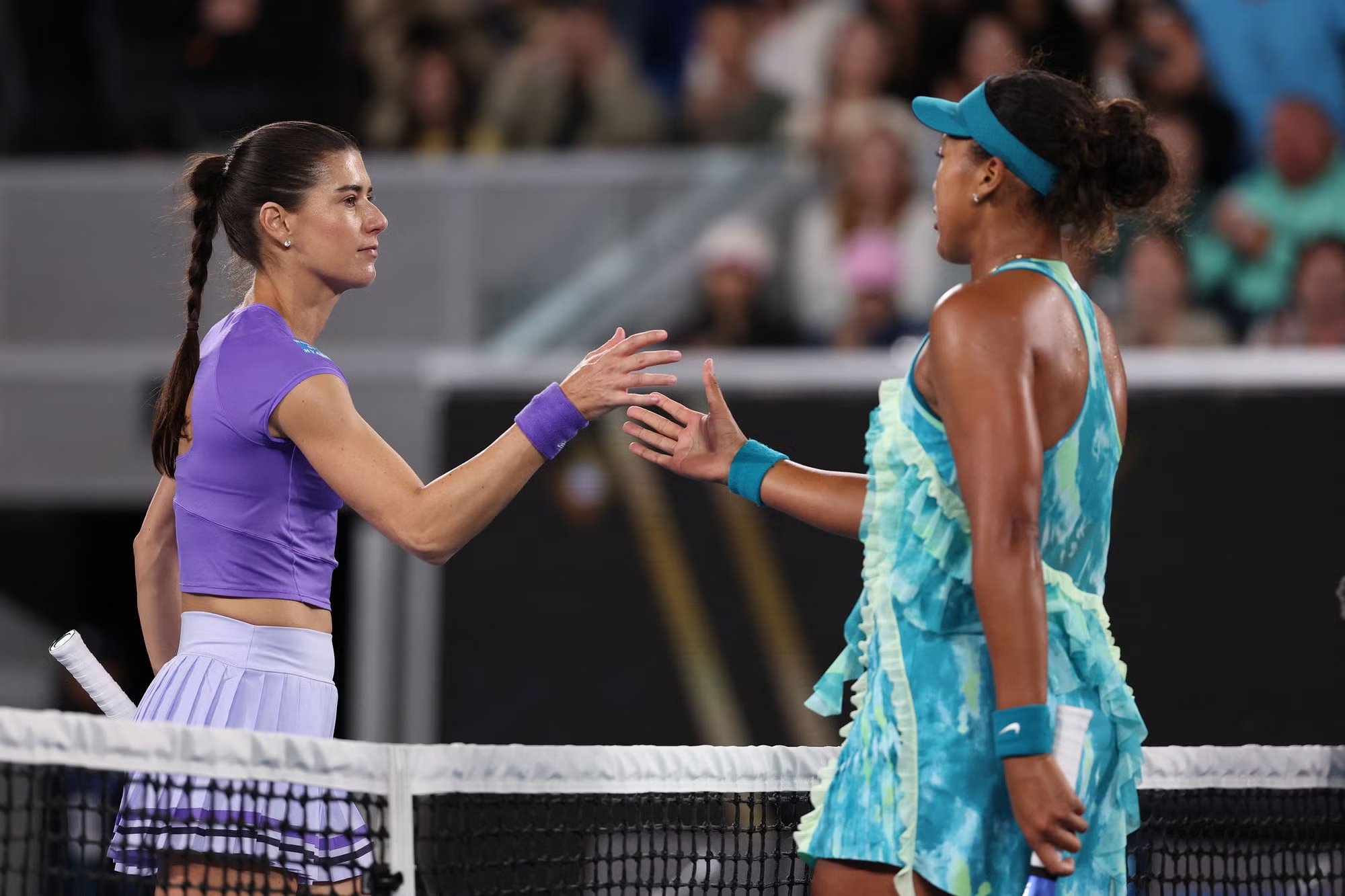
Naomi Osaka’s Australian Open story tightened into one of the tournament’s most scrutinized arcs on Thursday in Melbourne: a three-set win that confirmed her improving match toughness, followed by a tense on-court exchange that instantly became part of the narrative around her comeback. The tennis itself was loud enough—6-3, 4-6, 6-2 over Sorana Cîrstea—but the moment after the final point pulled attention toward tone, composure, and how elite players manage emotion when the margins get sharp.
Osaka responded quickly with an apology that reframed the incident as heat-of-the-moment friction rather than a lasting feud. That matters because her next test, against Australian qualifier Maddison Inglis, brings a different kind of volatility: a home crowd, a player with nothing to lose, and Osaka’s own workload after yet another early-round three-setter.
Naomi Osaka’s match: early wobble, late control, and a message about resilience
The match revealed two versions of Osaka in the same evening. The first was slightly rushed—patches of loose errors and disrupted rhythm. The second was the version that wins majors: decisive patterns, clearer targets, and a third-set surge that separated the contest. A brief medical timeout in the decider underscored that this wasn’t a comfortable cruise, yet her finishing stretch suggested she can still raise her level when the match demands a higher gear.
Just as telling: this is now a pattern in her opening week. Osaka has won two matches, both in three sets, and both required a mid-match recalibration rather than a straight-line performance. That is a positive sign for competitive stamina, but it also signals a risk: repeated detours in early rounds can tax recovery and narrow the buffer later in the fortnight.
Comparative snapshot: Osaka’s first two rounds at AO 2026
| Round | Opponent | Score | Match shape | What it signals |
|---|---|---|---|---|
| Round 1 | Antonia Ružić | 6-3, 3-6, 6-4 | Controlled start, dip, tight finish | Still building slam-week steadiness |
| Round 2 | Sorana Cîrstea | 6-3, 4-6, 6-2 | Wobble in Set 2, clear separation in Set 3 | Ability to reset and close with authority |
Naomi Osaka vs Maddison Inglis: the matchup that changes with the crowd
Inglis arrives with genuine momentum after a high-energy upset that carried her into the third round. The dynamic is obvious: Osaka owns the heavier baseline weapons and the bigger first-strike potential; Inglis can weaponize rhythm, crowd lift, and the freedom of a home underdog.
Expected tactical “lineups” (how each player is likely to set up points):
-
Osaka’s likely plan: First-serve percentage as the foundation, early forehand commitment, shorter points, and disciplined return positioning to avoid getting pulled into scrappy exchanges that energize the crowd.
-
Inglis’ likely plan: Extend rallies, vary pace and height to draw errors, use early holds to build belief, and lean into the atmosphere to turn close games into pressure moments for Osaka.
Scheduled time (subject to change): Friday evening in North America typically translates to around 7:00 PM ET (US/Canada) and 12:00 AM UK time heading into Saturday.
Who feels the ripple: US/UK/CA/AU stakes around Osaka’s moment
-
Australia: A local favorite facing a global star is peak-ticket energy. Organizers and broadcasters benefit from a crowd-forward storyline that can tilt a routine matchup into must-watch theater.
-
United States & Canada (ET): The time slot makes this a prime “night sports” window. For Osaka, that’s also her biggest commercial audience—meaning every on-court clip, good or bad, travels fast.
-
United Kingdom: Midnight-start viewing often compresses context into highlights. That raises the value of a clean performance: a straight-sets win plays as a reset; another three-set grind plays as instability.
What’s next for Naomi Osaka: a performance-based reset, not a statement
Osaka’s fastest path back to week-two contention is simple: reduce the emotional and physical tax of the early rounds. That means fewer lapses in the second set, fewer stretches where unforced errors arrive in clusters, and a calmer tempo between points—especially in an environment where the crowd can turn small moments into momentum swings.
If she clears Inglis efficiently, the broader signal strengthens: Osaka isn’t just surviving; she’s trending toward controlling matches again. The apology after the Cîrstea exchange can function as a pressure release—close the loop, move on, and let the tennis speak. But if the match becomes noisy—tight games, long rallies, crowd crescendos—Osaka’s real test will be whether she can stay tactically patient without letting adrenaline speed up her decision-making.
The tournament’s next milestone for her isn’t a particular opponent; it’s a style of win. One where she protects her body, limits drama, and finishes with the quiet inevitability that used to define her best slam runs.