























Record Solar Radiation Storm Hits Earth: Implications Explained

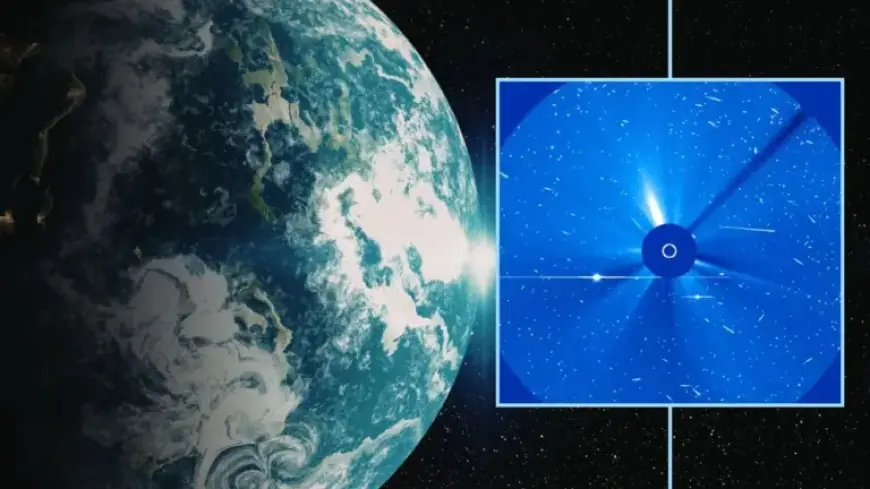
The Earth recently experienced a significant solar radiation storm, making headlines for its remarkable intensity. On January 19, the event marked the strongest solar radiation storm since October 2003, according to the National Oceanic and Atmospheric Administration (NOAA) Space Weather Prediction Center. The storm surpassed the levels of the infamous “Halloween” storms from 2003.
Understanding Solar Radiation Storms
Solar radiation storms are generated by powerful magnetic eruptions, commonly known as coronal mass ejections (CMEs). These phenomena release charged particles, primarily protons, which can achieve speeds nearing that of light. The particles can travel the approximately 93 million miles (or 150 million kilometers) from the Sun to Earth in minutes.
Classification and Severity
NOAA classifies solar radiation storms on a scale from S1 (minor) to S5 (extreme). The storm on January 19 was rated as S4, indicating a severe level of radiation. Despite its intensity, this event was not a ground-level occurrence. The energetic protons did not penetrate deep enough to be detected on the Earth’s surface thanks to our planet’s robust atmosphere and magnetic field.
- S1: Minor
- S2: Moderate
- S3: Strong
- S4: Severe
- S5: Extreme
Impact on Earth and Space Operations
While solar radiation storms do not pose a direct threat to people on the ground, they can affect astronauts, airline crews, and passengers flying over polar regions, where the Earth’s magnetic shielding is less effective. During this event, space weather forecasters noted some temporary data dropouts in satellite measurements, likely due to the intense flux of protons interfering with onboard electronics.
Differences between Solar Radiation and Geomagnetic Storms
It is essential to differentiate solar radiation storms from geomagnetic storms. Solar radiation storms result from fast-moving particles emitted by the Sun. In contrast, geomagnetic storms are instigated when disturbances in the solar wind impact the Earth’s magnetic field. These interactions can lead to auroras and may cause disruptions in navigation systems, radio communications, and power grids.
Conclusion
The January 19 solar radiation storm serves as a reminder of the dynamic and often unpredictable nature of space weather. Continued monitoring and research by organizations like NOAA are crucial for understanding these phenomena and mitigating their impacts on technology and human activities.