

























Massive Solar Flare Erupts, CME Approaches Earth with 24-Hour Impact Window

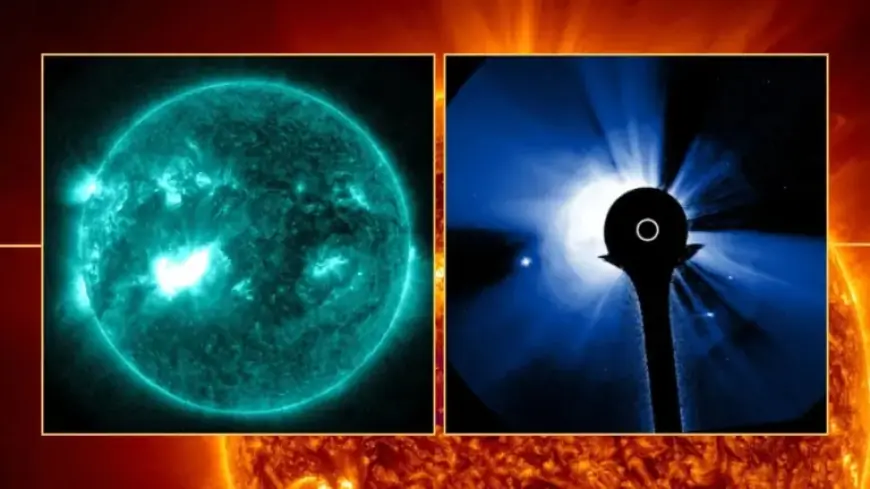
The Sun has shown impressive activity this week, unleashing a significant X-class solar flare. This event is accompanied by a coronal mass ejection (CME) projected to impact Earth within a 24-hour timeframe. As space weather experts monitor the developments, the forecast indicates a potential for geomagnetic storms of varying intensity.
Solar Flare and CME Overview
On January 18, an X1.9 solar flare emerged from sunspot region AR4341. This flare was noted at 1:09 p.m. EST (1809 GMT) and is classified as a strong event on the solar flare scale, which ranges from A to X. The intensity escalates tenfold with each letter category, marking X-class flares as the most powerful.
Alongside the flare, a CME has been forecasted to hit Earth’s magnetosphere, with predictions suggesting a range of geomagnetic storm conditions. The U.K. Met Office’s current analysis estimates the potential for strong (G3) to severe (G4) geomagnetic storms, depending on the CME’s magnetic orientation.
The Impact of CME on Earth
- If the CME arrives with a southward-oriented magnetic field, it can trigger significant geomagnetic storm conditions.
- A northward orientation would result in less interaction, limiting the event’s effects.
- Mixed magnetic orientations can produce fluctuating geomagnetic activity.
Conditions for visibility of auroras could extend much farther south than typical, reaching areas like Northern California and Alabama if severe storms develop. Space weather forecasters are currently analyzing data from monitoring spacecraft, including DSCOVR and ACE, for precise CME tracking.
Consequences of Geomagnetic Storms
Geomagnetic storms can disrupt technologies, including satellite operations and GPS systems. The intensity of these storms is classified on a scale that ranges from G1 to G5, with the potential for G3 and G4 storms possibly causing:
- Increased atmospheric drag on satellites.
- Strong radio blackouts, especially over the Americas.
- Enhanced auroral displays visible at lower latitudes.
As the impact window approaches, space weather observers remain on high alert for the CME’s arrival and its potential interactions with Earth’s magnetic field. Such activity underscores the need for ongoing monitoring and research into solar phenomena.