Reimagining Time: Transforming Past and Future into a Line

Our understanding of time has evolved significantly, particularly since the 18th century, with profound implications for philosophy, science, and culture. The conception of time as a linear progression has become dominant in Western thought, fundamentally altering how we perceive history and the possibility of time travel.
Historical Perspectives on Time
In ancient Greece, philosophers like Plato linked time to celestial movements. According to Plato’s creation myth in Timaeus, the universe’s cycles are intertwined with the movements of stars, defining days, months, and years. This cyclical view persisted, especially with Stoics, who embraced the concept of Eternal Recurrence — an endless cycle of creation and destruction.
- Plato’s connection of time to celestial bodies.
- Stoics’ belief in Eternal Recurrence.
- Biblical references suggesting both cyclical and linear concepts of time.
Historians like Stephen Jay Gould have noted that both cyclical and linear interpretations of time coexisted for centuries. However, the linear representation, where time is visualized as an unbroken line, became more widespread beginning in the 18th century.
Key Developments in Representing Time
Several critical innovations contributed to the linear conception of time:
1. The Birth of Timelines
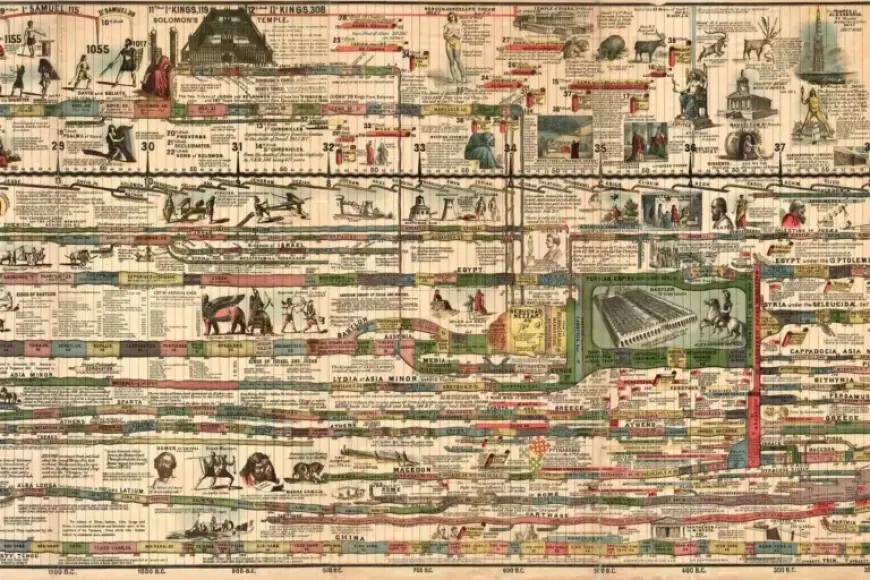
The timeline, a linear representation of historical events, emerged prominently in the 18th century. Joseph Priestley’s 1765 “Chart of Biography” is regarded as a pivotal creation in this transformation, graphically displaying the passage of time from ancient to contemporary figures.
2. The Impact of Darwinian Theory
Charles Darwin’s work shifted perceptions of evolution from cyclical to linear. His diagrams illustrated a clear progression of species over time, reinforcing the idea of a linear trajectory of evolution.
3. The Rise of Chronophotography
In the 1870s, chronophotography emerged, capturing motion in a linear sequence across images. This visual medium further supported the notion of time as a dimension represented by lines.
4. The Concept of the Fourth Dimension
Mathematically, the theorization of the fourth dimension, popularized by thinkers like Charles Hinton, argued for the identification of time as a spatial dimension, reinforcing the idea of time as a linear entity.
The Cultural Implications of Linear Time
By the late 19th century, the linear model of time had deeply influenced cultural narratives. Concepts of progress became ingrained, reflecting advancements in science and technology. Figures like Joseph Priestley highlighted human improvement over time, linking technological innovations to a narrative of happiness and progress.
- Victorian progress through technology (e.g. railways, telegraphs).
- Darwin’s portrayal of evolution as a linear narrative.
Philosophy began to grapple with the implications of viewing time as a linear progression. Debates emerged around the existence and reality of past and future events, often highlighting the singular importance of the present moment.
Time Travel and Modern Interpretations
The idea of time as a line paved the way for fictional explorations of time travel, significantly influenced by H.G. Wells’ “The Time Machine.” This literary work introduced the concept of navigating through time using the linear framework established by earlier thinkers.
The Ongoing Legacy
Today, timelines are ubiquitous, illustrating everything from technological advancements to historical events. Philosophers continue to explore the nature of time and its implications, examining concepts such as presentism, which asserts that only present entities exist.
As we continue to interpret time and its passage, the nuances of its representation may offer alternative perspectives on human history and our future. Rethinking time could reshape our understanding of progress and existence itself.