Neutron Bombardment Reveals Migdal Effect in Groundbreaking Observation

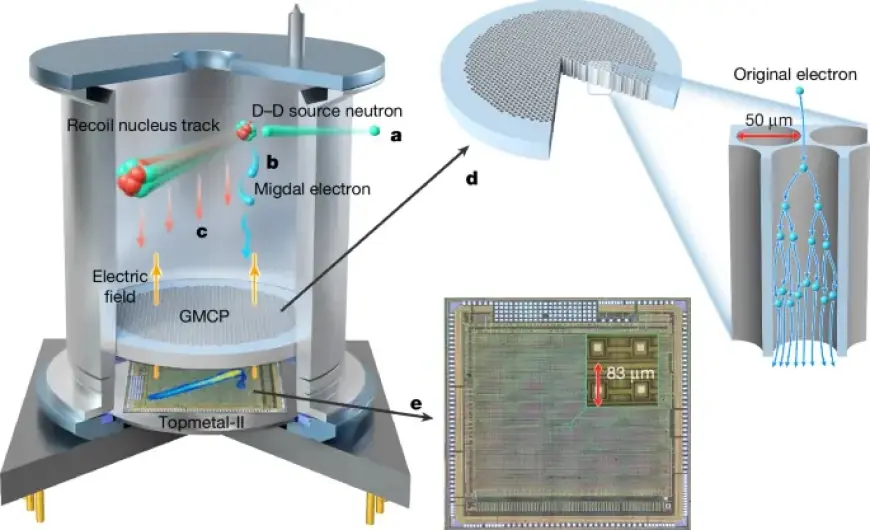
A recent groundbreaking observation has been made regarding the Migdal effect through neutron bombardment. This study investigates the interactions between neutron scattering and nuclei, revealing the significant impact of neutron-induced processes on electron behavior in different gas mixtures.
Understanding the Migdal Effect
The Migdal effect describes how electrons can be ionized when neutrons collide with nuclei. During neutron-nucleus scattering, energy is transferred from the neutron to the electron, causing ionization. The resulting differential cross-section plays a crucial role in understanding this phenomenon.
Experimental Setup
- Neutron Source: A 2.5-MeV D–D neutron beam was employed to induce reactions.
- Detection Threshold: The analysis required an approximately 50 keV nuclear recoil threshold.
- Gas Composition: Carbon (C), Hydrogen (H), and Oxygen (O) were treated as free atoms at the recoil energies.
Calculating the Cross-Sections
The total cross-section for the Migdal effect was derived from integrating the scattering cross-section over allowed energy ranges. The integral formula for the Migdal cross-section includes parameters such as the energy of recoiling nuclei and the emitted electron spectrum, allowing for precise comparisons with elastic scattering cross-section results.
Detector Design
The detector utilized advanced materials such as ceramics and Kovar alloys, ensuring low out-gassing and high mechanical stability. The structure was designed to maintain good gas tightness, which is vital for accurate measurements.
Data Acquisition and Processing
- Layered Electronics: The electronics system is divided into front-end, back-end, and high-voltage boards to manage data effectively.
- Real-Time Processing: Data from the detector is quantified, encoded, and compressed during collection.
Experimental Runs
The experiments were conducted in two phases: the first run took place in March 2024, followed by a second run in July 2024, which included an extra detection unit. Performance was monitored continuously to ensure detector reliability and consistency.
Significant Findings
The analysis returned an integrated theoretical probability of 3.9×10⁻⁵ for detecting the Migdal effect, which aligns closely with the observed result of (4.9-1.9+2.6)×10-5. This concordance highlights the importance of the Migdal effect in dark matter detection experiments.
Conclusion
This research opens new avenues in understanding nuclear interactions and the Migdal effect through neutron bombardment. The findings underscore the significance of neutron scattering in electron dynamics, contributing valuable insights into particle physics and potential applications in dark matter detection.