



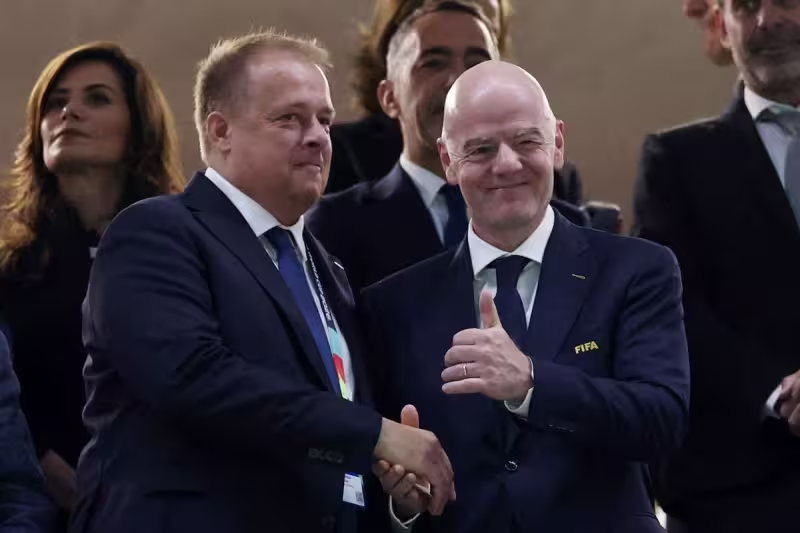
FIFA president Gianni Infantino said Thursday that expanding the World Cup to 64 teams had been presented to the FIFA council and joked that the change might help Italy get back into the tournament.
Infantino, speaking before the opening match of the 2026 World Cup, said: "We have had discussions about expanding to 64 teams... the matter was presented to the FIFA council," and added, "Maybe Italy qualify with 64 teams, or we could even go up to 208 teams." He also warned there is a condition: "We first have to see how this first World Cup with 48 teams goes."

The remark lands with weight because of Italy's recent record: the country failed to qualify for the 2018 World Cup in Russia, the 2022 World Cup in Qatar and the 2026 World Cup in North America. The 2026 tournament is the first edition to feature 48 teams and is hosted across Canada, the United States and Mexico.
Infantino's joke threaded two active debates. One is a concrete proposal being pushed by the South American Football Confederation: CONMEBOL president Alejandro Dominguez is promoting a 64-team plan for the 2030 World Cup, which would mark the centenary of the tournament first held in Uruguay in 1930. The other is an institutional caveat — Infantino pointed to the 2026 expansion to 48 teams as the test before any further enlargement.
The comment also pulled in an immediate public reaction from Italy's sports minister. Andrea Abodi said he was left puzzled by Infantino's quip: "Given that there is a big distance between Italy and Mexico, I'd rather speak to him on the telephone to understand (what he meant)." Abodi's remark underscored how out of step the joke felt to some in Rome: Italy are four-time World Cup winners, not a federation expecting to need a tournament expansion to qualify.


The wider picture is messy. Part of the 2030 event is scheduled to be held in Paraguay, Uruguay and Argentina, while Spain, Portugal and Morocco are listed as the main host nations. Those hosting arrangements and the symbolic weight of the centenary have helped fuel talk of a larger field, and CONMEBOL's push for 64 teams has given the idea an institutional champion.
But the friction here is plain: Infantino can present a 64-team format as a way to include traditional powers such as Italy, yet Italy has missed three straight World Cups under existing qualification systems. The joke invites a simple question about fairness and sporting merit — if expansion becomes the route back to the finals for past champions, what does that say about qualification standards and the competitive logic of the tournament?
Infantino has already framed the timeline around the 48-team experiment. He told colleagues the council had seen the expansion paper, and his public line was that FIFA must "see how this first World Cup with 48 teams goes." That places any decision about jumping to 64 teams — or beyond, to the hyperbolic 208-team number he mentioned — after the governing body evaluates the North American event.
The immediate consequence is administrative: the proposal has been aired at council level and in public, but no decision has been announced. The 2030 World Cup carries its own momentum because of the centenary and the transcontinental host map, and CONMEBOL's campaign ensures the 64-team idea will remain part of council discussions between now and whatever deadline FIFA sets.
The single consequential unanswered question now is straightforward and urgent for federations: will FIFA approve a 64-team World Cup for 2030 — and if so, when will the council make that call? The council has been shown the paper; the rest depends on a timetable and a vote that Infantino has signaled will wait on the 48-team test in 2026.



