

























Massive Star Enters Unstable Phase, Astronomers Anxious About Future Events

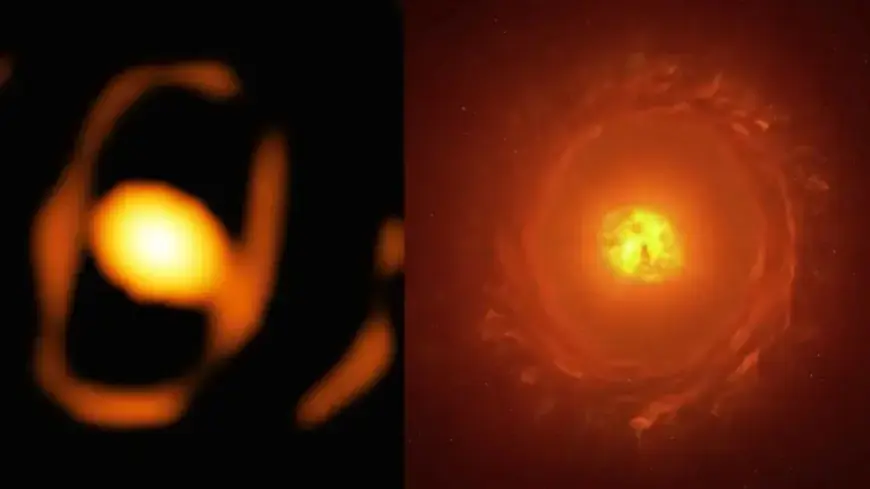
A nearby giant star is changing in ways few expected. Astronomers have recorded dramatic shifts in WOH G64, a supergiant in the Large Magellanic Cloud.
Where the star lives
WOH G64 sits in the Large Magellanic Cloud. That dwarf galaxy lies about 160,000 light-years from Earth.
NASA imagery from the International Space Station has highlighted the host galaxy. The star has long stood out for its enormous size.
Historic measurements and recent imaging
For decades, astronomers estimated WOH G64’s radius near 1,540 times the Sun. Such stars exhaust fuel quickly and shed mass as they age.
In 2024, the European Southern Observatory’s Very Large Telescope Interferometer revealed a thick cocoon of gas and dust around the star.
Unusual variability uncovered
Long-term surveys found an unusually long pulsation period of 886 days. The star dimmed around 2011 and then brightened again in 2013 and 2014.
Spectra and color changed markedly during that recovery. Surface temperature rose by about 1,000 kelvins, shifting the hue toward yellow.
Interpretations offered by researchers
The team that published the results in Nature Astronomy proposed two main scenarios. Neither scenario matches routine stellar behavior.
- One possibility is a binary interaction. A companion star could have stripped outer layers, revealing hotter interior regions.
- The alternative is a long eruption that first coated the star in dust. Later clearing would then reveal a warmer surface.
Why experts remain cautious
Not all astronomers accept the companion interpretation. Some say the evidence for a second star remains limited.
Follow-up spectra have at times shown a return of red-supergiant signatures. That ongoing disagreement makes the object scientifically valuable.
Recent decline and the supernova question
Observers report WOH G64 began fading again in 2025. The decline measured roughly two magnitudes in under a year.
Given the star’s mass, a core-collapse supernova is possible in its future. Predicting the timing of such an event remains very difficult.
As a nearby example, Supernova 1987A in the same galaxy briefly reached magnitude 2.9 for Southern Hemisphere observers.
Broader scientific stakes
WOH G64 may shed light on the long-standing “red supergiant problem.” Astronomers have struggled to link the brightest red supergiants to confirmed supernova progenitors.
Whether the star truly transitioned or merely uncovered itself from dust, both outcomes inform models of mass loss and stellar death.
Plans for continued monitoring
Teams plan continuous surveys, targeted spectroscopy, and further interferometry. These methods can test if the yellow state endures.
Some describe the episode as a Massive Star Enters Unstable Phase observed in real time. Astronomers Anxious About Future Events are organizing follow-up campaigns.
Night sky conditions and public viewing
Tracking faint changes requires dark skies. Citizen science data published in Science showed global night sky brightness rose by about 9.6 percent per year from 2011 to 2022.
The U.S. National Park Service warns that poorly aimed lighting wastes energy and harms wildlife. Simple fixes include shielded fixtures and switching off unnecessary lights.
Filmogaz.com will continue to follow WOH G64 as new observations appear. The star offers a rare chance to watch massive stellar evolution unfold.