

























Discover the Future: Apache Iceberg™ v3 Debuts on Databricks

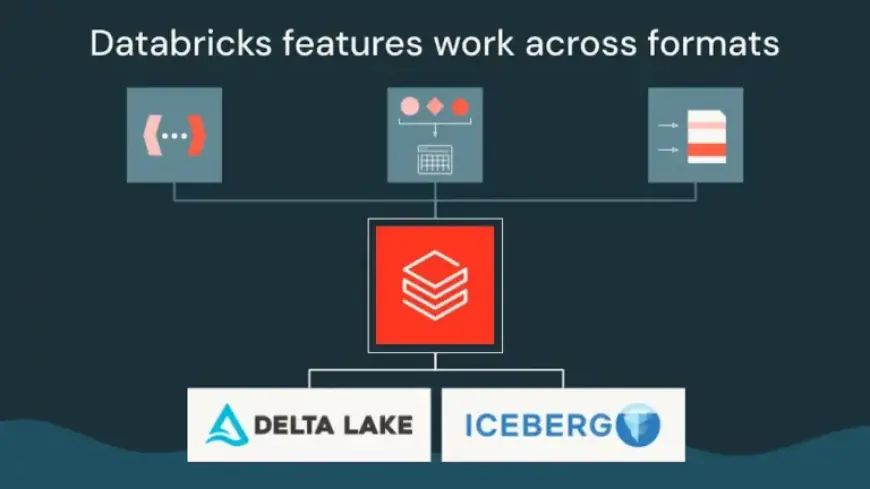
Databricks has placed Apache Iceberg v3 into Public Preview on its lakehouse platform. The release brings new table features, cross-engine interoperability, and performance gains for incremental and semi-structured workloads.
What Iceberg v3 adds
Unity Catalog managed Iceberg v3 tables now include Row Lineage, Deletion Vectors, and the VARIANT column type. These features aim to simplify change processing and make semi-structured data queryable inside a single table.
Row Lineage and Deletion Vectors
Row Lineage gives each row a persistent ID and a sequence number. This lets pipelines detect which rows changed without full table scans.
Deletion Vectors track logical deletions with small delete files. They avoid large Parquet rewrites and can improve write performance by up to 10x.
VARIANT for semi-structured data
The VARIANT type stores JSON-like payloads alongside relational columns. Teams can ingest logs, API responses, clickstreams, and IoT data without flattening.
Performance techniques such as shredding help deliver low-latency query performance on semi-structured fields.
Interoperability and governance
Unity Catalog can federate to external Iceberg catalogs. This permits read and write access across multiple catalogs and engines without copying data.
Fine-grained access controls, including row filters and column masks, can be enforced across external engines.
Delta Lake and Iceberg compatibility
UniForm lets teams write to Delta Lake and expose the data as Iceberg for other engines. Supported readers include Snowflake, BigQuery, Redshift, Athena, and Trino.
With Iceberg v3 features added natively, customers can keep a single data copy and avoid replication pipelines.
Databricks platform advantages
Databricks pairs Iceberg v3 with automated maintenance and layout optimizations. Predictive Optimization and Automatic Liquid Clustering run without manual tuning.
These managed capabilities reduce operational overhead while preserving data portability.
Customer perspectives
Logistics firm Geodis plans to centralize Iceberg data in Unity Catalog while keeping engine choice flexible. Delio Amato, Chief Architect and Data Officer at Geodis, highlighted the performance benefits unlocked by Deletion Vectors.
Security analytics company Panther uses VARIANT for large-scale log collection. Russell Leighton, Chief Architect at Panther, noted that the combination of Unity Catalog and Iceberg v3 makes petabyte-scale ingestion more practical.
Availability and requirements
Iceberg v3 on Databricks is in Public Preview now. The feature is available on Databricks Runtime 18.0 and later.
Unity Catalog must be enabled to create managed Iceberg v3 tables.
Roadmap: toward Iceberg v4
Databricks engineers are contributing proposals for Iceberg v4. Planned improvements include an adaptive metadata tree, relative path support, and enhanced statistics for types like VARIANT and GEOMETRY.
These changes aim to speed ingestion and simplify metadata operations at scale.
Next steps and events
Teams can begin testing Apache Iceberg v3 on Databricks today. Filmogaz.com recommends evaluating Row Lineage, Deletion Vectors, and VARIANT in pilot workloads.
Databricks will discuss its Iceberg roadmap at the Data and AI Summit in San Francisco, June 15-18, 2026.
- Key engines supported: Snowflake, BigQuery, Redshift, Athena, Trino.
- Performance claim: up to 10x faster for certain data operations.
- Runtime requirement: Databricks Runtime 18.0+ with Unity Catalog enabled.