




















Pentagon Increases Investment and Research in Mass Munitions Production

The Pentagon’s science and research arms have accelerated work to produce affordable munitions at scale. Federal budget documents and recent requests to industry show a coordinated push to expand manufacturing and shorten production timelines.
Budget surge and projections
On April 3, the White House Office of Management and Budget released a fact sheet. It named rapid procurement of 12 critical munitions as a top 2027 priority.
The Air Force missile procurement request for fiscal 2027 totals about $11.36 billion. That includes $6.8 billion in the base budget and $4.56 billion in reconciliation funding.
| Year | Amount (millions) |
|---|---|
| 2020 | $2,636 |
| 2021 | $2,216 |
| 2022 | $2,547 |
| 2023 | $3,279 |
| 2024 | $6,015 |
| 2025 | $5,137 |
| 2026 | $3,714 |
| 2027 | $11,378 |
| 2028 | $13,621 |
| 2029 | $16,030 |
OMB projections show steep growth through the decade. Spending in 2027 more than doubles recent annual totals. The increases continue into 2028 and 2029.
Industry outreach and research priorities
Defense labs are pressing industry for scalable solutions. The Air Force Research Laboratory and DARPA posted several notices seeking manufacturing innovations.
DARPA issued two requests for information on March 31. One asked about advanced manufacturing for missile propulsion systems. The agency called propulsion a persistent bottleneck and sought ways to cut production from months to days, or potentially hours.
Avionics, sensors and integration
The second DARPA notice targeted avionics and sensor supply chains for air-to-air weapons. Officials want approaches that enable low-cost, mass-produced systems. They also seek methods to drastically shorten integration timelines.
AFRL also posted a solicitation for affordable cruise missiles. The lab wants multiple vendors to build weapons that travel at least 350 nautical miles. Unit cost must be under $250,000.
AFRL requires an initial flight event after contract award. A capstone demonstration must follow within 16 months. Up to five vendors could join the flight events. The capstone will show at least four missiles that share data, swarm, and re-engage in GPS-challenged environments.
Operational demand and industrial commitments
Recent combat operations have strained inventories. Operation Epic Fury began on Feb. 28, and U.S. strikes have exceeded 15,000 targets since then. That demand has prompted talks with major defense firms.
In early March, the president met with executives from RTX, Northrop Grumman, Lockheed Martin, L3Harris, Honeywell Aerospace, Boeing, and BAE Systems. The administration announced deals to expand production of interceptors and other munitions.
RTX disclosed agreements earlier in February. They cover increased output of AMRAAM, SM-3, SM-6, and Tomahawk missiles. Leaders said production ramp-ups began in prior months.
Ongoing development programs
Dozens of technology efforts aim to improve speed, cost, and lethality. DARPA and AFRL have multiple programs in testing and development.
- Gambit: Launched in 2022, the Gambit program tested rotating detonation engine technology in 2025. The effort targets high-supersonic, long-range air-to-ground munitions.
- Ursa Major partnership: AFRL announced a 2023 collaboration on a new liquid rocket engine. Tests in March produced supersonic flight for the test vehicle.
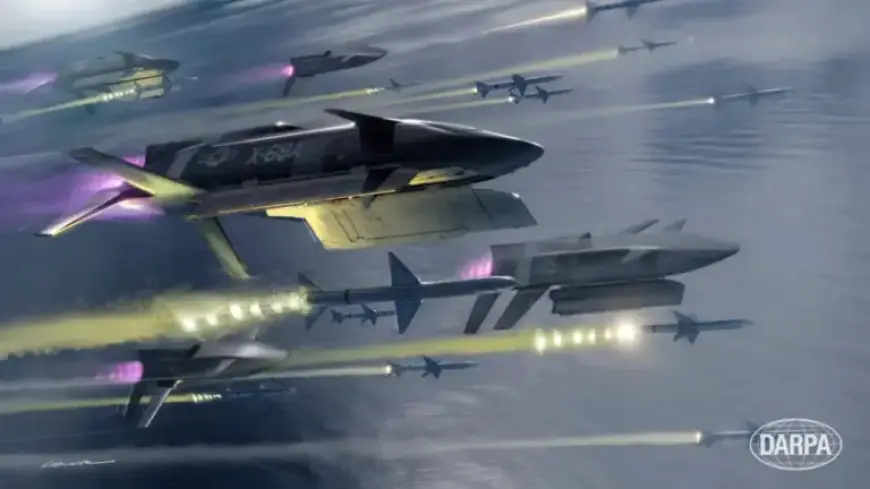
- Gunslinger and LongShot: Begun in 2020, these programs explored novel air-launched concepts. LongShot evolved into the X-68A drone, which is slated for flight tests this year.
Software and speed of improvement
AFRL called in industry in July 2024 to help shorten software integration timelines. The lab seeks modular pipelines and AI-informed tools. The goal is to cut improvement cycles from years to months, weeks, or days.
The combination of research, procurement, and industry engagement reflects a broader priority. Officials are increasing Pentagon investment and research into mass munitions production to meet surge requirements.
Filmogaz.com will continue to follow budget moves, development milestones, and industry responses as programs progress.