

























Bill Phillips Models Economy with Flowing Water Simulation

An excerpt from Alex Mayyasi’s new book appears today. The chapter traces the origins and influence of the Phillips Curve.
From New Zealand to London
Bill Phillips was born in New Zealand. He worked as a crocodile hunter, a gold miner, and an electrical engineer.
After World War II, he studied economics in London. He soon joined debates on macroeconomics at the London School of Economics.
A laboratory in a garage
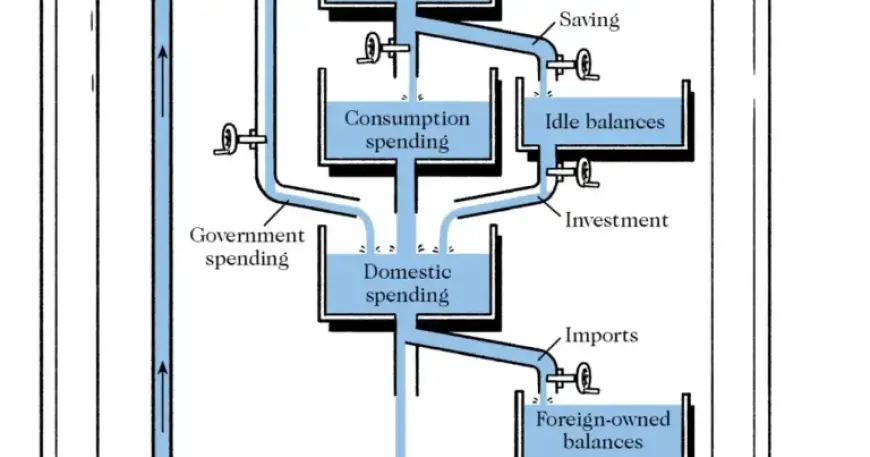
In 1949 Phillips built a mechanical model in his garage. It used flowing water to represent government spending and taxation.
This practical demonstration drew skepticism at first. Staff at LSE grew impressed and later offered him a job.
Bill Phillips Models Economy with Flowing Water Simulation
The garage device showed revenue moving from a Treasury tank to chambers labeled for public services. Levers altered tax rates and changed the water flow.
The setup illustrated how government spending and taxation affect circulation in an economy.
Discovering the curve
A colleague gave Phillips a century of UK wage and unemployment records. He analyzed the data and returned with a striking graph.
The plot revealed an inverse relationship between unemployment and wage growth. This became known as the Phillips Curve.
Adoption and influence
Economists in other countries found similar patterns, including in the United States. In 1961 Paul Samuelson and Robert Solow named the relationship the Phillips Curve.
Samuelson included it in his textbook. White House advisers and central bankers used it to describe trade-offs between inflation and employment.
Broader context and limits
The idea fit with earlier debates about controlling booms and busts. John Maynard Keynes argued governments should adjust spending to stabilize the economy.
Before the 1930s, many countries used the gold standard. After the Great Depression, fiat currency became the norm.
The Phillips Curve guided policy until economic changes in the 1970s forced economists to revise their playbook.
Legacy
Phillips’s blend of engineering and empirical analysis left a lasting mark. His curve remains central to macroeconomic history and debate.
Alex Mayyasi explores this story in Chapter 18 of his new book, available in bookstores today.