

























Robots Revolutionize Resource Discovery on Moon and Mars

Researchers from the University of Basel, ETH Zurich, and the European Space Agency say semi-autonomous machines could speed planetary exploration. Their study appeared Tuesday in the journal Frontiers in Space Technologies.
Laboratory trial of an autonomous explorer
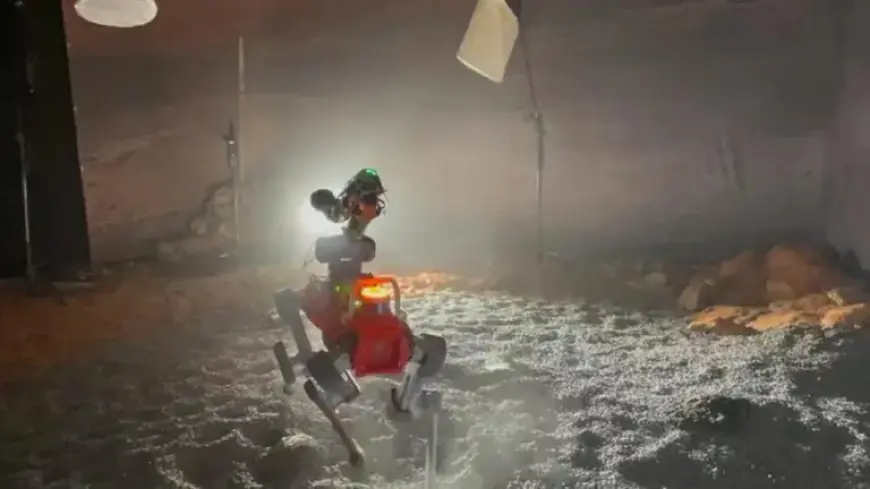
The team tested a quadrupedal robot fitted with a robotic arm. It carried a compact camera and a spectrometer to identify materials.
Testing occurred at the Marslabor facility at the University of Basel in Switzerland. The site recreates rocky planetary terrain and specialized lighting.
What the robot could do
- Move using locomotion and waypoint navigation.
- Deploy instruments with its arm.
- Return images and instrument data.
The robot’s autonomy ran predefined commands only. Human teams did not direct each movement during the experiments.
Multi-target missions versus human control
Researchers compared semi-autonomous scouting to traditional, human-guided operations. The goal was to measure efficiency and area coverage.
Multi-target missions completed by the autonomous system took between 12 and 23 minutes. Equivalent human-guided missions required about 41 minutes.
Why this matters for resource prospecting
Faster, autonomous scouting could change how teams conduct resource discovery on the Moon and Mars. Robots that act independently can survey more ground in less time.
Compact instruments on legged platforms make local prospecting more practical. That could accelerate searches for biosignatures and usable materials.
Relevance to lunar operations and NASA programs
Legged robots may reach steep crater walls and other rugged lunar features that wheels struggle with. This capability matters for accessing certain lunar resources.
NASA is also pursuing more autonomous systems for the Moon. The current Artemis II mission will not include a lunar rover, but future missions may benefit.
Recent AI navigation tests on Mars
In December, NASA demonstrated AI-guided navigation for the Perseverance rover. The team used Anthropic’s Claude models for two demonstrations.
During those tests, Perseverance negotiated obstacles and drove roughly 1,500 feet without issue. The success underscores growing trust in autonomous navigation.
Researchers say semi-autonomous platforms can complement human teams. The approach could revolutionize resource discovery and accelerate exploration timelines.
Reporting for Filmogaz.com.