

























New York Study Connects Solar Phenomena with Weather Forecasting

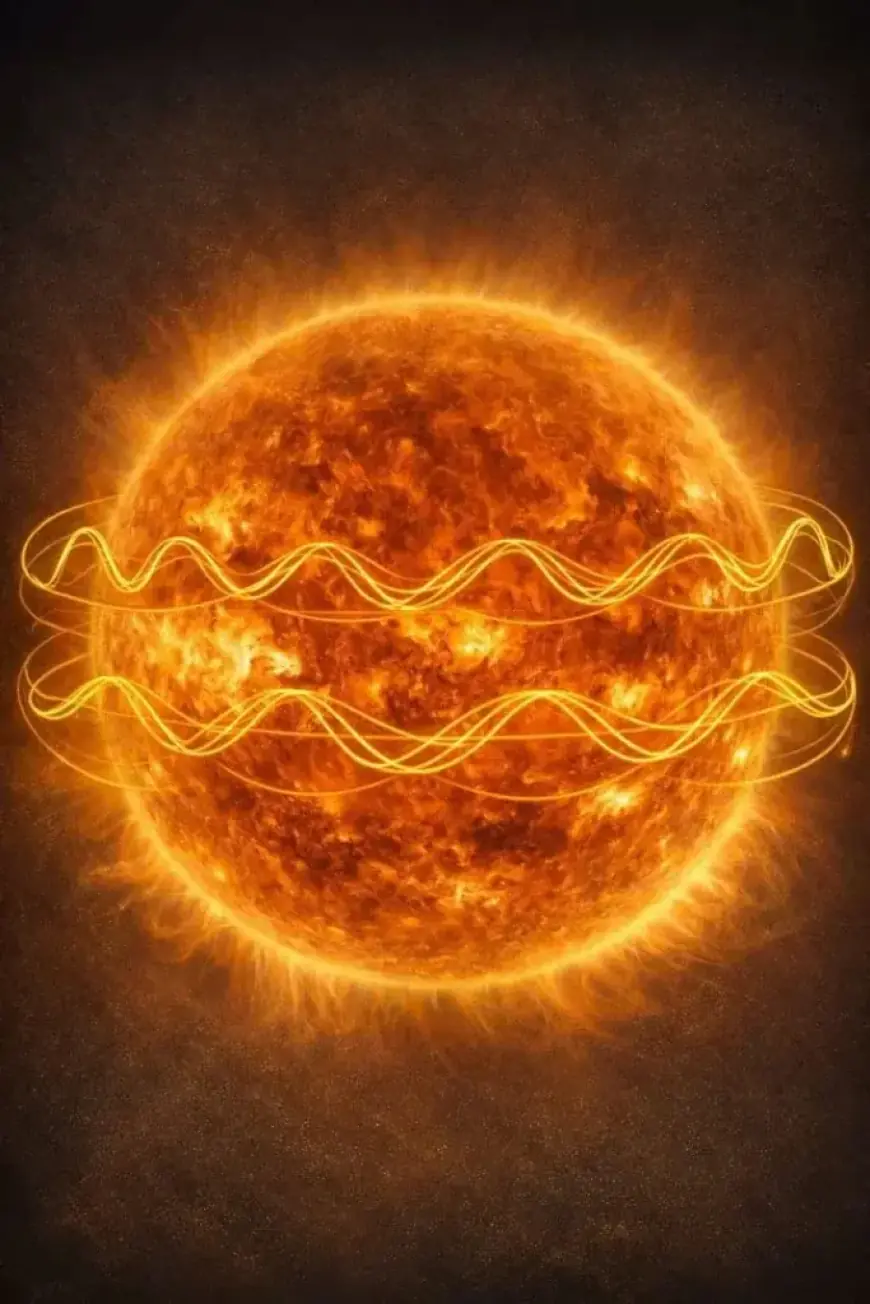
Researchers at New York University Abu Dhabi have detected large-scale waves moving beneath the Sun’s surface. The discovery offers a new window into hidden magnetic structures inside the star.
Study and data
The team analyzed more than a decade of the Sun’s natural vibrations. They used a long-duration data set collected and processed at the NYU Abu Dhabi Center for Astrophysics and Space Sciences.
The work appears in the journal Nature Astronomy. The analysis relied on detailed measurements of wave motion across the solar interior.
What the team found
Scientists identified previously unknown, large-scale waves shaped by internal magnetic fields. These waves reveal patterns that were not visible before.
By tracking the waves, the researchers estimated the size and strength of magnetic fields below the Sun’s surface. Those estimates provide direct clues about the Sun’s internal magnetic system.
Lead researchers and support
Shravan Hanasugi served as the study’s lead author. He is a research associate at the Center for Astrophysics and Space Sciences at NYU Abu Dhabi.
The project received backing from the Research Institute at New York University Abu Dhabi. The paper credits the institute for critical support.
Practical implications
The findings could improve forecasts of solar activity. Better knowledge of internal magnetic fields helps predict events that disrupt satellites and communications.
The New York research team connects observed solar phenomena with potential impacts on Earth. This link may strengthen space weather forecasting models.
Broader significance
The technique offers a new approach to studying stellar magnetism beyond our Sun. It could help scientists understand magnetic activity in other stars.
Improved predictions may protect orbital infrastructure and terrestrial power systems. The research opens a path to more reliable forecasts of solar-driven disturbances.