
























Missing Artifacts Eclipse Discovery of 5,000-Year-Old King’s Tomb

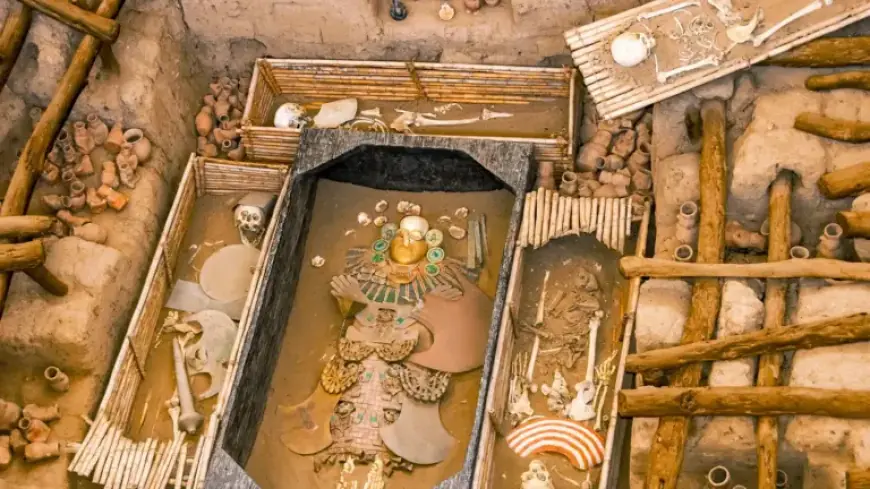
Archaeologists have announced a major prehistoric find at the Wangzhuang ruins near Yongcheng in Henan province. Excavations there uncovered a large tomb linked to ancient regional royalty.
Site and excavation teams
The work was led by the Henan Provincial Institute of Cultural Heritage and Archaeology. Researchers from Capital Normal University joined the field team.
Associate professor Zhu Guanghua of Capital Normal University described the site as more than an ordinary settlement. He suggested the ruins may represent the capital of a prehistoric kingdom.
The tomb’s dimensions and structure
One prominent tomb covered more than 17 square meters. Its internal chamber measured roughly 4.52–4.80 meters long and 3.47–3.68 meters wide.
Archaeologists found both outer and inner coffins within the grave. The scale and construction point to a high-status burial.
Artifacts recovered
Excavators reported more than 350 items in the primary tomb. Across the site, teams have now recovered over 1,000 artifacts.
- More than 100 pottery vessels.
- Nearly 200 small jade ornaments.
- Bone tools and animal remains, including pig mandibles.
- Stone ceremonial blades, many broken.
Evidence of tampering and missing remains
Investigators found the wooden coffin heavily disturbed. Most of the occupant’s skeleton was absent, with only a few toe bones remaining.
Zhu and colleagues believe many items were looted. Small jade pieces were scattered inside and outside the coffin.
Timing of the damage
Researchers suspect the damage occurred soon after burial. Deliberately broken blades suggest ritual or violent interference.
Cultural links and regional exchange
Specialists say the finds show influence from multiple prehistoric cultures. Artifacts reflect elements from the eastern regions, central plains, and the Yangtze River basin.
Li Xinwei, deputy director at the Institute of Ancient History, Chinese Academy of Social Sciences, highlighted this cultural fusion. He noted items that link Dawenkou and Yangshao traditions.
- Dawenkou influence: water deer teeth placed with certain skulls.
- Yangshao influence: small-mouthed pointed-bottom jars and shoulder jars.
Social structure and production
Team leader Liu Haiwang connected grave wealth to social rank. Larger tombs contained richer assemblages, indicating clear social hierarchy.
Liu also pointed to evidence of specialized production and division of labor. The variety and quality of goods suggest significant local productivity.
Ongoing study and significance
Archaeologists continue detailed analyses of the finds. Radiocarbon dates place the complex at roughly 5,000 years old.
Scholars say the missing artifacts and deliberate damage eclipse the discovery of a 5,000-year-old king’s tomb in terms of unanswered questions. Further study aims to clarify relations, ritual practice, and the timing of the tomb’s disturbance.
Filmogaz.com will follow updates as researchers publish new results from the Wangzhuang excavations.