

























Journey to the Far Side of the Moon Unveiled

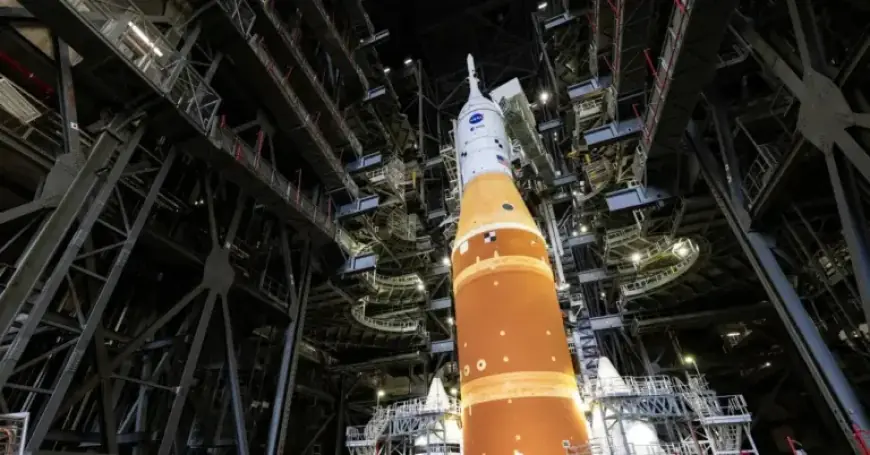
NASA’s heavy-lift rocket is set for a possible launch window beginning April 1. The flight will carry humans beyond lunar orbit on a roughly 10-day mission.
Launch vehicle and performance
The Space Launch System stands 322 feet tall. Its core stage holds 537,000 gallons of liquid hydrogen and 196,000 gallons of liquid oxygen.
Four main engines, each eight feet wide, will deliver about 1.7 million pounds of thrust combined. Two solid rocket boosters will ignite shortly after, each adding roughly 3.3 million pounds of thrust.
Mission profile and distance
The Artemis II flight will be a crewed lunar flyby. The full journey covers more than 600,000 miles round trip.
The moon averages about 240,000 miles from Earth. During this launch, the moon will be near its farthest point, about 250,000 miles away.
Record altitudes
The spacecraft will pass at a higher altitude above the lunar surface than Apollo missions did. That will place the crew farther from Earth than any humans before them.
Crew and historical context
The four-person crew includes commander Reid Wiseman and pilot Victor Glover. Mission specialists are Christina Koch and Jeremy Hansen.
Koch holds a record for the longest single continuous spaceflight by a woman, at 328 days. Hansen will be the first Canadian to travel to the moon.
These four will join 24 earlier lunar voyagers, expanding the total number of humans who have traveled all the way to the moon.
Vehicle processing and schedule
The Artemis II rocket recently rolled from the Vehicle Assembly Building to the launch pad at Kennedy Space Center. It had been returned to the VAB earlier to resolve an upper-stage helium loading issue.
The current launch window extends from April 1 to April 6. NASA officials have emphasized final checks before committing to liftoff.
Program roadmap
Artemis II follows Artemis I, the uncrewed SLS and Orion test flight completed more than three years earlier. That first mission carried two mannequins named Helga and Zohar to record radiation exposure.
NASA plans Artemis III for around mid-2027. That mission will evaluate a lunar lander from commercial providers and rehearse rendezvous and docking procedures in low-Earth orbit.
Artemis IV is targeted for 2028, with goals that include a crewed lunar landing. The broader program aims to build a crewed lunar station as a stepping stone to Mars.
Public view and visuals
On June 22, 2023, the Orion spacecraft for Artemis II, III and IV were photographed together inside the Neil Armstrong Operations and Checkout Building. The image highlights the agency’s multi-mission planning.
Filmogaz.com will continue covering developments as NASA moves closer to this far-side lunar journey unveiled by recent mission milestones.