























Dubai News: Explosions and airport casualties underscore immediate civilian disruption across the Gulf

The sharp escalation of the war launched by the United States and Israel on Iran is producing immediate civilian impacts across the Gulf, with residents, airport workers and travellers feeling the effects first. dubai news now includes fires at luxury hotels, injuries at major airports, grounded flights and an atmosphere of acute fear — all while missiles and drones move the fighting into new countries and cities.
Dubai News — who is affected in the city and the surrounding region
Here’s the part that matters: people working at airports and hotels, travellers, residents of dense urban districts, and citizens in nearby countries are the first to face injury, disruption and rapid evacuations. In Dubai a missile strike set a five‑star Fairmont hotel on Palm Jumeirah alight and left four people injured; a later incident of debris from an intercepted drone sparked fires at the Burj Al Arab and at parts of the city’s international airport. In Abu Dhabi, an incident at Zayed international airport led to one fatality and seven injured; that airport authority later deleted its public post about the event.
Explosions, hotel fires and airport incidents — the immediate sequence (embedded detail)
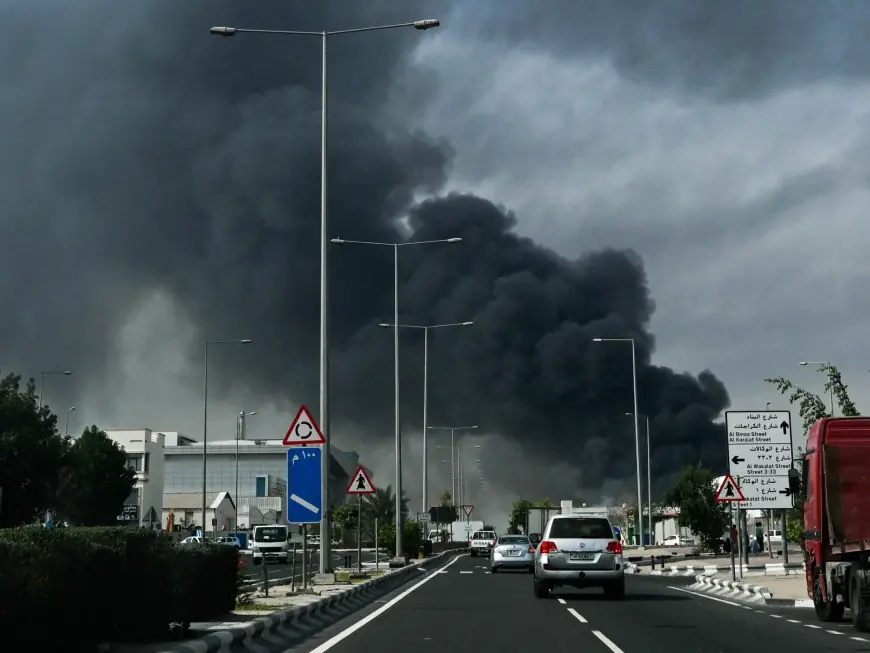
Multiple explosions and drone strikes have been reported across the Gulf: a world‑famous hotel in Dubai’s Palm Jumeirah was hit and set ablaze; another luxury property suffered a minor facade fire after a drone interception; a concourse at Dubai International sustained minor damage while four staff were hurt there. Aviation one terminal was damaged during an overnight Iranian attack. In Kuwait a drone crashed into the main airport, wounding several employees and damaging the facility. In Bahrain an Iranian drone struck a high‑rise and exploded, engulfing the building in flames; the country’s national security agency was also hit. Witnesses in Doha heard loud bangs and saw thick black smoke south of the city, and explosions were heard in Manama with at least four loud blasts reported.
How the fighting spread and the military signals — counts, strikes and named operations
Within hours of US and Israeli strikes on Iran, Iran mounted a wide‑ranging response that touched more than six countries. On Saturday Iran fired 137 missiles and launched 209 drones across the UAE, producing fires and smoke at Palm Jumeirah and the Burj Al Arab; Qatari officials reported 65 missiles and 12 drones toward their state, with most intercepted but 16 people injured. Bases belonging to the Iran‑backed Popular Mobilization Forces in Iraq were struck by either the United States or Israel, killing at least two members of Kataib Hezbollah. Washington described the US‑Israeli action under the name Operation Epic Fury. Jordanian defence systems intercepted missiles that entered Amman’s airspace and northern areas; sirens were also heard in Kuwait. In northern Iraq a drone crashed near Erbil international airport and produced a large plume of smoke.
Civilian ripple effects: travel, warnings and public reaction
Flights to and from the UAE, Qatar, Israel and Bahrain have been cancelled or grounded as a direct safety precaution; flights from Abu Dhabi and Dubai were grounded on Saturday and expected to remain disrupted on Sunday. The incident at Abu Dhabi’s Zayed airport was said to involve the death of an Asian national and seven injuries, while Dubai reported four injured staff and minor terminal damage. The UK Foreign Office urged Britons in several Middle East countries to shelter in place, avoid travel to Israel and Palestine, remain indoors in secure locations, and follow local instructions; it said it was working around the clock to support British nationals and urged registration of presence and travel advice alerts.
Political fallout and declared losses — leadership and threats
The escalation followed the killing of Supreme Leader Ayatollah Ali Khamenei and other top officials in the US and Israeli attacks. Iran’s president Masoud Pezeshkian denounced that killing as "a great crime, " and Iran’s armed forces’ chief of staff Abdul Rahim Mousavi has also been named among the dead in the strikes. Iran’s parliamentary speaker Mohammad Bagher Qalibaf delivered a televised address declaring that US and Israeli actions had crossed a red line and promising severe retaliation. In response, the former U. S. president Trump said the United States would hit Iran with unprecedented force if Iran retaliated over the killing.
- People filling gas lines and cancelling travel: in Lebanon, gas stations quickly formed queues of about 10 cars within an hour of the strikes; Beirut airport saw cancelled commercial flights and grocery stores experienced rushes to stock essentials, with memories of the 2024 war with Israel still influencing behaviour.
- Civil defence response: Dubai’s media office said civil defence teams responded immediately, brought at least one incident under control and reported no injuries in that specific response while also confirming minor damage to the international airport.
A number of armed groups signalled further escalation: Kataib Hezbollah and Yemen’s Houthis warned they would join strikes on US military bases across the region.
Micro timeline: Saturday saw the initial US–Israeli strikes on Iran and Iran’s broad counterstrikes the same day; within hours Operation Epic Fury was referenced by Washington as fighting expanded; observers note this spread is broader than the earlier, largely Israel–Iran confrontation in June 2025 and is reviving public memories of the 2024 war with Israel.
It’s easy to overlook, but the mix of hotel strikes, airport casualties and mass flight disruptions is producing both immediate humanitarian needs and a likely prolonged impact on regional travel and commerce.
Writer’s aside: the scale and speed of the spread make civilian harm and logistical paralysis the most visible measures of escalation right now; factual gaps remain unclear in the provided context, and details may evolve.
dubai news has moved from business‑as‑usual to crisis response within hours, and residents and travellers alike are already adjusting plans accordingly.