























Dubai Airport and dubai airport among targets as new explosions rock Dubai, Doha and Manama

Explosions were heard for a second day across Gulf states as Iran continued retaliatory attacks on US assets, a surge that has raised fears of a wider conflict. The strikes have hit cities, airports and ports — and dubai airport was among facilities listed as targeted in the earlier wave of strikes.
Second day of strikes in Dubai, Doha and Manama raises regional alarm
The blasts were heard again on Sunday morning in Dubai, the United Arab Emirates; Manama, the capital of Bahrain; and Doha, the capital of Qatar. The attacks are described as retaliation for strikes by the United States and Israel that killed Supreme Leader Ayatollah Ali Khamenei and other top officials, and the continued exchanges have heightened concern about escalation across the Gulf.
Witnesses in Doha, Dubai and Jebel Ali describe smoke and interceptions
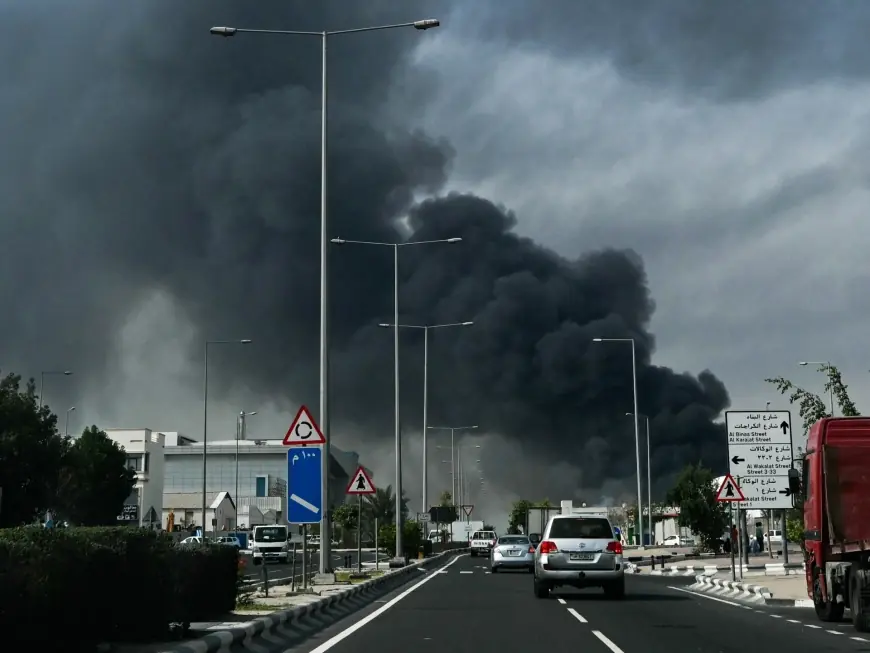
In Doha, witnesses reported several loud bangs and thick black smoke rising on the clear morning horizon in the south of the city. Shortly after those reports, another wave of explosions reverberated through Dubai, a regional business hub. Observers in Dubai saw puffs of white smoke from missile interceptions in the skies and billows of dark smoke over the port of Jebel Ali, one of the busiest ports in the Middle East.
Dubai Airport, Abu Dhabi airport and Kuwait's airport hit amid casualties at Abu Dhabi
Saturday's strikes included hits on airports across the UAE and the region. At Abu Dhabi's airport, the facility's authority described an "incident" in which at least one person was killed and seven others were wounded. Dubai Airport — described in reports as the world's busiest for international traffic — and Kuwait's airport were also listed among facilities hit in the same set of attacks.
Large missile and drone volleys: 137 missiles, 209 drones in UAE; Qatar and Jordan see interceptions
The previous day, Iran fired 137 missiles and 209 drones across the UAE, the country's Ministry of Defence said, with fires and smoke reaching landmarks including Palm Jumeirah and Burj al-Arab. Qatari Iran launched 65 missiles and 12 drones towards their country on Saturday; most of those were intercepted but 16 people were injured. Jordanian defence systems intercepted missiles that entered Amman's airspace and the country's northern areas, and sirens were heard in Kuwait. In northern Iraq, a drone crashed near Erbil international airport, producing a large plume of smoke.
Leadership statements after Khamenei's killing and warnings of retaliation
Iranian President Masoud Pezeshkian denounced the killing of Ayatollah Ali Khamenei "as a great crime. " Iran's armed forces' chief of staff, Abdul Rahim Mousavi, has also been killed in the joint US-Israeli attacks. Iran's parliamentary speaker, Mohammad Bagher Qalibaf, said in a televised address on Sunday, "you [US and Israel] have crossed our red line and must pay the price, " and added, "We will deliver such devastating blows that you yourselves will be driven to beg. "
In response, former US President Trump warned that the United States would hit Iran "with a force that has never been seen before" if Iran strikes back over the killing of Khamenei, who ruled the country for 37 years.
Wider regional footprint and US presence
The explosions and interceptions followed a day of strikes on US military bases and other assets across the Gulf, with Oman noted as an exception because it was mediating nuclear talks between the US and Iran. The oil-and-gas-rich Arab states that lie just across the Gulf from Iran collectively host thousands of US troops. The US is reported to still have troops in Iraq's autonomous Kurdish region as part of an international coalition against ISIL (ISIS).
There were no immediate reports of damage or injuries from Sunday's blasts in Dubai, Doha or Manama, beyond the casualties already reported at Abu Dhabi's airport and the injury toll cited in Qatar.