
























Planets Aligning Tonight: How to See the Six-Planet Parade Peaking Feb. 28

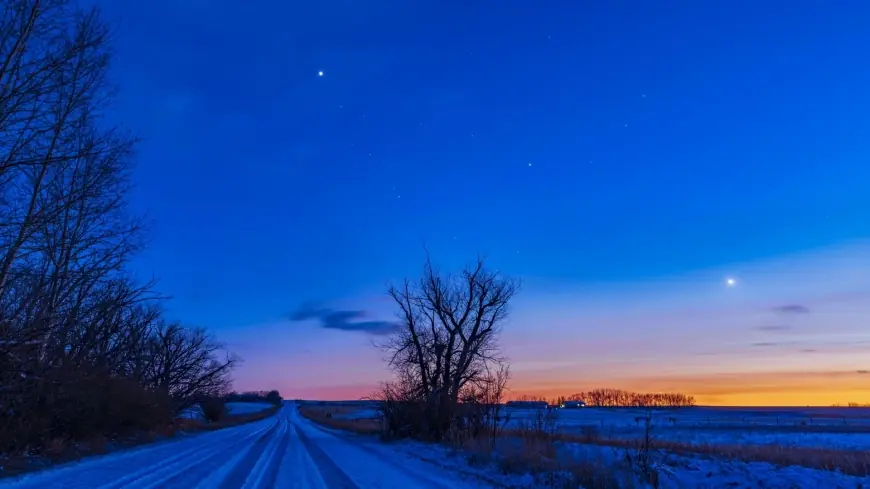
The sky is staging a six-planet parade, with Jupiter, Saturn, Venus, Neptune, Uranus and Mercury arrayed for a rare sight — and planets aligning tonight matters because the parade peaks on Feb. 28 and offers only a narrow, weather-dependent window for viewers. Preparation, the right equipment and careful timing will determine whether observers catch the display.
Planets Aligning Tonight: where to look in the western sky
Most of the naked-eye planetary action will take place low in the western sky after sunset. Mercury will be about 10 degrees — roughly the width of a clenched fist at arm’s length — above the late-winter horizon, with Venus just to its left. Saturn will sit less than 10 degrees to the upper left of Venus, forming a compact trio close to the setting sun. Mercury and Venus are expected to follow the sun out of sight roughly an hour after sunset, briefly brightening as the sky darkens and they approach the horizon.
Mercury and Venus: timing and brief visibility
For those planning to see the planets aligning tonight, stake out a raised site with an unobstructed view of the western horizon well before sunset. The parade’s low altitude means the planets will set quickly; observers should arrive early and use a stargazing app to pinpoint exact local bearings rather than guessing. Weather will play a decisive role: a clear, steady horizon significantly increases the odds of seeing Mercury and Venus before they disappear into twilight.
Saturn and Neptune: small separations and telescope needs
Neptune will lie about two degrees to the right of Saturn but will be too faint for unaided viewing. Under dark skies, a telescope with an aperture of 8 inches (200 millimeters) or more can reveal Neptune’s tiny bluish disk. Its low position on the horizon and proximity to the sun’s glare make Neptune a challenging target on the nights surrounding Feb. 28. Observers are explicitly warned to ensure the sun is fully below the horizon before pointing any telescopic equipment in that direction.
Uranus, the Pleiades and finder techniques
Uranus sits about 5 degrees below the Pleiades open star cluster and to the right of the "V" of Taurus; sweep a scope across that patch in the hours following sunset to locate it. Both Uranus and Neptune will benefit from magnification, yet even with optics the low elevation and lingering twilight will stack the odds against clear views. Newcomers are encouraged to use smartphone astronomy apps that employ augmented reality to mark constellations, planets and precise offsets from bright star patterns.
Jupiter, the waxing gibbous moon and viewing caveats
Opposite the western group, Jupiter will shine high in the eastern sky, with the waxing gibbous moon positioned below it. The moon’s reflected light will wash out the stars of the constellation Cancer in that area, changing contrast for observers trying to use star patterns to orient themselves. What makes this notable is the parade’s split presentation — a bright western assembly of inner planets and a dominant Jupiter in the east — which requires viewers to scan both horizons.
Practical notes, safety and supplementary material
Tips embedded in the coverage stress that preparation and equipment matter: choose a raised viewing spot, bring optics if you hope to see Neptune or Uranus, and rely on smartphone apps for precise local positioning. The piece also includes a consumer note that purchases made through links on the story may generate an affiliate commission, and it invites readers to sign up for a monthly entertainment newsletter, a skywatching newsletter covering moon phases and must-see events, and a Sci‑Fi Reader’s Club that delivers a monthly short story and community activities.
The coverage adds a light-hearted line — "We truly hope it doesn't rain on your parade" — and acknowledges the practical hurdles for photographers. Award-winning night-sky photographer Josh Dury is cited as having grappled with the sweep of the scene, the glow of the setting sun and other technical challenges while attempting to capture the alignment visually. Finally, a separate note for website visitors warns that some readers may encounter an unsupported browser message and should update to a modern browser to ensure the best online experience.
For viewers hoping to catch the planets aligning tonight, the core checklist is clear: pick a horizon-facing, elevated site well before sunset, have a plan for timing (the parade peaks on Feb. 28), bring adequate optics for the dim outer worlds, and confirm that the sun is completely set before using any telescope.