






















Tracey Emin’s My Bed Returns: How the Artist’s Confessional Icon Forces Museums, Staff and Viewers to Recalibrate

The return of tracey emin’s My Bed shifts attention away from headline shock and onto real-world consequences: conservation teams, exhibition planners and audiences must navigate a fragile, deeply personal work that the artist now says she would present as tidy and luxurious. That admission reframes the piece’s cultural power and raises questions about how institutions steward objects that double as intimate life records.
Impact on museums, staff and audiences: Tracey Emin’s choice changes the work’s contract with viewers
My Bed no longer functions purely as provocation; its presence on the gallery floor affects the people who set it up, the curators who contextualise it and the visitors who confront its history. The artist, now 62, has described both practical and emotional consequences of reinstalling the piece: conservators contend with fragility and health rules, while viewers meet the artifact of a self-described survival story rather than an anonymous stunt. The return asks institutions to weigh preservation against public access every time the bed is shown.
What the installation contains and why it still shocks
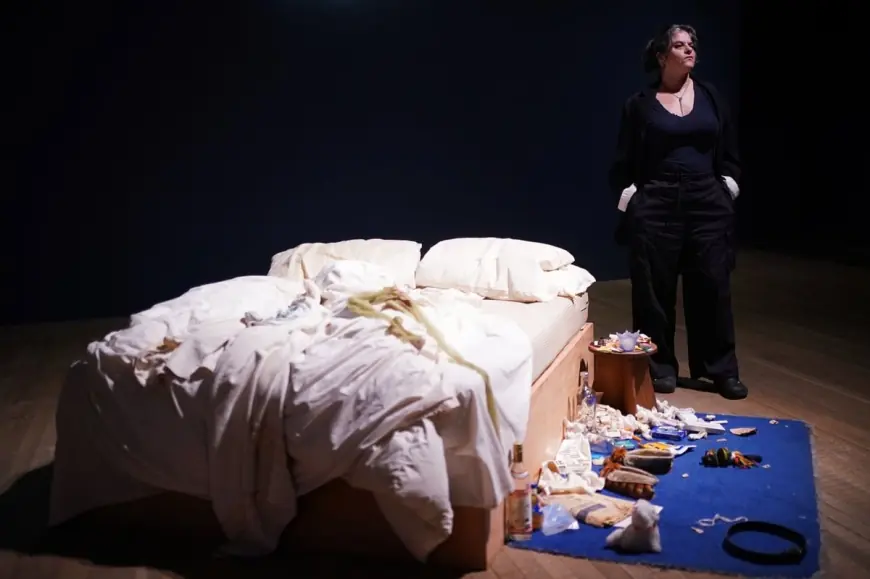
The 1998 installation depicts a dirty, dishevelled bedroom scene featuring cigarettes, alcohol, underwear and condoms alongside stained sheets, soiled knickers, empty vodka bottles and cigarette butts. The work was inspired by a sexual yet depressive phase in the artist’s life and by a depressive episode that saw her spend four days in bed. When it first appeared at London’s Tate Gallery almost 30 years ago, it caused a major stir; the piece was later sold at auction by Christie's in 2014 for more than £2. 5m and has been loaned back to Tate Modern for the retrospective titled Tracey Emin: A Second Life, which opened on Friday.
Conservation, logistics and the ‘crime scene’ setup
Practical constraints shape how often and how long My Bed can be displayed: the installation can only be shown about every five years and only for a limited period because of its fragility. When it is being installed or removed, staff use a hazmat suit, the artist has said, describing the setup as "like a crime scene. " The bed contains small pockets and boxes; within them are individually bagged items — examples given include two safety pins, an apple core and condoms. About 20 years ago the Nurofen and headache pills were changed because of concerns they might be taken, an alteration driven by health and safety. Although the bed was once hers, ownership has changed and the lending institution now carries responsibility for its identity.
Personal stakes: why the object matters to the artist
For the artist the piece is not mere spectacle but a literal survival record. She has said the bed "kept me alive" after a period when she nearly lost her life in it; seeing the work back on display moved her to tears. That emotion is tied to recent personal history: she was diagnosed with bladder cancer in 2020 and underwent major surgery including an urostomy, and in 2024 she received a damehood for services to British art and has said she was given a four-year "all clear" from cancer. Reinstalling My Bed after those experiences felt sad and wrenching—she described the process as pulling memory and identity through her and said she felt like crying as she worked.
How the artist would remake it today and the wider context
Tracey Emin has said that if she made My Bed now it would be "tidy, " "clean" and even "boring" — the sheets would have a 1600 thread count. Asked on her upcoming Sunday TV show by Laura Kuenssberg what would sit beside the bed today, she replied that it might be "my two cats, maybe a few love letters, " and emphasised that the bedding would be very clean and beautiful. She described luxurious sheets as a reward for surviving a messier youth and young womanhood, and said she would tell her younger self not to smoke. The piece also sits in the trajectory of the Young British Artists movement of the 1990s, where she rose to fame alongside Damian Hirst and Sarah Lucas; that cohort was known for entrepreneurial energy, bold use of unconventional materials and what some contemporaries called shock tactics.
Here’s the part that matters for institutions, practitioners and visitors:
- Conservation teams must balance preservation limits (show every ~five years, limited runs) with public demand for a high-profile work.
- Exhibition planners face logistical burdens: hazmat-level handling, item-by-item cataloguing and occasional content changes for safety.
- Audiences encounter a work that the artist now frames as both life-saving and reworkable—its meaning shifts when she says she would present it tidier today.
- For the artist the bed functions as a life document tied to serious health history and public recognition; that personal arc alters how the work is received.
It’s easy to overlook, but the combination of high auction value (sold at Christie's in 2014 for more than £2. 5m), institutional stewardship and the artist’s own evolving stance turns My Bed into a test case for how museums handle confessional, fragile art.
What’s easy to miss is the human cost beneath the headlines: reinstalling a piece like this is as much an emotional act for its creator as it is a curatorial exercise.