

























Amy Coney Barrett and the Republican Justices' Fight Over Who Really Runs the Government

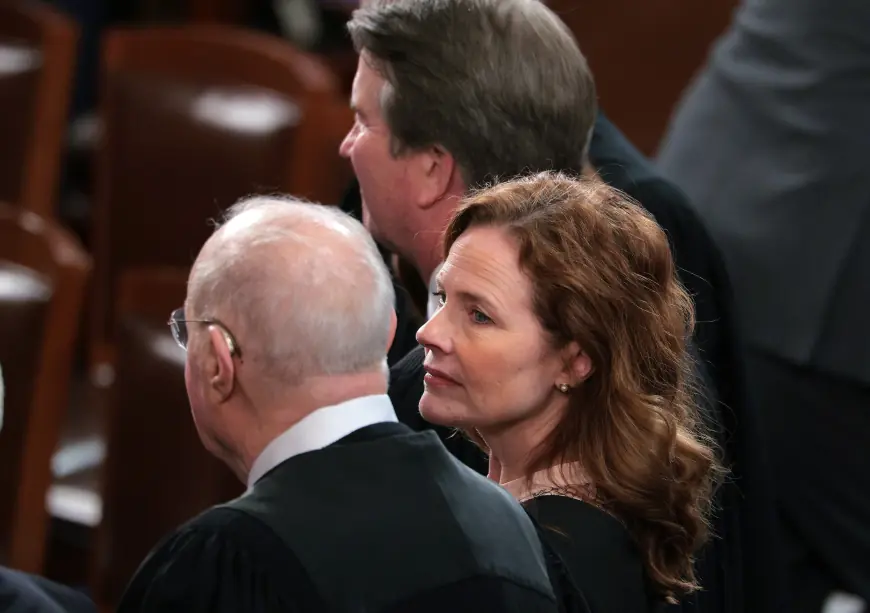
In the aftermath of the Supreme Court's decision in Learning Resources v. Trump, which struck down many of President Trump's tariffs, amy coney barrett has emerged as a distinct force in a Republican majority now visibly divided over who should really run the government. The ruling and the opinions around it stripped away assumptions about unanimity on executive power and highlighted three camps on the Court: the judicial supremacists, the GOP partisans, and amy coney barrett as a separate, moderating voice.
Amy Coney Barrett's role in the split
Learning Resources revealed deeper philosophical differences among the Court's Republican justices than might have been apparent from prior case outcomes. On one side are three dissenters—Clarence Thomas, Samuel Alito, and Brett Kavanaugh—whose views suggest that how much power a president may wield depends in part on which party occupies the White House. On another is Neil Gorsuch, who articulated a more sweeping doctrinal stance that resists allowing significant presidential authority regardless of party control. In the middle, amy coney barrett set out a more modest framework than Gorsuch's, a position that points toward a potentially greater role for Congress in governing policy choices.
What the fracture means for executive power and future cases
Although the disagreement among Republican justices did not determine the outcome of the tariffs case, the split matters for how the Court may approach future conflicts between the branches. Gorsuch's opinions align with a judicial supremacist approach that would invalidate many federal policies even when Congress has authorized them. Barrett's approach, by contrast, counsels humility: she signaled that when the two elected branches are at odds with the Court's preferences, the judiciary should take a narrower path and leave more to Congress where feasible.
Notably, Barrett and Gorsuch nonetheless vote together frequently in executive-power disputes, and both joined the Court's 2024 decision that allowed a president to use the powers of the presidency to commit crimes. Barrett, however, registered disagreement with minor portions of that majority opinion. Both justices also supported decisions that limited a Democratic president's ability to govern in several Biden-era cases, underscoring that shared outcomes can mask meaningful doctrinal differences.
The practical implication is straightforward: doctrinal splits on the Court can be durable fault lines even when votes align in particular cases. The Learning Resources opinions suggest a contingency in which Barrett might side with Democratic interests if Congress expressly authorizes a course of action and leaves the Court no reasonable alternative; conversely, Gorsuch may be more inclined to invalidate congressional measures that enable executive action he deems excessive.
Why this fight over who runs the government matters now
The dispute among Republican justices maps directly onto broader questions about separation of powers and democratic governance. If the Court's internal divisions harden, the result could be divergent outcomes across presidential administrations depending on which facet of the Court's philosophy predominates. That dynamic is most consequential when Congress deliberately grants power to a president and the judiciary must choose how to interpret and, where necessary, constrain that delegation.
Learning Resources did not settle those questions; instead, it exposed the lines along which future litigation will be fought. The competing visions—judicial supremacism, partisan deference, and a more Congress-oriented humility represented by amy coney barrett—set the terms for what the Court may allow or curtail in years ahead. Observers should expect these doctrinal differences to resurface in cases that test the balance between presidential authority and congressional intent. Recent developments indicate the debate is ongoing and that future major disputes could hinge on which internal philosophy gains ascendancy.