























Tropical Cyclone Horacio: How a remote disturbance became Earth’s first Category 5 tropical cyclone of 2026

Why this matters now: tropical cyclone horacio reached Category 5 strength during the climatological peak of the Southern Hemisphere season, showing how a short window of warm seas and favorable outflow can drive explosive intensification. Fishermen and marine operators felt the first impacts while the system tracked southward and began a steady weakening trend that will reshape risks over the open Indian Ocean in the next 48 hours.
Why conditions aligned for rapid growth
Sea-surface temperatures of 27–28 degrees Celsius (81–82°F) and favorable upper-level outflow combined with only moderate wind shear to create a narrow corridor for intensification. The timing also coincided with the climatological peak of the Southern Hemisphere cyclone season (February to March), when both warm waters and monsoonal outflow patterns make rapid deepening more likely. What’s easy to miss is that basin-scale timing matters: this kind of alignment helps explain why a remote low can escalate to extreme strength within days.
Tropical Cyclone Horacio: peak intensity and track
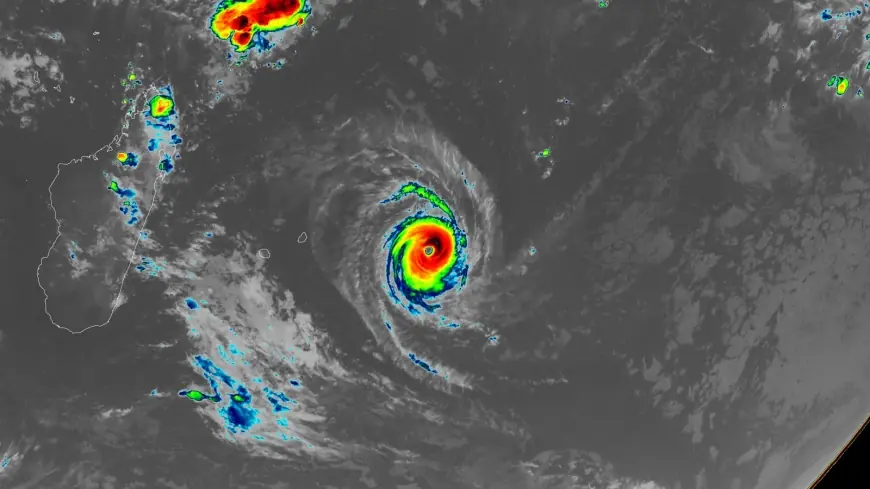
The system intensified from a low-pressure disturbance east of Rodrigues Island on February 18 and was named by RSMC La Réunion on February 19. Within about 48 hours it underwent rapid intensification, reaching very intense status by February 22. At peak between February 22 and 23, one-warning assessments placed 10-minute sustained winds around 230–240 km/h (140–150 mph) with gusts near 280–300 km/h (175–185 mph) and a central pressure near 910 hPa. A concurrent 1-minute assessment put the top winds near 260 km/h (160 mph), making it a Category 5-equivalent system as it moved southward over the central Southwest Indian Ocean east of Mauritius.
Local marine threats, warnings and observed seas
Outer rainbands delivered periods of rain and strong gusts to Rodrigues Island, where winds reached around 100 km/h (60 mph) and seas exceeded 6 to 8 m (20 to 26 feet). The Mauritius Meteorological Services maintained a Class 1 Cyclone Warning until February 23 and later issued a Heavy Swell Warning for Rodrigues at 04: 30 LT (00: 30 UTC) on February 24, valid until 04: 00 LT (00: 00 UTC) on February 25. That advisory warned of high-energy swells of 7 m (23 feet) beyond the reefs and potential breaking in lagoons and along low-lying coastal areas during high tides; fishermen, pleasure-craft operators and the public were urged not to venture to sea while the warning remained in effect. No major damage or casualties were reported.
Forecast trajectory, weakening and rarity of the event
After peaking, meteorological agencies assessed that Horacio had likely reached maximum intensity and would steadily weaken as it moved southward into cooler waters and an area with higher vertical wind shear. At 06: 00 UTC on February 24 the center was about 315 km (196 miles) southeast of Rodrigues and continuing south while weakening. Forecasters projected a transition into a post-tropical system within roughly 48 hours as environmental conditions deteriorate—an increase in vertical wind shear partly offset by strong upper-level divergence and an outflow channel to the southeast.
RSMC La Réunion classified the system as a "Very Intense Tropical Cyclone, " the basin’s highest rating; that classification is rare and typically occurs only once or twice per season. This event also marked the first Category 5 system in the Southern Hemisphere since Cyclone Errol off the coast of northwestern Australia on April 16, 2025.
- Feb 18 — Developed from a low-pressure disturbance east of Rodrigues Island.
- Feb 19 — Named by RSMC La Réunion.
- Feb 22 — Reached very intense status after rapid intensification.
- Feb 22–23 — Peak intensity with 1-minute winds near 260 km/h (160 mph) and 10-minute winds estimated 230–240 km/h (140–150 mph).
- Feb 24 (06: 00 UTC) — Center ~315 km (196 miles) southeast of Rodrigues, moving south and weakening; expected to become post-tropical within ~48 hours.
Here’s the part that matters for broader patterns: the 1990–2025 average annual number of Category 5 storms globally was 5. 3, and there were five such storms in 2025. Those 2025 systems included three Atlantic hurricanes—Melissa, Erin and Humberto—plus Typhoon Ragasa in the Northwest Pacific and Cyclone Errol in the South Indian Ocean. Climate scientists expect the share of tropical cyclones that reach Category 4 and 5 levels to rise over time.
Micro timeline above summarizes the immediate sequence; the real question now is how quickly Horacio weakens and whether any remaining swell/sea-state impacts persist for adjacent islands as the system moves into higher-latitude waters.
The real test will be matching forecasted shear and sea-surface cooling to the storm’s weakening trend; if those factors unfold as expected, the most dangerous phase for marine interests will pass within a couple of days.
It's easy to overlook, but the clear-eye structure and strong convective bands visible in satellite imagery were signatures of the storm’s rapid peak intensity and help explain why remote systems can still pose substantial marine hazards despite being far from major landmasses.