
























Curiosity Surveys Boxwork Region and Finds Crunchy Nodules on Mount Sharp

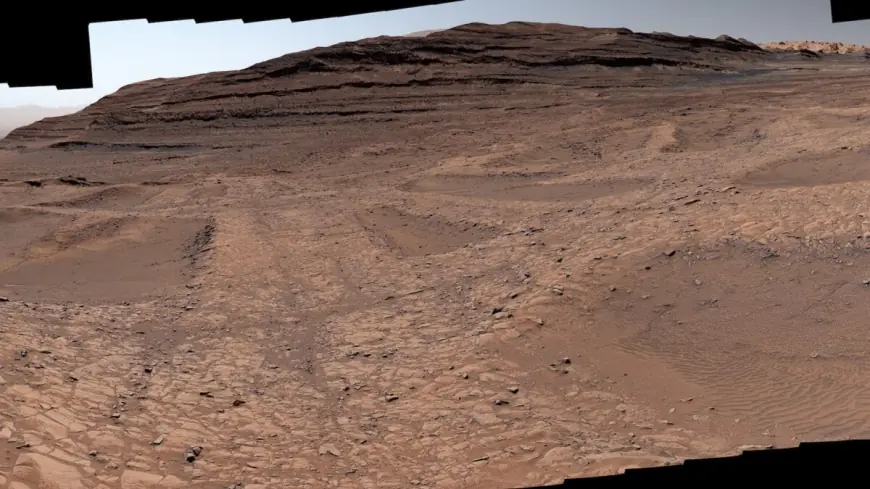
curiosity captured a stitched panorama of boxwork formations on Sept. 26, 2025 — the rover's 4, 671st Martian day, or sol — and has spent months examining the ridges and crunchy nodules up Mount Sharp. The images and in‑place observations matter because the features preserve a record of groundwater and changing climate on Mars.
Mastcam panorama: 179 images from Sol 4, 671
The panorama was taken with Mastcam on Sept. 26, 2025, the 4, 671st Martian day (sol) of the mission and is made up of 179 individual images that were stitched together after being sent back to Earth. The view is a natural color composite, presented roughly as an average person would see the scene if they were on Mars, and it centers on low ridges with hollows between them known as boxwork formations.
How the boxwork formed: water, minerals and wind
Those boxwork ridges were created billions of years ago when water leaked through rock cracks and carried minerals into those fractures. The minerals later hardened; after eons of windblown sand eroded the softer surrounding rock, the hardened mineralized ridges remained exposed. Scientists link the pattern to groundwater that flowed through large fractures in the bedrock, leaving mineral reinforcement in some areas while other parts were hollowed out by wind.
Close-up study finds nodules and spiderweb-like patterns
Over the past six months, the rover has been moving through a region of delicate zigzag ridges that look like giant spiderwebs from orbit. On the ground, the team found small bumps — nodules — in the nodules region that formed when water dried up and left minerals behind billions of years ago. Those nodules appeared along ridge walls and in the hollows between ridges rather than in central fractures; the team says it cannot yet explain why the nodules sit where they do and suggests one possibility is that the ridges were cemented first and later groundwater episodes deposited nodules around them.
Ridge heights, Mount Sharp layers and what they imply
The boxwork formations on Mars are much taller than their typical Earth counterparts, which are usually only a few centimeters tall and found in caves or dry, sandy environments. On Mount Sharp, the ridges measure roughly 3 to 6 feet (1 to 2 meters) tall and were found along Curiosity's trail up the mountain. Each layer of Mount Sharp, described as a 3-mile-tall (5-kilometer-tall) mountain, formed in a different era of the planet's changing climate, and the higher the rover climbs, the more the observations show water drying out over time with occasional wet periods that suggest the return of rivers and lakes.
Driving the ridges and mission stewardship
The rover had a bumpy ride driving along the ridges, some of which were not much wider than the SUV-sized vehicle itself. "It almost feels like a highway we can drive on. But then we have to go down into the hollows, where you need to be mindful of Curiosity's wheels slipping or having trouble turning in the sand, " said Ashley Stroupe, operations systems engineer at the Jet Propulsion Laboratory. Stroupe added that finding safe paths often requires trying different routes.
Curiosity will keep exploring the ridges until sometime in March before moving on to a different region on Mount Sharp to continue studying how the Red Planet's climate changed over time. The rover was built by the Jet Propulsion Laboratory, which is managed by Caltech in Pasadena, California; JPL leads the mission on behalf of NASA's Science Mission Directorate in Washington as part of the Mars Exploration Program portfolio. Malin Space Science Systems in San Diego built and operates Mastcam. The mission materials emphasize that NASA explores the unknown in air and space, innovates for the benefit of humanity, and inspires the world through discovery.
Scientific significance highlighted by mission scientists
"Seeing boxwork this far up the mountain suggests the groundwater table had to be pretty high, " said Tina Seeger of Rice University in Houston, one of the mission scientists leading the boxwork investigation. "And that means the water needed for sustaining life could have lasted much longer than we thought looking from orbit. " The combination of orbital imagery and Curiosity's ground visits has allowed the team to compare broad patterns seen from above with what the rover can examine at close range.