

















Connor Hellebuyck’s stick stop shifted the tide — his goaltending handed the U.S. its first Olympic men’s hockey gold since 1980

Here’s the part that matters: Connor Hellebuyck’s last-ditch stick save — whether it happened in the second or third period is unclear in the provided context — kept the game tied and directly preserved the path to Jack Hughes’ overtime winner, giving the U. S. men their first Olympic hockey gold since the 1980 Lake Placid team. The 32-year-old netminder’s save sequence, and the larger body of work around it, left teammates, fellow medalists and fans feeling the impact almost immediately.
Connor Hellebuyck’s save: who felt the impact and how
Team USA’s title and the immediate celebrations hinged on goaltending resilience more than a single moment — but that single moment bent momentum. Taylor Heise, a recent women’s hockey gold medalist for the United States, told interviewers she believed the men could replicate that success; Hellebuyck’s intervention validated that confidence in real time. The real question now is how much this performance reshapes Hellebuyck’s legacy and U. S. hockey narratives going forward.
Event details embedded around the key stop
At the Milano Santagiulia Ice Hockey Arena on Feb. 22, 2026 (day 16 of the Milano Cortina 2026 Winter Olympic Games in Milan, Italy), the U. S. and Canada were deadlocked 1-1 through regulation. The game finished 2-1 in overtime after Jack Hughes scored the winner following a pass from defenseman Zach Werenski; that shot beat Canada’s netminder Jordan Binnington. Canada had been in control for much of the game, firing heavy pressure and testing the U. S. cage repeatedly.
How the stop unfolded and why the period timing is unclear
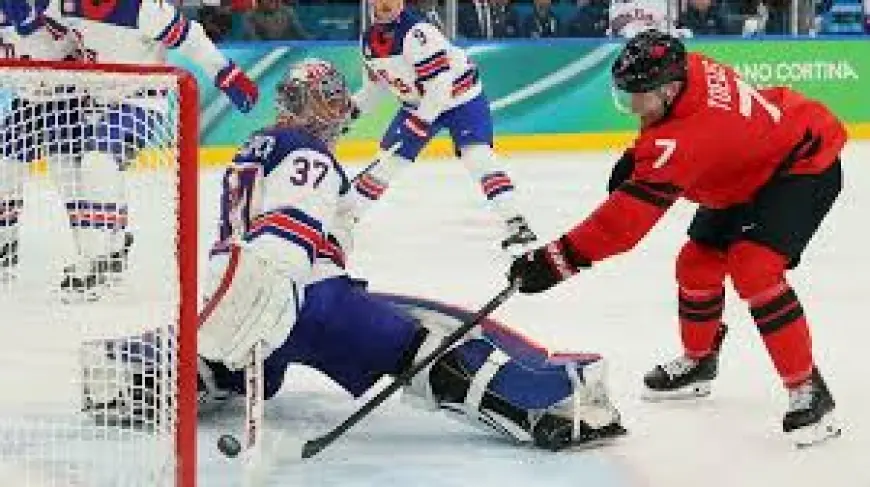
Multiple play descriptions in the available context converge on a desperate stick save that denied a likely goal: Mitch Marner had the puck in the offensive zone and sent an attempt toward the net where Devon Toews (#7) was positioned in front. Toews deflected or lifted the puck toward goal and Hellebuyck extended his stick to block it. One account frames that action as a second-period moment; photo captions and other accounts place a similar denial in the third period. Because both placements appear in the provided material, the precise timing is unclear in the provided context.
Numbers and the wider performance picture
- Final saves cited: one account lists 41 saves in the Olympic final; another description calls him the architect of more than 30 stops — both are included in the available material.
- Scoreline: 2-1 in overtime, with the decisive goal coming after a Werenski pass to Jack Hughes and a shot past Jordan Binnington.
- Hellebuyck conceded a goal to Cale Makar in the second period, and then produced multiple subsequent stops to keep the U. S. level.
Game flow, pressure moments and individual matchups
Reported sequences show Canada peppering the U. S. net through the opening two periods. At the start of the third, with the score tied 1-1, Canada launched a heavy barrage that produced eight shots on goal before the Americans answered with two. Devon Toews found himself in the crease with the net gaping on the key play; many observers noted that Toews would usually convert that chance, but Hellebuyck’s stick intervention redirected the outcome and maintained the tie.
Hellebuyck, who has faced scrutiny for early-season struggles in league play, entered the Olympic final and produced acrobatic, high-leverage saves that anchored the American effort. He later described the result in simple terms after the game: "It's a dream come true. We grinded, we battled, and this was some of the best and most fun hockey that I’ve ever played. "
It’s easy to overlook, but the sequence that included the stick save dovetailed with a string of stops after the team allowed the tying goal, illustrating that the moment was part of a sustained response rather than an isolated flash.
Short takeaways and signals to watch
- Immediate effect: the stick save preserved a 1-1 score and directly enabled the overtime finish that produced the U. S. gold.
- Legacy indicators: the performance — described in the material as both a 41-save night and “more than 30” stops — will be invoked when assessing Hellebuyck’s international pedigree and his standing after earlier domestic struggles.
- Next confirmations: roster and team reactions, post-tournament reflections, and season-long tracking of Hellebuyck’s form will confirm whether this outing becomes a career inflection point.
What’s easy to miss is how a goaltender’s single improvisational choice — throwing a stick — can change not just a game but the immediate arc of a national team’s Olympic narrative. The available material places that improvised act at the center of the U. S. victory, even if some timing details remain unclear in the provided context.