




















Payton Pritchard has picked up where he left off last season as Sixth Man

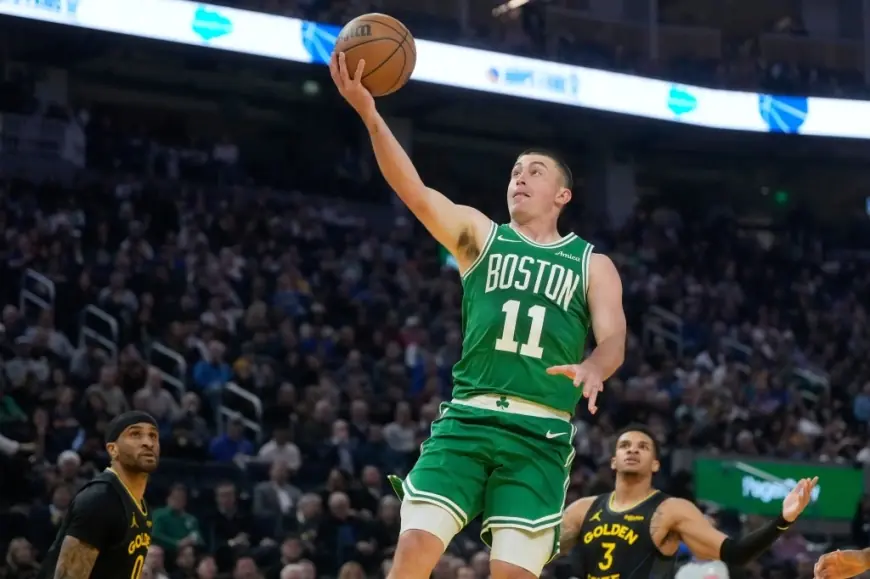
Payton Pritchard has returned to the bench role that earned him Sixth Man of the Year last season and immediately produced high-level results. The change matters because it followed a trade that altered Boston’s rotation and has coincided with a string of productive performances that helped keep the Celtics near the top of the East.
Development details: Payton Pritchard's surge after the Simons trade
Boston moved Payton Pritchard off the starting unit after trading Anfernee Simons to acquire Nikola Vucevic, a roster decision made to preserve a ball-handler and scorer for the second unit. Pritchard had started each of the first 48 games he played this season before the move. In the six games since the trade, the Celtics are 5-1, and Pritchard has been a driving force: he has scored at least 24 points in each of the five wins and has played 30 or more minutes in all six contests.
Statistically, that stretch has been striking. Over those six games Pritchard is averaging 22. 5 points and 6. 4 assists while shooting 52. 0% from the field and 42. 9% from three. In the most recent outing, a 121-110 win in San Francisco, he led all scorers with 26 points and went 6-for-11 from beyond the arc. The coach who made the lineup adjustment, Joe Mazzulla, has kept Pritchard in the rotation’s closing lineup and preserved his minutes, which Pritchard said helps him find rhythm when he enters after the game’s opening minutes.
Context and escalation
The lineup reshuffle was not driven by poor play; before the trade Pritchard was on pace for career highs in points, assists and rebounds while helping power one of the league’s most efficient offenses. The front office’s acquisition of veteran center Nikola Vucevic created a need for a reliable second-unit ball-handler, and Mazzulla turned to Baylor Scheierman as a starter while returning Pritchard to the bench — a role he occupied during his Sixth Man of the Year season.
Pritchard’s role change followed a rough performance on Feb. 8 in New York — six points on 2-for-9 shooting with a minus-27 plus-minus — after which he responded with back-to-back team-leading scoring efforts. His recent efficiency extends beyond volume: he has been one of the league’s more effective isolation scorers this season and has posted an unusually high midrange conversion rate, with 56. 8% on shots from 10–14 feet. Over the most recent six-game span he has shot better than 60% on two-pointers.
Immediate impact
The immediate consequence of the lineup shuffle has been tangible on the scoreboard. Boston has gone 5-1 since the trade, and Pritchard’s bench scoring has prevented a drop-off in offensive fluidity when starters rest. In the win over Golden State, his long-range shooting helped the Celtics withstand a late Warriors push; that game also marked Kristaps Porzingis’s debut for Golden State after a trade from Atlanta and included a difficult night for Al Horford, who made two of 10 field-goal attempts against his former team.
Beyond single games, the move preserved Boston’s rotation balance: starters like Jaylen Brown and Derrick White retain primary ball-handling duties for the opening lineup, while Pritchard’s presence ensures the second unit can run the offense and sustain scoring. The roster change also allowed veteran Nikola Vucevic to be integrated without displacing the bench’s offensive engine.
Forward outlook
The Celtics will continue their West Coast road trip on Sunday night against the Los Angeles Lakers at 6: 30 p. m. ET, presenting another opportunity to test the adjusted rotation. Pritchard’s immediate milestones to watch are the continuation of his at-least-30-minute appearances and whether he can sustain the 22. 5-point, 6. 4-assist pace and the current shooting splits over a larger sample.
What makes this notable is that the roster decision that moved Pritchard back to the bench both addressed an explicit team need and produced measurable gains: higher bench scoring, preserved starter minutes, and a 5-1 record in the six-game window since the trade. That sequence of cause and effect — trade for Vucevic leading to a planned role change, followed by on-court production — has restored the Celtics’ second-unit stability while keeping Pritchard in high-leverage minutes.